

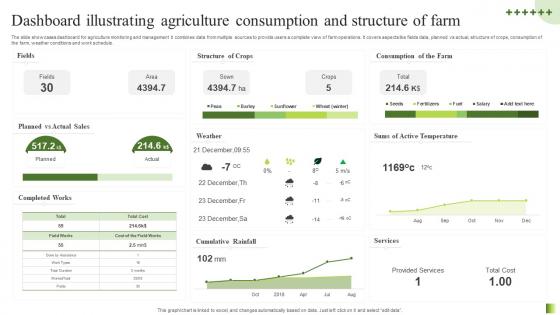
Dashboard Illustrating Agriculture Consumption And Structure Of Farm




Try Before you Buy Download Free Sample Product
 Impress Your
 Audience
 100%
100% Editable
 Save Hours
 of Time


The slide showcases dashboard for agriculture monitoring and management it combines data from multiple sources to provide users a complete view of farm operations. It covers aspects like fields data, planned vs actual, structure of crops, consumption of the farm, weather conditions and work schedule.
People who downloaded this PowerPoint presentation also viewed the following :
Dashboard Illustrating Agriculture Consumption And Structure Of Farm with all 7 slides:
Use our Dashboard Illustrating Agriculture Consumption And Structure Of Farm to effectively help you save your valuable time. They are readymade to fit into any presentation structure.






FAQs for Dashboard Illustrating Agriculture Consumption And
For your farm dashboard, I'd focus on crop yield per acre first - that's your bread and butter. Track input costs against revenue too, plus soil stuff like pH and nutrients. Weather integration is clutch, and don't sleep on equipment efficiency rates. Water usage matters more than people think. Honestly, labor costs will eat you alive if you're not careful - I've seen it happen. Oh, and if you have livestock, feed conversion rates are key. Start with maybe 5-7 metrics that actually move the needle profit-wise, then add more once you've got the hang of it.
Dude, real-time data is seriously worth it. Instead of walking around with a clipboard like it's 1995, you'll see everything live - soil moisture, weather, equipment breakdowns, the whole deal. When that irrigation system craps out or there's a storm rolling in, you know instantly instead of finding out way too late. Honestly beats the hell out of making decisions based on yesterday's info. My advice? Figure out which decisions are most time-sensitive first, then get those data feeds set up. Makes such a difference when you can actually react to what's happening now.
Weather data runs everything in ag analytics - crop predictions, when to irrigate, pest timing, harvest schedules. Your dashboard combines real-time and historical patterns so you know when to plant or spray. Honestly crazy how a couple degrees can mess up your whole season! Disease models, soil moisture tracking - they all need weather inputs. The smart move is pairing those weather insights with your field observations. Spot the trends early and you can adjust before things go sideways. Way better than just winging it and hoping for the best.
Dude, these agricultural dashboards are actually pretty cool - they pull from soil sensors, lab tests, even satellite data to show you pH, moisture, and what nutrients you're missing. Way better than those nightmare spreadsheets we used to deal with! You get these visual maps that literally show which spots need nitrogen or phosphorus. Plus it tracks how your soil reacts to different fertilizers over time, so you can dial in your timing and stop wasting money. Oh, and set up alerts for when conditions hit certain levels - saves you from constantly babysitting everything.
Maps and time-series charts are where it's at for ag dashboards - farmers think geographically about their land anyway, so it just clicks. Heat maps show soil moisture and temp variations really well across different field zones. Bar charts work perfectly for comparing stuff like rainfall or harvest volumes between seasons. Oh, and I'd definitely stick to maybe 2-3 chart types max. Too many different visualizations just confuse people when they're trying to make quick decisions about their crops. Trust me, clean and simple beats fancy every time.
Dude, mobile accessibility is make-or-break for field dashboards. I've watched gorgeous desktop interfaces become completely useless the second workers take them outside. Think about it - they're wearing gloves, dealing with terrible signal, squinting in bright sun. Your dashboard better load fast and work offline or they'll ditch it immediately. Big touch targets are non-negotiable too. Honestly, high contrast displays should be obvious but so many people miss this. Test everything on real devices in actual field conditions - not just your iPhone in the office. Field workers have zero tolerance for anything clunky.
Cost is the big one - smaller farms think it's just fancy tech they don't need. Rural internet still sucks, which makes cloud stuff a nightmare. Learning these clunky interfaces is tough when you've been doing things the same way for 30+ years. Privacy freaks people out too, like who's seeing their data? Honestly, a lot of these dashboards are pretty user-unfriendly. ROI skepticism is huge. You need something that fits into what they're already doing and shows results fast, or they'll just go back to their old methods.
So predictive analytics basically takes all your farm data - yields, weather, soil conditions, satellite images - and builds forecasts for crop performance. Feed it rainfall, temps, planting dates, soil moisture, whatever you've got. More data points = better predictions. The algorithms spot patterns you'd totally miss doing it manually. Your dashboard shows this as charts with expected yields by field, plus those confidence intervals (which are actually pretty useful). Oh, and start collecting consistent data now because the models get way smarter over time. Makes planning so much easier.
Start with clean data - validate sensor readings and weather APIs before they hit your dashboard. Automated quality checks are a lifesaver for catching outliers or missing values. Trust me, I got burned once when faulty soil sensors showed everything looked great while my crops were actually dying. Cross-validation between sources is huge too. When satellite imagery doesn't match ground sensors? Drop everything and figure out why instead of just picking one. Oh and keep clear records of where each data point comes from - you'll thank yourself later when something goes sideways.
So basically you'd set up IoT sensors and RFID tags on your animals - tracks health, location, breeding stuff, feed intake. Then pipe all that data straight into your existing dashboard with the crop info. Pretty wild how much you can monitor now tbh. I'd focus on the livestock metrics that actually move the needle for your farm first, then build those feeds in. The real magic happens when you connect it all - like your pasture conditions automatically adjusting feed schedules, or medication costs rolling into your budget tracker. Makes the whole operation way more integrated.
So first figure out your actual KPIs - that's the real starting point here. Crop farms need weather data, soil moisture, planting schedules up front. Livestock? Totally different game - animal health, feed consumption, breeding cycles. Most platforms let you set up role-based templates anyway. You can hide/show sections based on what type of operation you're running. Way better than cramming everything into some generic layout that doesn't actually help anyone. Oh and pasture rotation data if you've got grazing - forgot that one initially.
Dude, these dashboards are game-changers for staying compliant. They monitor your water use, pesticide apps, soil health - all that environmental stuff in real-time. No more panic when inspectors randomly show up! Mine alerts me before I hit regulatory limits, which honestly beats scrambling to fix violations after the fact. You can pull sustainability reports instantly too, since buyers care about that now. The automated flagging system suggests fixes before you breach anything. Set those threshold alerts and you'll actually stay ahead of regulations. Way better than my old spreadsheet mess, trust me.
Keep those buttons big and navigation dead simple - like your phone, not some crazy control panel. Visual charts beat boring data tables every time. Use icons that actually make sense (thermometer = temperature, duh) and ditch the tech speak for plain English. Pop-ups for urgent stuff are clutch. Honestly, tooltips explaining what metrics mean for actual crops will save you so many headaches later. The whole point is farmers can spot issues fast without feeling like they need a CS degree. Test it with real farmers first though - they'll tell you exactly what sucks about it.
Honestly, cloud tech is a total game-changer for ag dashboards. You can scale up instantly when you're drowning in sensor data during harvest season, then dial it back when things slow down. Your team gets real-time crop data from literally anywhere - the field, their couch, wherever. No more server headaches either since everything updates automatically. I got stuck behind a tractor for 20 minutes yesterday and still managed to check moisture levels on my phone. If you're starting fresh, definitely go cloud-native from day one.
So basically you set up this dashboard where everyone can see the same stuff - farmers, distributors, retailers, whoever. Real-time data on crops, harvest timing, inventory, quality metrics. No more playing phone tag with crusty old spreadsheets (honestly the worst). Everyone's looking at current info instead of guessing. Really helps with coordination and you'll catch problems early before they blow up. First figure out who needs to see what data, then give people the right access levels. Don't want to overwhelm anyone with info they don't actually need, you know?
-
The slides are remarkable with creative designs and interesting information. I am pleased to see how functional and adaptive the design is. Would highly recommend this purchase!
-
The best collection of PPT templates!! Totally worth the money.