


Data Breach Crisis Communication Plan Flowchart




Try Before you Buy Download Free Sample Product
 Impress Your
 Audience
 100%
100% Editable
 Save Hours
 of Time


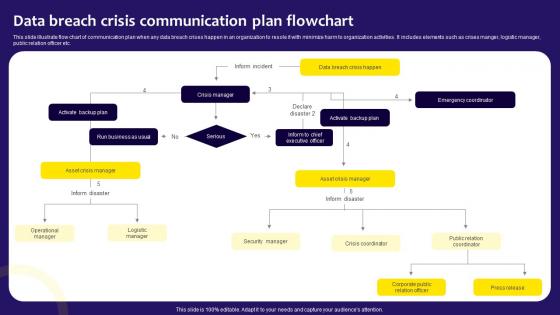
This slide illustrate flow chart of communication plan when any data breach crises happen in an organization to resole it with minimize harm to organization activities. It includes elements such as crises manger, logistic manager, public relation officer etc.
People who downloaded this PowerPoint presentation also viewed the following :
Data Breach Crisis Communication Plan Flowchart with all 6 slides:
Use our Data Breach Crisis Communication Plan Flowchart to effectively help you save your valuable time. They are readymade to fit into any presentation structure.





FAQs for Data Breach Crisis
Honestly, you need five main things sorted out ahead of time. First, get your incident response team locked down with clear roles. Pre-write those notification templates for customers, regulators, and media - trust me on this one. Know your timeline requirements because some states only give you 72 hours (yikes). Pick your spokespeople carefully so nobody goes rogue and makes things worse. Don't forget monitoring tools to track how people are reacting. The whole point is having this stuff ready before everything hits the fan. Writing customer emails while your systems are burning? That's my personal version of hell. Oh, and test it yearly so people actually remember what they're supposed to do.
For breach communication, I break it down by three things: what type of data got hit (PII, financial stuff, health records), how many people, and how bad the damage could be. High-risk situations? You're talking to everyone immediately with full details. Medium-risk usually means just the affected groups need to know. Low-risk is mostly internal first, then maybe a quick public statement if legally required - though honestly, truly low-risk breaches don't happen much. The key is matching your response intensity to actual risk, not just using some generic template. Set up your categories ahead of time so you're not scrambling later.
Ugh, legal stuff controls everything about breach communications - the timing, what you can say, all of it. GDPR gives you 72 hours but state laws are all over the place. Your legal team has to approve every message before it goes out because one wrong word can get you in trouble. If you're dealing with multiple countries? Good luck juggling all those different rules. I learned this the hard way last year. Get legal involved from day one - yeah they might slow things down, but they're saving you from major compliance headaches later.
Just tell them straight up what happened and when - people can spot corporate BS instantly. Don't dump every technical detail at once though, that's overwhelming. Share what you actually know as you figure it out. Acknowledge how this screws with their day, not just the boring technical stuff. Give them real steps they can take to protect themselves right now. Oh, and whatever you promise to do? Actually do it. Nothing tanks trust faster than saying you'll follow up and then... crickets. The whole thing sucks but honesty goes way further than damage control speak.
Be super specific about what got stolen - credit cards, SSNs, addresses, whatever. Don't try to soften it because people will just get more pissed. Tell them exactly when it happened and how (if you even know). The key thing is giving people actual steps they can take, like changing specific passwords or freezing their credit. Not just "stay vigilant" - that's useless. Oh, and make sure someone's actually answering the phone when people call with questions. You'll get flooded. Also explain what you've already done to fix the hole in your system. People want to know you're not just sitting there hoping it doesn't happen again.
Honestly? Update them every 24-48 hours, even when nothing's happening. Radio silence makes people panic - learned that the hard way. Set expectations upfront about how often you'll check in, then actually stick to it. Critical stuff obviously gets sent immediately, but regular updates prevent the frantic "what's going on??" emails. Oh, and draft your update template now while you're not stressed. You don't want to be writing from scratch when everything's on fire and your brain's mush. Being ahead of it makes such a difference.
Email's your best bet for customers - you need documentation plus you can walk them through fixes step by step. Press releases handle media, though honestly they'll probably hear about it elsewhere first anyway. Whatever you normally use for internal stuff works fine - Slack, Teams, whatever - just send follow-up emails so there's a record. Oh, and regulators are picky about their portals and forms, so double-check what they actually want. Speed beats perfection here. Match how each group expects to hear from you and you'll be fine.
Honestly, just do practice runs every few months - like tabletop exercises where everyone walks through what they'd actually do if you got breached. Who calls who, what gets documented, all that stuff. Your legal team will stress about it (they always do) but it's so much better than scrambling when it's real. Train customer service people extra well since they'll get hit with angry calls first. Oh, and pick ONE person to talk to the press - trust me, mixed messages make everything worse. We learned that the hard way at my last job. Practice enough and it becomes automatic instead of pure chaos.
Stick to official company accounts only - personal employee posts will just create a mess of mixed messages. Get legal approval first, but then move fast because I've watched companies get absolutely destroyed for staying quiet too long. Brief updates work best, then send people to your main incident page for everything else. You'll want alerts set up for your company name so you can jump into conversations happening elsewhere. Reply to real questions in the comments but honestly? Don't waste time arguing with internet trolls.
Don't build your data breach plan from scratch - that's way too much work. Just fold it into whatever crisis management stuff you already have. Use the same team leads and escalation process you'd use for any other disaster. Honestly, the legal/PR/tech people should already be talking to each other anyway. Templates are your friend here - when everything's on fire, you don't want to be writing press releases from zero. I learned this the hard way at my last job. Map out how the breach response connects to your existing crisis playbook and call it a day.
Track your response times first - detection, containment, communication speed. Media sentiment and social mentions will show if your messaging actually worked. Customer retention rates matter way more than you'd think right now. Survey people about how they felt you handled it. Regulatory stuff is terrifying but necessary - watch for any compliance flags. Did your employees know what to tell customers when phones started ringing? That's huge. Oh and definitely set up some kind of real-time dashboard. You'll want to pivot fast if sentiment tanks mid-crisis.
Look, you've got to control the story before it controls you. Draft response templates for different breach scenarios now - trust me on this. Get your spokespeople trained and have legal pre-approve some basic holding statements. Social media's going to be an absolute mess, so watch it like a hawk and jump on misinformation fast. Set up that war room with PR, legal, and execs who can actually make decisions in real time. Practice this stuff through tabletop exercises because scrambling when it hits is the worst. Having your crisis playbook ready from day one will save your sanity.
Check out NIST Cybersecurity Framework and ISO 27035 first - they're good baselines. SANS has practical templates too that map out when to notify different people. Legal compliance gets messy fast, so start with the basics: internal escalation steps, customer scripts, media templates, regulatory checklists. Look at how companies like Shopify handled their breach communications - super transparent approach. Build your template now while you're thinking clearly. When shit hits the fan, you won't have bandwidth to craft anything coherent. Trust me on this one.
Oh man, this stuff gets tricky fast. Different cultures handle bad news completely differently - some want you to be super direct and transparent right away, others expect formal channels and hierarchy. Mess this up and you're toast trust-wise. High-context cultures need way more background info, while others just want the bare facts. Your legal stuff changes by country too, which is honestly a pain. Timing matters. So does who's actually delivering the message. I'd say build this cultural angle into your response plan from day one and definitely get local people to check your messages before hitting send.
Honestly? Just be fast and upfront about it. Equifax totally screwed themselves by waiting forever and then giving some weird defensive non-apology. Compare that to companies who jumped on it immediately - "hey, we messed up, here's what happened, here's what we're doing about it." They bounced back way quicker. Get your story out before journalists start digging around and making assumptions. You don't need every detail figured out yet. Just say what you know, what you're still investigating, and when you'll update people. Oh, and write up some crisis templates now while you're not panicking - trust me on this one.
-
Commendable slides with attractive designs. Extremely pleased with the fact that they are easy to modify. Great work!
-
Great quality product.