


Data Breach Risk Process Flow Model




Try Before you Buy Download Free Sample Product
 Impress Your
 Audience
 100%
100% Editable
 Save Hours
 of Time


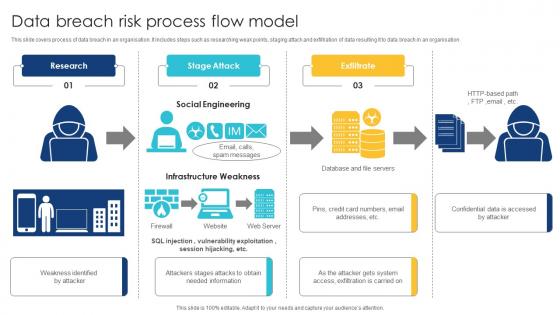
This slide covers process of data breach in an organisation. It includes steps such as researching weak points, staging attack and exfiltration of data resulting it to data breach in an organisation.
People who downloaded this PowerPoint presentation also viewed the following :
Data Breach Risk Process Flow Model with all 6 slides:
Use our Data Breach Risk Process Flow Model to effectively help you save your valuable time. They are readymade to fit into any presentation structure.





FAQs for Data Breach Risk
You'll need four main things: prevention stuff like access controls and training your people, detection systems that actually work (not ones that cry wolf constantly), solid response procedures, and recovery plans. Most companies totally blow the response part - everyone just runs around freaking out instead of having a clear playbook. Your plan should cover who calls the lawyers, templates for telling customers what happened, and how you'll figure out what went wrong afterward. Oh, and actually practice this with tabletop exercises. Trust me, you don't want people learning their roles during an actual breach.
Start with a full security audit - figure out where your sensitive data actually lives and how it moves around. Run vulnerability scans and pen tests on everything. Your employees' security awareness is probably terrible (sorry, but it usually is), so test that too. Don't skip third-party vendors - they're like the back door everyone forgets to lock. Be brutally honest about what's broken instead of pretending you're fine. Oh, and make this a quarterly thing because new vulnerabilities pop up constantly.
Honestly, training your people is the biggest thing you can do. Most breaches happen because someone clicks a sketchy email or has "password123" as their login - not some crazy Hollywood hacker stuff. Monthly security sessions work way better than those boring annual trainings nobody remembers. Teach them to spot phishing emails and use strong passwords. Make sure they know how to report weird stuff right away. I've seen companies where this actually prevented major incidents. It's not glamorous but your employees become like... your first line of defense against the real threats out there.
Honestly, phishing is still the biggest pain - people fall for it way more than they should. Ransomware's everywhere too, where hackers lock up your files and want money. Don't forget about employees being careless or straight-up stealing data. Cloud stuff gets misconfigured all the time now that everyone's going digital. Oh, and insider threats are tricky because sometimes it's intentional, sometimes people just mess up. I'd probably start with phishing training since that's how most of the bad stuff begins anyway. It's crazy how one wrong click can snowball into a huge mess.
Honestly, automated monitoring is your best bet - it'll catch stuff 24/7 that you'd never spot manually. The AI threat detection these days is actually pretty impressive at finding weird patterns. Make sure you've got encryption running on everything, plus multi-factor auth (I know, it's annoying but worth it). Network segmentation is clutch too because it stops hackers from moving around if they get in. Don't just pick one thing though - you want multiple layers working together. Oh, and start with the monitoring system first since it gives you the most protection for the money.
Okay, first things first - isolate those compromised systems and change any passwords that got hit. Document everything you're doing because lawyers and investigators will want a paper trail later. Figure out what data actually got accessed, then loop in your legal team ASAP. You've got to notify authorities and affected customers per whatever regulations apply to you (GDPR, state laws, etc.). Honestly, this part's a pain but it's non-negotiable. Keep a communication log of every step - trust me, your future self will appreciate it when people start asking a million questions. Move quickly but don't skip steps.
Look, first thing - figure out what data would actually screw you over if it got out. Customer info, financials, trade secrets, that kind of stuff goes in the high-priority bucket. Most companies I've seen just blanket-protect everything equally, which is honestly pretty dumb since your budget isn't infinite. Do a quick inventory of what you've got, then score each type based on how much damage a breach would cause. Don't forget operational impact too - some data might not be sensitive but you'd be toast without it. Focus your security spending on that top 20% first. Way better ROI than spreading yourself thin across everything.
So first figure out which laws actually apply to you - GDPR, CCPA, HIPAA, whatever. GDPR's the brutal one with that 72-hour notification rule and fines up to 4% of revenue (honestly ridiculous). Where your customers live matters just as much as where you're based. Most of these laws want the same stuff though - tell authorities fast, document everything that happened, and show you're fixing it. I'd start by mapping out your shortest deadline since that's what you'll be racing against. Oh and the type of data you handle changes everything too.
Stop doing those yearly risk assessments and call it a day. Set up threat intel feeds that actually update regularly - quarterly at minimum. Most companies I know got wrecked because they were still planning for last year's attacks. Track what's hitting your industry specifically, not just generic stuff. Build frameworks that can adapt fast when new attack methods pop up. Also, get plugged into security communities for real-time info (way better than waiting for official reports). Set up protocols so you're not scrambling when the next big vulnerability drops. Risk assessment should be ongoing, not some annual box-checking exercise.
You absolutely need an incident response team set up beforehand - trust me on this one. When a breach hits, they're literally your damage control squad. They handle detection, forensics, talking to people, getting systems back up. Without them? You'll be scrambling around trying to figure out who's supposed to do what while hackers are still in your network doing whatever they want. Get your technical people, legal folks, and communications team identified now. Train them regularly too. I've seen companies learn this the hard way and it's not pretty.
So for continuous monitoring, you've got a few routes. SIEM tools are probably your best bet - Splunk and IBM QRadar are solid but pricey. OSSEC or the ELK stack work great if budget's tight (honestly, ELK's gotten way better lately). DLP tools like Symantec will catch sensitive data moving around, though fair warning - they're annoying as hell until you tune them properly. If you're already on AWS or Azure, just use their native stuff like CloudTrail. My advice? Figure out where your important data actually lives first. Then pick tools that watch those specific areas instead of trying to monitor everything at once.
Here's the deal - vendors basically expand your attack surface. They get hacked, your data goes down with them. You're handing over access to systems and customer info, but can't control how they secure it. Some are surprisingly sloppy about security too. The real problem? You probably have tons of these vendor relationships, each one a potential backdoor for attackers. My advice: audit their security before signing anything and make them promise immediate breach notifications. Those security questionnaires they send are pretty much useless, honestly.
Start with AES-256 encryption for everything - both stored data and stuff moving around. Multi-factor authentication is a must, no exceptions (honestly, if you're not using it yet, what are you waiting for?). Set up role-based access so people only get what they need for their actual job. Regular access reviews help catch old permissions that should've been removed ages ago. Oh, and classify your data first - figure out what's actually critical before you go crazy trying to protect everything. Work from your most important assets outward. Way more manageable that way.
So you'll need both leading and lagging indicators to see what's actually working. Leading stuff is like training completion rates, how fast you patch vulnerabilities, threat detection speed. Lagging indicators are the real incidents - breach frequency, containment time, financial damage. Honestly, those quarterly tabletop exercises are pretty useful too (and weirdly fun once you get the hang of it). Start with baseline metrics first, then track improvements. Don't overcomplicate it though - pick 3-4 metrics that actually matter to your business and stick with those consistently.
Look, you absolutely need that communication plan ready before anything goes wrong. When a breach happens, people panic and start saying contradictory stuff - I've seen CEOs and their legal teams completely contradict each other in public, which is honestly just embarrassing. Draft your messaging templates now for customers, media, regulators, all of them. Figure out who talks to who and when. Otherwise you'll burn hours trying to craft responses while everything's falling apart around you. Different breach scenarios need different approaches too. Get this sorted before you actually need it.
-
SlideTeam is my one-stop destination for templates. Highly recommended!
-
They had the topic I was looking for in a readymade presentation…helped me meet my deadline.