


Debt Recovery Process For Reducing Bad Debts Powerpoint Presentation Slides




Try Before you Buy Download Free Sample Product
 Impress Your
 Audience
 100%
100% Editable
 Save Hours
 of Time


Check out our professionally designed Debt Recovery Process for Reducing Bad Debts PowerPoint Presentation. The debt recovery process encompasses a series of actions and protocols employed by creditors or debt collection agencies to recover unpaid debts from individuals or businesses falling behind on payments. The ultimate objective of this process is to retrieve the funds owed. Initially, this PowerPoint presentation provides an overview of fundamental terminologies and recent trends within the debt recovery process. Additionally, the Debt collection methods PPT templates shed light on crucial strategies for debt collection, including employing know-your-customer approaches, prompt payment requests, and maintaining regular communication to encourage timely payments from debtors. Furthermore, it offers insights into effective debt collection strategies to mitigate the risk of bad debts. Lastly, the Credit recovery campaign presentation concludes with dashboards illustrating the credit control status and progress of debt collection. Get access to 100 percent editable strategy template now.
People who downloaded this PowerPoint presentation also viewed the following :
Content of this Powerpoint Presentation
Slide 1: This slide introduces Debt Recovery Process For Reducing Bad Debts. State your company name and begin.
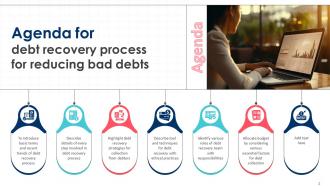
Slide 2: This is an Agenda slide. State your agendas here.
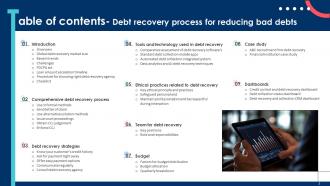
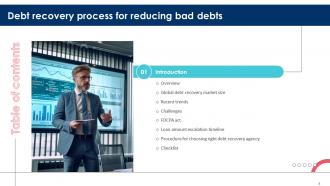
Slide 3: This slide shows Table of Content for the presentation.
Slide 4: This slide shows title for topics that are to be covered next in the template.
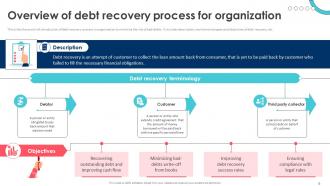
Slide 5: This slide presents a brief introduction of debt recovery process in organization to minimise the risk of bad-debts.
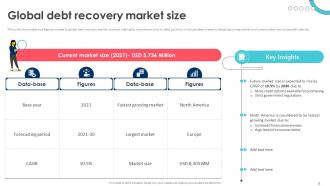
Slide 6: This slide shows data and figures related to global debt recovery market size that highlights importance of strict debt policies.
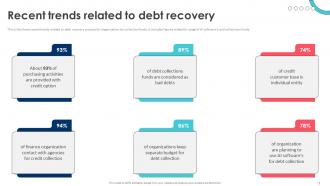
Slide 7: This slide shows recent trends related to debt recovery process for organization for collection funds.
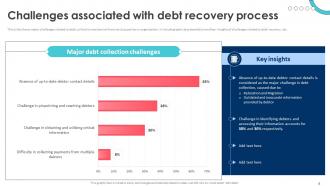
Slide 8: This slide displays major challenges related to debt collection mechanism from various parties in organization.
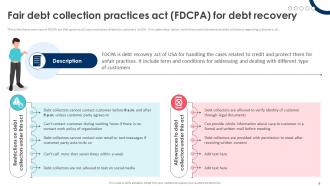
Slide 9: This slide shows overview of FDCPA act that governs all issue and cases related to customers in USA.
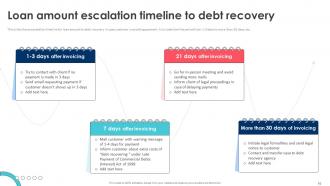
Slide 10: This slide displays escalation timeline for loan amount to debt recovery in case customer is avoiding payment.
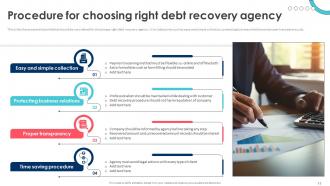
Slide 11: This slide shows essential points that should be considered for choosing a right debt recovery agency.
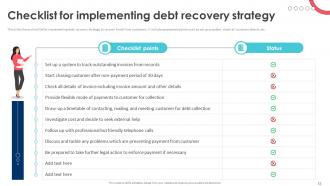
Slide 12: This slide displays checklist for implementing debt recovery strategy to recover funds from customers. It include assessment points such as set-up a system etc.
Slide 13: This slide shows title for topics that are to be covered next in the template.
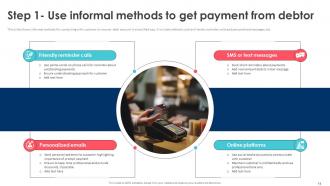
Slide 14: This slide displays informal methods for contacting with customer to recover debt amount in simplified way.
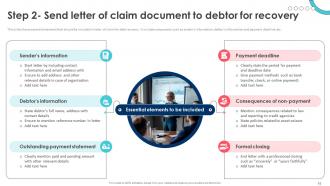
Slide 15: This slide shows essential elements that should be included in letter of claim for debt recovery.
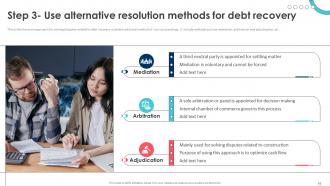
Slide 16: This slide presents an approach for solving disputes related to debt recovery outside traditional method of court proceedings.
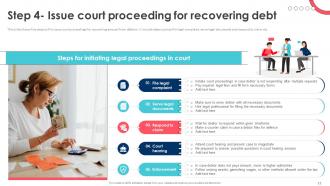
Slide 17: This slide shows five steps to file issue court proceedings for recovering amount from debtors.
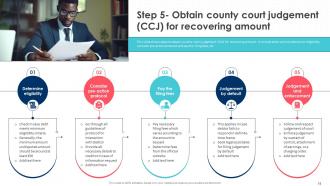
Slide 18: This slide displays steps to obtain country court judgement (CCJ) for recovering amount.
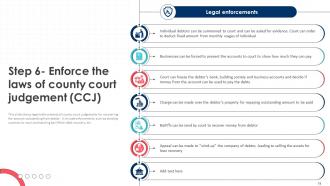
Slide 19: This slide presents legal enforcements of county court judgements for recovering the amount outstanding from debtor.
Slide 20: This slide shows title for topics that are to be covered next in the template.
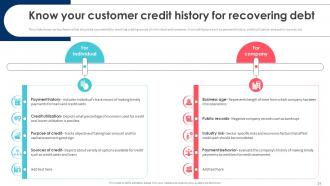
Slide 21: This slide presents various factors that should be considered for checking credit grounds of individual and company.
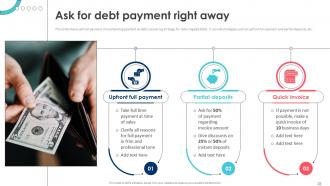
Slide 22: This slide shows upfront payment of outstanding payment as debt recovering strategy for reducing bad debts.
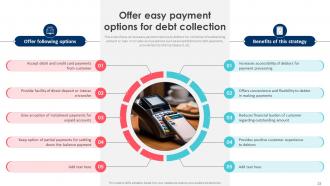
Slide 23: This slide displays various easy payment options to debtors for collection of outstanding amount or loan.
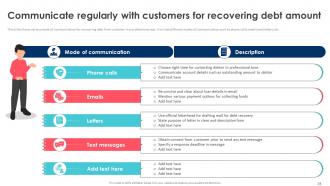
Slide 24: This slide shows various mode of communication for recovering debt from customer in a professional way.
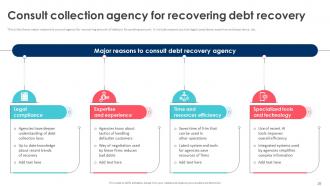
Slide 25: This slide displays major reasons to consult agency for recovering amount of debtors for pending amount.
Slide 26: This slide shows title for topics that are to be covered next in the template.
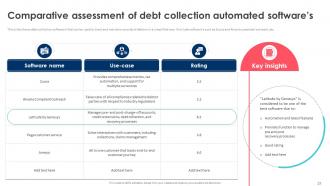
Slide 27: This slide presents debt collection software's that can be used to track and maintain records of debtors in a simplified way.
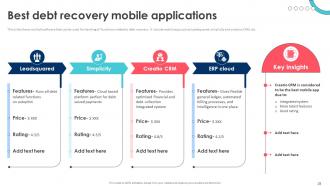
Slide 28: This slide shows multiple software that can be used for handing all functions related to debt recovery.
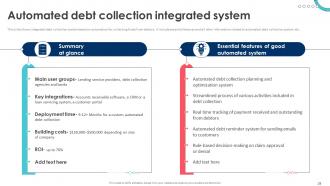
Slide 29: This slide displays integrated debt collection system based on automation for collecting funds from debtors.
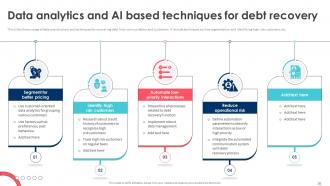
Slide 30: This slide presents usage of data analytics tool and techniques for recovering debt from various debtor and customers.
Slide 31: This slide shows title for topics that are to be covered next in the template.
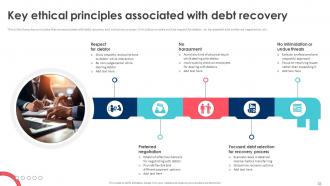
Slide 32: This slide displays key principles that are associated with debt recovery and collection process.
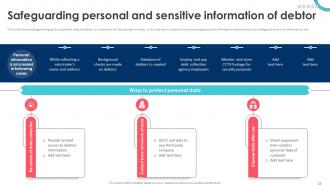
Slide 33: This slide shows safeguarding policy to protect data of debtor or customers for being used wrongly.
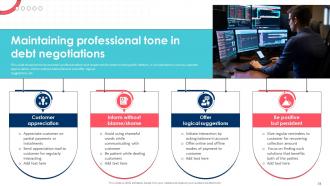
Slide 34: This slide displays tactics to maintain professionalism and respect while communicating with debtors.
Slide 35: This slide shows title for topics that are to be covered next in the template.
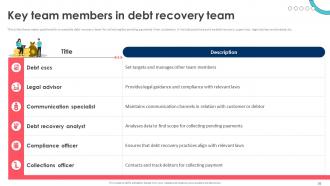
Slide 36: This slide displays major positions for a complete debt recovery team for collecting the pending payments from customers.
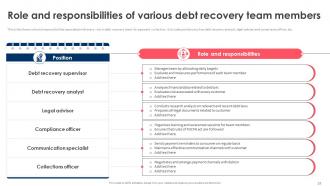
Slide 37: This slide presents role and responsibilities associated with every role in debt recovery team for payment collection.
Slide 38: This slide shows title for topics that are to be covered next in the template.
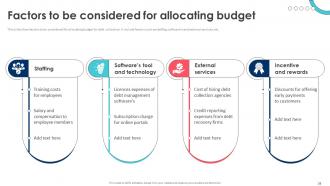
Slide 39: This slide displays factors to be considered for allocating budget for debt collection. It include factors such as staffing, software’s and external services, etc.
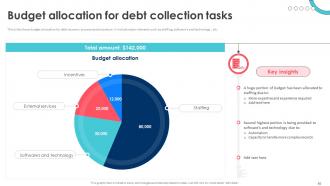
Slide 40: This slide shows budget allocation for debt recovery process and procedure. It include major elements such as staffing, software’s and technology , etc.
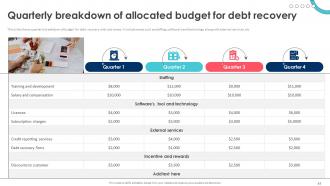
Slide 41: This slide displays quarterly breakdown of budget for debt recovery with sub-areas. It include areas such as staffing, software’s and technology.
Slide 42: This slide shows title for topics that are to be covered next in the template.
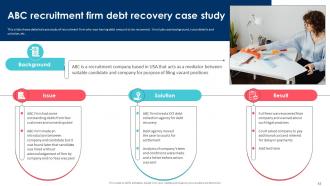
Slide 43: This slide displays detailed case study of recruitment firm who was having debt amount to be recovered. It include case background, issue details etc.
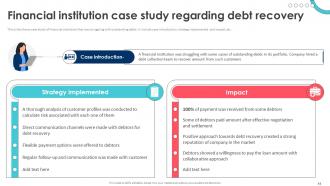
Slide 44: This slide presents case study of financial institution that was struggling with outstanding debts. It include case introduction, strategy implemented and impact, etc.
Slide 45: This slide shows title for topics that are to be covered next in the template.
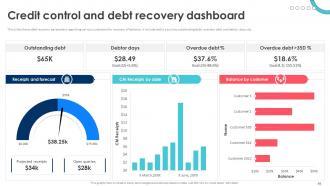
Slide 46: This slide displays debt recovery parameters regarding various customers for recovery of balance. It include metrics such as outstanding debt etc.
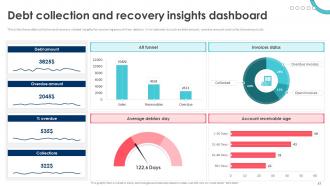
Slide 47: This slide shows debt collection and recovery related insights for recovering amount from debtors. It include metrics such as debt amount, overdue amount etc.
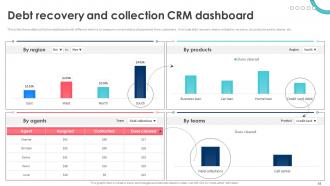
Slide 48: This slide presents debt collection dashboard with different metrics to measure current status of payments from customers.
Slide 49: This slide shows all the icons included in the presentation.
Slide 50: This slide is titled as Additional Slides for moving forward.
Slide 51: This is About Us slide to show company specifications etc.
Slide 52: This is Our Vision, Mission & Goal slide.
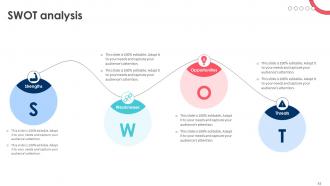
Slide 53: This slide shows SWOT analysis describing- Strength, Weakness, Opportunity, and Threat.
Slide 54: This slide shows Post It Notes for reminders and deadlines. Post your important notes here.
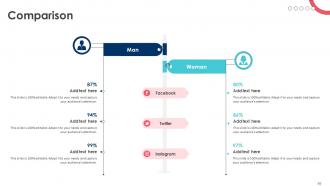
Slide 55: This is a Comparison slide with additional textboxes and related imagery.
Slide 56: This is Our Team slide with names and designation.
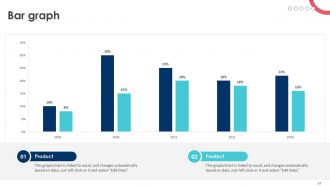
Slide 57: This slide presents Bar Graph with two products comparison.
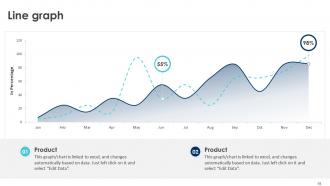
Slide 58: This slide describes Line chart with two products comparison.
Slide 59: This is a Thank You slide with address, contact numbers and email address.
Debt Recovery Process For Reducing Bad Debts Powerpoint Presentation Slides with all 67 slides:
Use our Debt Recovery Process For Reducing Bad Debts Powerpoint Presentation Slides to effectively help you save your valuable time. They are readymade to fit into any presentation structure.











FAQs for Debt Recovery Process For Reducing Bad Debts
Get your paperwork together first - original debt docs, payment records, all that stuff. Then send a proper demand letter with the exact amount and deadline. Honestly, most people screw this up by either being way too nice or coming off like total jerks. Phone calls come next if they ignore you. Maybe throw in a payment plan option so you don't look unreasonable. Write down everything you do - trust me on this one. Most of these situations actually get sorted out pretty quickly if you're just persistent without being a complete nightmare about it.
Honestly, just think of it like customer service instead of being the bad guy. Start friendly - maybe acknowledge you've worked together before. Nobody wants payment surprises, so most people actually respect straight talk about what's owed. Listen to their situation first before making demands. Offer payment plans if you can. Document everything so you're not having the same conversation twice (been there!). The "helpful partner" thing works way better than playing tough creditor. You'll recover more money and maybe keep them as a customer too.
So you'll need to follow the FDCPA since you're third-party collecting, plus whatever your state throws at you (and trust me, some states are way stricter). Don't call at weird hours, can't threaten stuff you won't actually do, no harassment - pretty standard "don't be a jerk" rules. Most states have their own timing rules too. Consumer debt means sending that validation notice within five days. Honestly, state laws are all over the place, so definitely look up your specific requirements. Getting legal templates reviewed isn't a bad idea either.
Look, communication really makes or breaks debt recovery - I can't stress that enough. Start by actually listening to what's going on with them financially. Nobody wants to deal with aggressive collectors, so keep it professional but human. Document everything though, that part's crucial. Work out payment plans that actually make sense for their situation. Quick follow-ups on any agreements you make. Honestly, the whole adversarial approach is so outdated - when people feel like you get their struggle, they're way more motivated to pay. Oh and your tone in every interaction? That's everything right there.
I'd bring in a collection agency after you've tried for about 90-120 days with no luck. Once you've sent notices and made calls but they're still ghosting you, time to escalate. Some people will straight up ignore small businesses but suddenly find their checkbook when an agency calls - it's annoying but true. Just make sure you've got all your attempts documented first since agencies need that paper trail to be effective. Oh, and don't drag your feet too long on this. Debts get way harder to collect after 6 months, so don't wait forever.
Honestly, automation is a game-changer for debt recovery. Start with automated payment reminders - that alone will save you tons of time. SMS and email campaigns can handle the repetitive outreach stuff without you lifting a finger. There's also AI systems now that'll tell you which accounts are actually worth chasing based on who's likely to pay (though I'm still getting used to trusting robots for that). Digital payment portals make it super easy for people to pay you back too. Real-time tracking keeps everything organized. The reminder automation should be your first move since it handles the biggest headache.
Honestly, most people screw up by waiting way too long to follow up - like don't let it slide past 30 days or you're basically shooting yourself in the foot. Document everything though, seriously. Every call, excuse, broken promise, all of it. I've seen people lose winnable cases just because they had zero paper trail. Oh and here's the thing - getting pissy with debtors never works. Stay calm but don't back down. Start simple with a call or email before you go nuclear with formal letters and stuff.
Go after the big debts that'll actually pay up first - easy money in the bank. After that, chase the high-dollar ones even if they're being difficult since it's worth your time. Quick collections on smaller amounts work well next because you can knock them out fast. Those tiny debts though? Man, they'll eat up your whole day if you let them. I'd honestly just write off the small stuff that looks impossible to collect - life's too short. Make yourself a basic chart with amount owed versus how likely you think you'll get paid, then just work down the list.
Oh man, you really need to think about cultural differences before jumping into debt collection anywhere. What works great in one country can totally blow up in your face somewhere else. Like, being super direct might fly in parts of the US, but try that in Japan or Korea where saving face matters so much? You'll get nowhere fast. Religious holidays mess with timing too - people literally can't pay during certain periods. I'd honestly just find local partners who actually get the cultural stuff instead of guessing. Your communication style, payment methods, even when you reach out - it all needs to match local customs or you're wasting time.
Look, treat people how you'd want to be treated if you owed money - sounds cheesy but it's true. Don't call at crazy hours or keep harassing them after they ask for written contact only. Be upfront about what they owe and give them real payment options. Some collectors are total assholes about this, which honestly just makes everything worse for everyone. Make sure the debt's actually accurate before you go after someone - I've heard horror stories about that. Document your calls and conversations. Oh, and if they want to dispute it, don't be a dick about explaining the process.
First thing - get that original contract, that's your gold right there. Grab all your invoices, purchase orders, delivery receipts, anything showing the debt exists. Payment records are super important too - what they've paid vs what's left. Email screenshots work perfectly as evidence, btw. Terms and conditions matter a lot, especially stuff about deadlines and late fees. More documentation = better odds of winning. I learned this the hard way once - now I save everything from day one instead of scrambling later when someone decides not to pay.
Honestly, data analytics is a lifesaver for debt recovery. Start by looking at payment patterns - you'll quickly see who's actually gonna pay vs who's just wasting your time. The numbers don't lie about contact timing either, like when people actually answer calls or respond to texts. You can predict which payment plans will work and catch accounts before they go completely south. I've seen companies boost their recovery rates just by segmenting accounts based on behavior patterns. It's wild how much insight you get once you dig into the data properly.
Dude, payment plans are seriously your best bet here. People can actually handle smaller chunks, so your collection rates go way up. Auto-pay is clutch though - once they start doing manual payments, they usually drop off after like 3 months. Even if someone can only swing $50 a month, that's still infinitely better than getting nothing and torching the relationship. You skip all the legal drama too, which honestly just drags on forever and costs a fortune. I'd say start with whatever they can realistically do, even if it feels low.
Honestly, focus on three main things: recovery rate (what percentage you actually collect), cost per dollar recovered, and how long collection takes. Recovery rate's the most important - most industries see around 20-30%, but it depends on how old the debt is. Don't forget to track customer retention after you go after people though, because sometimes it's not worth torching the relationship. I'd check these numbers monthly and compare to previous months to see if you're improving. Just figure out where you stand now, then set some realistic goals for next quarter.
Look at their income first - job stability, pay stubs, that kind of thing. Credit reports show you payment patterns which honestly tell you everything you need to know. Do they have actual liquid assets they can access? Bank statements will give you the real picture of cash flow. Major life stuff like divorce or job loss changes everything fast, so watch for that. Sometimes people have money but just won't pay - you gotta figure out if they're willing or just can't. Oh and existing debts matter too since you're probably not their only creditor.
-
Very well designed and informative templates.
-
Extensive range of templates! Highly impressed with the quality of the designs.