


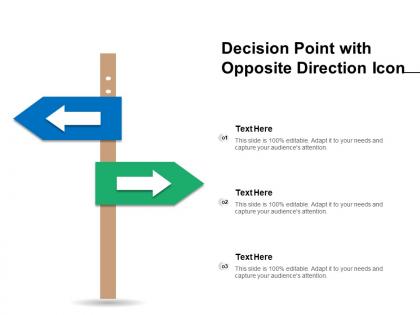
Decision point with opposite direction icon




Try Before you Buy Download Free Sample Product
 Impress Your
 Audience
 100%
100% Editable
 Save Hours
 of Time


Inspire folks on the job with our Decision Point With Opposite Direction Icon. Be an example of intense concentration.
People who downloaded this PowerPoint presentation also viewed the following :
Decision point with opposite direction icon with all 2 slides:
Be an example of intense concentration with our Decision Point With Opposite Direction Icon. Inspire folks on the job.
FAQs for Decision point with
Data analysis plays a crucial role in effective decision-making by providing objective insights, identifying patterns and trends, reducing uncertainty, and enabling evidence-based choices rather than relying on intuition alone. Through advanced analytics, organizations streamline strategic planning, enhance operational efficiency, and minimize risks, with many financial services and retail companies finding that data-driven approaches ultimately deliver faster responses and competitive advantage.
Cognitive biases can significantly impair decision-making in high-stakes situations by creating overconfidence, anchoring to irrelevant information, and prioritizing immediate outcomes over long-term consequences. These mental shortcuts often lead executives to misallocate resources, overlook critical risks, and rush strategic decisions, with many organizations finding that structured decision frameworks and diverse perspectives help minimize bias-driven errors while enhancing outcomes.
Teams can enhance decision-making collaboration through structured brainstorming sessions, cross-functional workshops, digital collaboration platforms, transparent communication protocols, and defined role clarity. These approaches streamline input gathering, minimize conflicts, and accelerate consensus-building, with many organizations finding that combining diverse perspectives with clear frameworks ultimately delivers faster decisions, improved buy-in, and stronger implementation outcomes.
Decision trees simplify complex business choices by breaking down multifaceted decisions into clear, sequential pathways, visualizing potential outcomes, quantifying risks and benefits, and providing structured frameworks for evaluation. Through systematic branch analysis, organizations streamline strategic planning, resource allocation, and operational decisions, while enabling teams to anticipate consequences and make data-driven choices, ultimately delivering improved decision accuracy and organizational alignment.
Visual aids enhance stakeholder understanding by transforming complex data into digestible formats, highlighting key trends, simplifying comparisons, and facilitating faster comprehension of critical insights. Through strategic use of charts and graphs, organizations streamline decision-making processes, reduce meeting times, and improve stakeholder alignment, with many executives finding that visual presentations ultimately deliver clearer communication and more confident strategic decisions.
Emotional intelligence significantly enhances decision-making by enabling better self-awareness, impulse control, empathy, and social understanding during critical choices. Leaders with high emotional intelligence can navigate complex stakeholder dynamics, assess risks more objectively, and build stronger consensus around strategic decisions, ultimately delivering improved outcomes and reducing costly emotional reactions that derail business judgment.
Companies can leverage AI through predictive analytics, automated data processing, real-time reporting, machine learning algorithms, and intelligent forecasting systems. These technologies streamline decision-making by analyzing vast datasets rapidly, identifying patterns humans might miss, and delivering actionable insights, with many organizations finding that AI-powered tools ultimately enhance strategic planning while reducing response times significantly.
Best practices for conducting a SWOT analysis include gathering diverse stakeholder input, using specific data rather than assumptions, prioritizing findings by strategic impact, focusing on actionable insights, and regularly updating the analysis. These practices enhance strategic decision-making by ensuring comprehensive perspective gathering, eliminating bias through factual grounding, and maintaining relevance in dynamic business environments, ultimately delivering more informed choices and competitive advantage.
Scenario planning helps organizations navigate uncertainty by developing multiple plausible future scenarios, identifying potential risks and opportunities, and creating flexible strategic responses for each possibility. Through systematic analysis of different outcomes, companies in sectors like healthcare, finance, and manufacturing can stress-test decisions, allocate resources more strategically, and maintain competitive advantage even when facing unpredictable market conditions.
Groupthink undermines collaborative decision-making by suppressing dissenting opinions, reducing critical analysis, and creating false consensus among team members. This leads to poor risk assessment, missed opportunities, and flawed strategic choices, with many organizations finding that diverse perspectives and structured debate processes ultimately deliver more innovative solutions and competitive advantages.
Real-time data significantly enhances managerial decision-making by providing immediate insights, reducing uncertainty, and enabling faster response times to market changes. This immediate access allows managers in retail, manufacturing, and financial services to adjust strategies quickly, optimize resource allocation, and capitalize on emerging opportunities, ultimately delivering competitive advantage and improved operational efficiency.
Effective prioritization techniques include impact-versus-effort matrices, MoSCoW method (Must/Should/Could/Won't), time-boxing critical decisions, and stakeholder value scoring systems. These approaches streamline decision-making by focusing resources on high-impact outcomes, eliminating less critical options quickly, and enabling teams to deliver strategic results even under compressed timelines, ultimately maintaining competitive advantage.
Cultural differences significantly impact international team decision-making through varying communication styles, hierarchy preferences, risk tolerance levels, and time orientations. While Western teams often favor direct communication and individual accountability, Asian teams typically emphasize consensus-building and collective responsibility, with many global organizations finding that acknowledging these differences ultimately enhances collaboration and delivers more comprehensive strategic outcomes.
Risk assessment frameworks include cost-benefit analysis, decision trees, scenario planning, SWOT analysis, and Monte Carlo simulations. These methodologies enable organizations to quantify potential outcomes, evaluate probabilities, and weigh strategic trade-offs across sectors like financial services, manufacturing, and retail, ultimately delivering more informed choices and competitive advantage in uncertain markets.
Feedback loops enhance decision-making by systematically capturing outcomes, identifying patterns in successful and unsuccessful choices, and integrating these insights into future processes. Organizations using structured feedback mechanisms, particularly in project management and strategic planning, streamline decision accuracy, reduce repeated errors, and accelerate response times, ultimately delivering more informed choices and competitive advantage.
No Reviews