


Demand Generation Funnel And Its Importance




Try Before you Buy Download Free Sample Product
 Impress Your
 Audience
 100%
100% Editable
 Save Hours
 of Time


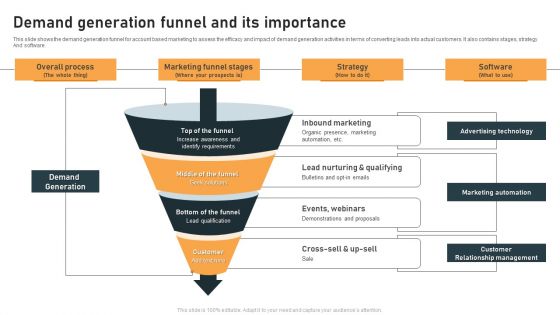
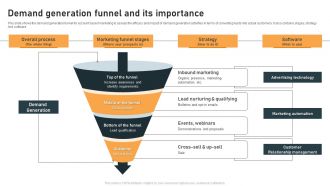
This slide shows the demand generation funnel for account based marketing to assess the efficacy and impact of demand generation activities in terms of converting leads into actual customers. It also contains stages, strategy And software.
People who downloaded this PowerPoint presentation also viewed the following :
Demand Generation Funnel And Its Importance with all 6 slides:
Use our Demand Generation Funnel And Its Importance to effectively help you save your valuable time. They are readymade to fit into any presentation structure.





FAQs for Demand Generation Funnel
A demand generation funnel typically includes awareness, interest, consideration, intent, evaluation, and purchase stages, each designed to guide prospects through their buyer's journey systematically. These stages enable organizations to nurture leads through targeted content, personalized messaging, and strategic touchpoints, with many companies finding that structured funnels increase conversion rates significantly while optimizing resource allocation.
Understanding the buyer's journey enhances demand generation by enabling targeted content creation, personalized messaging, and strategic touchpoint optimization at awareness, consideration, and decision stages. This approach streamlines lead nurturing through relevant experiences, reduces acquisition costs, and accelerates conversion rates, with many organizations finding that journey-mapped strategies deliver higher-quality leads and improved sales alignment.
Content marketing serves different strategic functions at each funnel stage, from awareness-building blog posts and educational resources to consideration-stage case studies, whitepapers, and product demonstrations, ultimately delivering targeted emails and personalized content for decision-making. These content types work together to nurture prospects through their buyer journey, with many organizations finding that strategic content alignment across funnel stages significantly improves conversion rates and shortens sales cycles.
Businesses can effectively measure demand generation funnel success through lead quality scores, conversion rates at each stage, cost per acquisition, pipeline velocity, and customer lifetime value metrics. By tracking these KPIs across touchpoints, companies in sectors like SaaS and financial services gain actionable insights into campaign performance, enabling strategic optimization that ultimately delivers higher ROI and accelerated revenue growth.
Common demand generation mistakes include targeting overly broad audiences, neglecting lead nurturing sequences, focusing solely on top-funnel activities, misaligning sales and marketing teams, and failing to track meaningful metrics beyond vanity numbers. These missteps often result in wasted resources and poor conversion rates, with many organizations finding that strategic audience segmentation and comprehensive funnel optimization ultimately deliver higher-quality leads and improved ROI.
Segmentation enhances demand generation funnels by enabling targeted messaging, personalized content delivery, and optimized resource allocation across different audience groups. Through behavioral and demographic segmentation, organizations can tailor campaigns for specific buyer personas, improve conversion rates, and reduce acquisition costs, with many companies finding that segmented approaches deliver significantly higher engagement and pipeline quality.
Essential technologies include marketing automation platforms, CRM systems, analytics tools, lead scoring software, and content management systems. These technologies streamline lead nurturing, track customer journeys, and automate personalized communications, with many organizations finding that integrated platforms deliver faster lead conversion, improved sales alignment, and ultimately enhanced revenue growth.
Social media leverages the demand generation funnel by creating awareness through targeted content, nurturing prospects with educational resources, and facilitating conversions through social proof and engagement. Platforms like LinkedIn enable B2B companies to reach decision-makers with sponsored content, while Facebook and Instagram help consumer brands build communities and drive traffic, ultimately delivering higher-quality leads and shorter sales cycles.
**INPUT**: What metrics should be tracked at each stage of the demand generation funnel? **OUTPUT**: Key metrics include awareness stage website traffic and social engagement, consideration stage lead quality scores and content downloads, decision stage conversion rates and sales-qualified leads, and retention stage customer lifetime value and expansion revenue. These metrics enable organizations to optimize funnel performance by identifying bottlenecks, measuring campaign effectiveness, and improving resource allocation, with many marketing teams finding that stage-specific tracking ultimately delivers higher ROI and more predictable revenue growth. [Word count: 60]
Lead nurturing bridges the gap between initial interest and sales readiness by delivering targeted content, personalized communications, and strategic touchpoints that guide prospects through each funnel stage. Through automated email sequences, educational resources, and behavioral tracking, organizations maintain engagement with qualified leads, accelerate decision-making timelines, and ultimately convert more prospects into customers while reducing sales cycle length.
Conversion rate optimization strategies include A/B testing landing pages, personalizing content based on buyer personas, implementing progressive profiling, optimizing call-to-action placement, and nurturing leads through targeted email sequences. These approaches streamline the buyer journey by reducing friction points, delivering relevant messaging, and providing timely follow-up, with many organizations finding that strategic personalization and systematic testing ultimately deliver significantly higher conversion rates and improved ROI.
Customer feedback informs demand generation by revealing pain points, preferences, and decision-making triggers that shape messaging, content creation, and channel selection throughout the funnel. Through surveys, reviews, and behavioral data, organizations refine targeting strategies, optimize conversion touchpoints, and personalize experiences, ultimately delivering higher-quality leads and improved customer acquisition rates across industries.
Effective top-of-funnel awareness strategies include content marketing through blogs and whitepapers, social media engagement, search engine optimization, webinars and virtual events, and strategic partnerships with industry influencers. These approaches streamline brand visibility by delivering valuable insights, establishing thought leadership, and reaching target audiences where they consume information, with many organizations finding that consistent, educational content ultimately drives qualified prospects into their sales pipeline.
ABM integrates into the demand generation funnel by targeting high-value accounts with personalized campaigns, aligning sales and marketing efforts, and creating account-specific content journeys rather than broad audience approaches. Through strategic account selection, customized messaging, and coordinated touchpoints, organizations streamline their sales cycles, enhance conversion rates, and ultimately deliver higher ROI, with many enterprises finding that this targeted approach significantly accelerates deal closure.
Different industries tailor demand generation funnels based on their customer journey complexity, sales cycles, and regulatory requirements, with B2B technology companies emphasizing educational content and lengthy nurturing sequences, while retail focuses on shorter, conversion-driven paths. Healthcare and financial services incorporate compliance-heavy touchpoints and trust-building elements, whereas manufacturing emphasizes relationship-building and technical specifications, ultimately delivering industry-specific customer experiences and optimized conversion rates.
-
Use of different colors is good. It's simple and attractive.
-
Their professional templates are very impressive, even my manager was curious about the source. I am very grateful.