


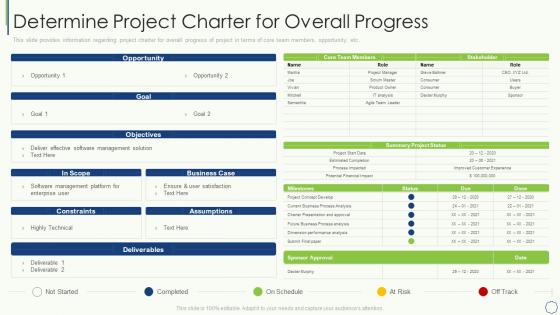
Determine project charter for overall progress key elements of project management it




Try Before you Buy Download Free Sample Product
 Impress Your
 Audience
 100%
100% Editable
 Save Hours
 of Time


This slide provides information regarding project charter for overall progress of project in terms of core team members, opportunity, etc.
People who downloaded this PowerPoint presentation also viewed the following :
Determine project charter for overall progress key elements of project management it with all 6 slides:
Use our Determine Project Charter For Overall Progress Key Elements Of Project Management It to effectively help you save your valuable time. They are readymade to fit into any presentation structure.





FAQs for Determine project charter for overall progress key elements of
So your project charter needs the basics - purpose, objectives, scope, who's doing what, timeline, and budget estimates. Don't forget to name the actual project manager (seriously, I've seen charters without one and it's chaos). Include your assumptions and any constraints you're dealing with. Honestly, the whole thing is like a contract that keeps people honest later. Scope creep is real, trust me. Make sure your sponsor actually signs off before you start anything - saves you from those "but I thought we agreed..." conversations down the road. Oh, and throw in some risk assessment stuff too.
Honestly, a solid project charter is like having a roadmap before a road trip - saves you from arguing about where you're going later. It spells out your goals, who's involved, and what success looks like. When people start adding random stuff to your project (and they will), you can just point back to it. "Nope, that wasn't in the original plan." Plus leadership actually knows what they're signing off on, which makes getting resources way easier. Just don't make it so rigid that you can't pivot when needed. Oh, and get specific - vague charters are useless.
Look, you gotta figure out who actually matters for your project right from the start. Map out sponsors, users, department heads - anyone who could torpedo things if they're pissed off. Seriously, I've watched projects crash because someone ignored a random VP who felt excluded. Find out who approves what and where resistance might come from. Communication gets way easier when you know who needs what info. Oh, and don't think you're done after the first pass - new people pop up constantly. Keep adding to that list as you go.
Look, project charters are honestly a lifesaver because they make you nail down what you're actually doing. No more vague "let's improve stuff" nonsense. Write 3-5 concrete goals that you can measure - like real numbers or outcomes. Then get super specific about what's IN your project versus what's OUT. Trust me, you'll thank yourself later when Bob from marketing tries sneaking in his pet feature halfway through. I always do the scope boundaries first since that's where projects usually go off the rails. It's basically your "nope, not happening" documentation.
Okay so the project justification is basically your "sell me on this" section. Executives want to know what problem you're fixing and why they should care about it. Show them the ROI numbers - honestly, that's half the battle right there. Connect everything back to company goals so they can't ignore it. Without this part being rock solid, your project gets axed the second budgets get tight. I've seen it happen too many times. Make your benefits measurable and specific. Think of it like writing the world's most important elevator pitch, except it actually determines if you get funding or not.
Yeah, definitely add a risks section but don't go overboard with it. Focus on the big stuff that could actually kill your project - like budget getting slashed, your main sponsor leaving, or losing critical team members. Skip the tiny risks for now (that's what your detailed risk register is for anyway). For each major risk, just note what it would do to the project and how you'd handle it. Honestly, leadership loves seeing you've actually thought about what could go sideways. Keep it tight though - maybe 3-5 risks tops. Any more and people's eyes glaze over.
So the project charter is like your "permission slip" to get started - it's the high-level stuff about what you're doing and why it matters. Pretty straightforward. Then the project plan? That's where things get messy and detailed. You're breaking everything down into actual tasks, timelines, who does what. Charter says "we're building a house," but the plan has all the blueprints and construction schedules. You can't really jump into planning until someone approves your charter first - learned that the hard way on my last project!
Dude, get that project charter locked down before you do anything else. It's basically your contract with stakeholders - objectives, timeline, deliverables, all that stuff in writing. Trust me, when people start asking for "just one more feature" (and they will), you can wave that document around and say "nope, we agreed on this." I learned this the hard way on my last project. Get everyone to actually sign off on it first though. Otherwise you'll be drowning in scope changes and random requests. It's honestly the only thing standing between you and chaos.
Mix both hard numbers and softer stuff in your charter. Budget variance and schedule tracking are obvious ones. Quality scores, customer satisfaction ratings, ROI - all good picks. But honestly? Don't sleep on stakeholder engagement levels. I learned that one the hard way on my last project when everyone was technically hitting targets but people were miserable. Acceptance criteria for deliverables matter too. Just don't go crazy - maybe 4-5 metrics max or you'll spend more time tracking than actually doing work. Make sure whatever you pick connects back to what you're trying to accomplish.
Look, you need a communication plan in your charter to avoid the whole "wait, I thought you told Sarah about this" nightmare. Define who gets which updates and how often - like weekly reports or whatever works. Map out your escalation paths too, because someone's always gonna need to bump issues upward. Honestly, half the project disasters I've witnessed could've been prevented if people just wrote down who was supposed to communicate what. Don't forget to note how each stakeholder actually wants to receive info - some love email, others prefer quick calls. Trust me, spending time on this upfront beats playing telephone later.
Honestly, you've gotta spell out who does what in your project charter or you'll end up with those awkward "wait, I thought YOU were doing that" moments later. Clear roles mean no confusion about boundaries - like who can make calls versus who needs permission first. Stakeholders won't waste time hunting down the right person either. The key is being specific about actual deliverables, not just throwing around job titles. I learned this the hard way on a project last year where "marketing support" could've meant literally anything. Short sentences work. But detailed role descriptions save your sanity when things get hectic and everyone's scrambling to figure out their responsibilities.
So basically your project charter is like having receipts when you need to fight for stuff. It spells out what you're actually building and why the business should care - makes it way harder for people to say no to your budget requests. Having that authority piece written down helps too, honestly those resource conversations are already weird enough. You can wave it around when someone tries to steal your best developer or whatever. Plus if things go sideways later, you've got proof of what everyone agreed to upfront. I always keep mine handy for pushback situations.
Hey! So three things that actually work: Get them involved in writing the charter itself - people care way more when they helped create it. Show each group what's specifically in it for them, not just boring corporate benefits. Oh and do live review meetings instead of email chains - way better for handling pushback on the spot. Honestly, the individual follow-ups with your VIP stakeholders make or break everything though. I'd prioritize those over anything else if you're short on time.
Check your project charter every 2-3 months, or whenever big stuff changes. Honestly, most teams just forget about it after kickoff - don't be that team. When scope shifts or you realize your original assumptions were totally wrong, update it. Same goes if key stakeholders change. I usually do quick reviews during steering meetings since everyone's already there anyway. Your charter should reflect what's actually happening, not what you thought would happen six months ago. Oh, and put these reviews on your calendar now or you'll definitely skip them. Trust me on that one.
Dude, a messy project charter will absolutely wreck you. Stakeholders start arguing about scope because everyone thinks you're building something different. Your team pulls in opposite directions. Making decisions? Forget it - nobody knows what matters most. Budget fights are basically inevitable, and I've watched projects drag on forever because of this exact mess. Plus you can't even tell if you're succeeding without clear goals upfront. Honestly, just bite the bullet and nail down that charter first. Trust me on this one - it's worth the extra time.
-
Visually stunning presentation, love the content.
-
Great quality product.