


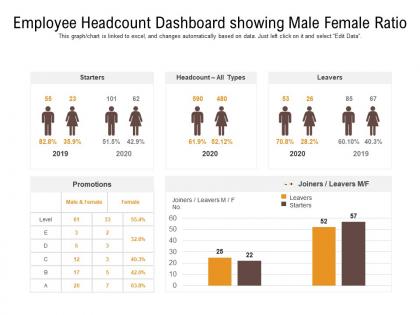
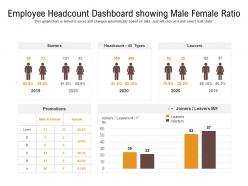
Employee headcount dashboard showing male female ratio




Try Before you Buy Download Free Sample Product
 Impress Your
 Audience
 100%
100% Editable
 Save Hours
 of Time


Our Employee Headcount Dashboard Showing Male Female Ratio are topically designed to provide an attractive backdrop to any subject. Use them to look like a presentation pro.
People who downloaded this PowerPoint presentation also viewed the following :
Employee headcount dashboard showing male female ratio with all 2 slides:
Use our Employee Headcount Dashboard Showing Male Female Ratio to effectively help you save your valuable time. They are readymade to fit into any presentation structure.
FAQs for Employee headcount dashboard showing
Look at age, gender, race/ethnicity, education, tenure, and what departments people work in. Geography too if you've got multiple locations. Salary data is gold but can be tricky to break down cleanly - worth the effort though. This stuff helps you catch representation gaps and spot if all your senior folks are about to retire (yikes). Also shows if certain groups get stuck in specific roles. I'd pull this quarterly rather than just once. Oh, and definitely track trends over time instead of just looking at one-off snapshots.
Yeah, age totally matters for retention strategies. Younger folks usually want growth opportunities and flexible schedules. Older employees? They're more focused on job security and solid benefits - honestly makes sense when you think about it. Gen Z is all about purpose-driven work and work-life balance (typical, right?). But here's what I'd actually do - don't just assume what each group wants. Survey your own people first. You might be surprised by what you find. Then build programs around what YOUR workforce actually tells you they need, not some generic age-based checklist.
Honestly, mixed-gender teams just think differently about problems. When you've got people with different experiences working together, they don't get stuck in that echo chamber thing as much. There's actual research showing these teams crush complex tasks - makes sense since they're questioning each other's ideas more. The communication tends to be way more open too. I've noticed diverse groups are less afraid to challenge assumptions, which obviously leads to better calls. Oh, and the creativity boost is real. Just make sure everyone actually feels comfortable speaking up, otherwise you're not getting the full benefit.
Anonymous surveys through your HRIS are definitely the way to go here. Ask about race, gender, age, disability status, sexual orientation - but make everything optional because nobody likes feeling forced to share personal stuff. Look for patterns in the data rather than individual responses. Honestly, the leadership representation gaps are usually pretty obvious once you see the numbers. Share what you find with everyone (transparency matters) and actually do something about it. Oh, and don't expect perfect response rates even with anonymous surveys - some people just won't participate no matter what.
Your team's cultural backgrounds totally shape how they connect with work. Some people want individual recognition, others care more about group success. Communication styles vary too - like how direct feedback should be or how they view authority. Honestly, most companies just ignore this stuff completely. Work-life balance expectations? Super different across cultures. Don't stereotype individuals though - that's the trap. Just survey your people about what kind of recognition they prefer, how they like to communicate, development opportunities they want. Then adjust your approach based on what you learn.
Honestly, you've gotta mix up your training formats because everyone learns differently. Some older folks still love in-person sessions and handouts, while younger employees are all about digital stuff and interactive content. Mixed-age mentoring is where the magic happens though - I've seen people teach each other things that formal training never covers. Survey your team first to see what they actually want (might surprise you). Then create options so everyone can pick what works. Use different examples that don't play into those tired generational stereotypes. A blended approach gives you the best shot at reaching everyone effectively.
Honestly, forget the usual stuff like age or where they went to college. What matters is adaptability - you want people who've switched roles, learned new skills, stayed current with changes. Tech comfort is obvious but here's what I've noticed: diverse backgrounds actually help teams pivot faster when everything goes sideways. Curiosity and resilience in their work history? That's your gold mine. I mean, someone who shows they can roll with the punches beats a fancy degree every time. Look for continuous learners who don't get rattled by change.
Yeah, it's a real problem. People from lower-income backgrounds literally can't drop $2K on a conference or take unpaid time off for training. Meanwhile their wealthier coworkers are out there networking and collecting certifications. The whole system basically rewards people who already have money - kind of messed up when you think about it. If someone's supporting a family, they can't exactly skip billable hours for professional development. Smart companies offer paid training time and cover costs upfront. Flexible options help too, since not everyone can afford travel or evening events.
Look, your team's location spread totally dictates your remote policies. Time zones are brutal - you can't expect someone in Tokyo to hop on calls at 3am just because it works for NYC. Different countries have their own labor laws and data privacy rules too, which honestly gets messy fast. I'd start by figuring out where everyone actually is first. Then ditch the standard 9-to-5 for flexible core hours that don't screw anyone over. Compensation gets tricky since you'll probably need to adjust for local markets. One-size-fits-all policies just don't work when you're dealing with multiple regions.
Look, demographic shifts basically give you a crystal ball for talent gaps. Got a bunch of senior people hitting retirement age? Time to start grooming replacements now instead of panicking later. But age is just one piece - check out your diversity gaps and where skills are clustered too. Like maybe your tech leads are all older while junior devs are Gen Z. That's actually pretty common these days. Use that intel to figure out where mentoring makes sense and who needs cross-training. Map your leadership pipeline against these patterns so you're not blindsided when half your C-suite decides to retire simultaneously.
Okay so three main things to tackle: recruitment, retention, and advancement. For recruiting, ditch the usual suspects and partner with diverse universities, professional orgs, community groups instead. Use structured interviews and diverse panels too. But honestly? That's the easy part. The real challenge is making sure people actually want to stay once they're hired. Mentorship programs help a ton, plus bias training and clear paths for moving up. Oh and definitely track your demographics regularly - otherwise you're just guessing if anything's working. The retention piece is where most companies mess up.
Looking at your employee demographics is basically like getting a reality check on where you actually stand with diversity. You'll see exactly which departments or leadership levels are lacking representation - gender, ethnicity, age, whatever matters to your company. The data can be pretty brutal sometimes, not gonna lie. But that's good! Instead of just crossing your fingers and hoping things get better, you can actually set real goals with numbers behind them. Plus it shows whether your current hiring and promotion strategies are working or if you need to completely switch things up.
Look, consent and transparency are huge here. Tell people upfront why you're collecting this stuff - diversity tracking, compliance, whatever. Keep it voluntary if you can (though yeah, some EEO stuff is mandatory). Security's obviously critical - lock that data down tight and only give access to people who genuinely need it. Your collection process shouldn't make anyone squirm or create weird biases either. Honestly, I'd say document everything clearly and train whoever's touching this data. It's one of those things where being overly cautious beats dealing with a mess later.
So demographic data basically reveals who's missing from your leadership pipeline - super helpful for building programs that actually move the needle. Break down your promotion/retention numbers by gender, ethnicity, age, whatever makes sense. You'll probably be surprised by what you find (I always am). Look for patterns: are certain groups getting stuck at specific levels? Who's leaving and why? Then you can design targeted stuff - mentorship programs, succession planning, etc. The key is spotting these gaps before half your talent walks out the door. Start simple though, just pull the basic data first.
Companies are scrambling to overhaul their benefits because different generations want totally different things. Older workers still prioritize solid healthcare and retirement plans. Meanwhile, millennials and Gen Z are all about mental health resources, student loan help, and flexible schedules. Work-life balance beats traditional perks every time now - seriously, nobody cares about company cars anymore. More diverse workforces mean covering fertility treatments, elder care, even culturally inclusive PTO. My cousin's company just added pet insurance, which honestly seems random but whatever. Bottom line: if you haven't updated benefits recently, people will jump ship.
No Reviews