

Employee Record Management Software Transforming HR Process Across Workplace




Try Before you Buy Download Free Sample Product
 Impress Your
 Audience
 100%
100% Editable
 Save Hours
 of Time


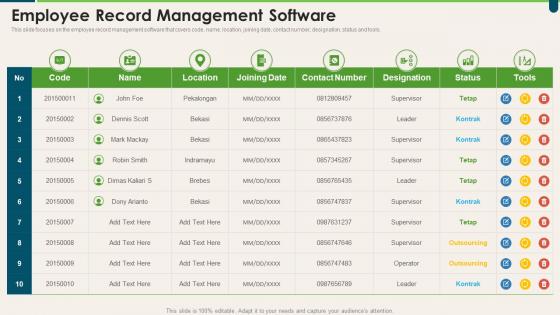
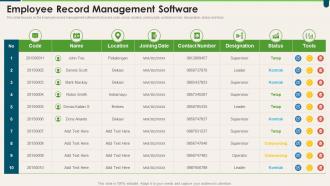
This slide focuses on the employee record management software that covers code, name, location, joining date, contact number, designation, status and tools.
People who downloaded this PowerPoint presentation also viewed the following :
Employee Record Management Software Transforming HR Process Across Workplace with all 6 slides:
Use our Employee Record Management Software Transforming HR Process Across Workplace to effectively help you save your valuable time. They are readymade to fit into any presentation structure.





FAQs for Employee Record Management Software Transforming HR
Security's gotta be your top priority - encryption, access controls, all that compliance stuff can't be optional. Make sure it automates the boring stuff like onboarding and performance reviews so you're not drowning in manual work. Integration with payroll and your other systems is clutch, trust me on this one. Don't underestimate how much you'll need decent search - digging through employee records with terrible search is pure hell. User permissions and audit trails will save your butt during compliance checks. Skip their demo scenarios and test it with your real-world mess instead.
Honestly, this stuff is a lifesaver for compliance. You get automated alerts for renewals and all your documentation stays digitized - no more digging through random filing cabinets for I-9s. The software updates itself when regulations change, which is clutch because who has time to track that? Everything creates an audit trail too. If investigators show up, you're not scrambling around looking like an idiot. Start with automated reminders for your biggest deadlines first - that's where you'll see the most immediate relief. Most platforms generate reports that auditors actually want to see, not just random spreadsheets.
Hey! So employee records are super sensitive - SSNs, salaries, performance stuff that hackers dream about. You'll want software with encrypted databases and role-based access (so only certain people see certain files). Audit trails are huge too - they track who looked at what and when. Some platforms automatically delete old data so you're not hoarding info forever, which honestly makes sense legally. Look, the software basically acts like a bouncer for your data. I wouldn't even consider HR software without solid security features - one breach and you're screwed.
So you'll want to track stuff like retention rates, time-to-hire, and which teams are crushing it vs struggling. Analytics help you spot turnover patterns before they blow up and predict when you'll need more people. Honestly, the visual dashboards beat the hell out of endless Excel sheets - total lifesaver. Set up automated reports for your key metrics first, then do monthly deep dives into exit interview trends and pay gaps. That data will guide your hiring and retention moves way better than gut feelings. Performance correlations across different roles are super telling too if you dig into employee satisfaction scores.
Yeah, most of these systems connect pretty well with whatever HR tools you're already using. APIs and built-in connectors handle the heavy lifting. Your payroll, benefits, performance stuff - it all talks to each other. The popular ones like Workday and BambooHR are usually no problem. Honestly, if they can't integrate easily, that's kinda their fault at this point. Just double-check what your current setup actually supports first. Don't let them just show you pretty dashboards either - make them demo real data moving around between systems.
Honestly, cloud wins by a mile for accessibility. You can check employee stuff from anywhere with wifi, but on-premise? You're basically stuck using the office network or dealing with those annoying VPN connections. I swear, trying to access HR data from home on those old systems is the worst. Scalability's another huge win for cloud - it just grows with your team automatically. With on-premise, you're locked into whatever server you bought originally. Growing means big IT headaches and expensive upgrades. If you've got remote people or you're expanding, cloud's definitely the way to go.
Backup everything twice before you even think about switching - learned that the hard way once. Train your HR people way earlier than you think you need to. Running both systems at the same time for a month sounds like overkill but it's not. Your employees will freak out if they don't know what's happening, so overcommunicate the timeline. Test literally everything because there's always some random feature that breaks. Oh, and make sure IT is ready to jump in those first couple weeks. Something weird always pops up. Honestly? Double whatever timeline you're thinking.
Honestly, it's been a game changer for us. Cloud-based means your HR team can handle everything from anywhere - approvals, onboarding, updates, whatever. Super helpful when people are scattered across time zones. You can set permissions so managers only see their team's stuff, and employees can update their own info without constantly hitting up HR. Way better than having spreadsheets everywhere (ugh, the nightmare). Oh, and employees actually like being able to handle their own basic stuff. I'd say migrate your main employee data first, then add other features slowly so you don't overwhelm everyone.
Oh man, data migration is where everything goes wrong. Companies dump messy records into the new system and wonder why it's chaos. Training gets rushed too - suddenly everyone hates the software because they're lost. HR should be picking the system from day one, but somehow IT always chooses first? Makes no sense. Also watch out for overly complex platforms or ones missing compliance stuff you actually need. Honestly, just slow down the whole rollout and actually train people properly. Worth the extra time.
Dude, this stuff saves you so much time. New hires can fill out their tax forms, emergency contacts, all that boring paperwork online before day one. No more sitting there with clipboards everywhere when they show up. The system builds their profile automatically and shoots out welcome emails with everything they need. ID badges get generated too - though honestly that part can be glitchy sometimes. I'm telling you, it cuts onboarding time in half easily. Start with digitizing your most-used forms first, then build from there. You'll wonder why you waited so long.
Dude, this stuff is a game changer for keeping people happy at work. Your employees can log in and grab their own pay stubs, update addresses, check PTO - no more bugging HR constantly. It's so much better than those painful company-wide emails everyone ignores. You can actually target messages to specific teams instead. People see their performance reviews and time off balances right there, so there's no confusion about where they stand. Honestly, once you give employees control over their own info, they just feel way more invested. It's like night and day.
Honestly, mobile employee record software is pretty clutch. Your team can approve PTO requests or update info from anywhere - no more desk prison! Workers get to check pay stubs and handle their own stuff on their phones, which they actually love. Response times get way faster since people aren't constantly emailing HR for basic details. The work-life balance improvement is real. I'd say start small though - maybe just roll out PTO requests first? Gets people used to it without overwhelming everyone. Once they see how smooth it is, they'll want more features.
Honestly, it's all about your company size. Small businesses get hit harder per person - you're looking at maybe $3-10 monthly per employee since you can't spread those licensing costs around much. But hey, at least your total bill stays reasonable. Big companies? They negotiate way better deals but then their IT gets stupidly complicated. Don't forget you'll need money for setup, training your team, and dealing with whatever integration mess comes up with your current systems. Oh, and small companies should probably just go cloud-based - way less upfront cash and headaches.
Honestly, start by timing how long your HR team spends on all that manual stuff right now - filing, digging through records, fixing screwups. Write it all down this week so you've got real numbers. After you implement the software, track the same things and compare. The time savings alone usually make it worth it pretty fast. Don't forget about those compliance penalties either - they can absolutely wreck your budget if you're not careful. Employee satisfaction scores are another good metric since people get way less cranky when their requests actually get processed quickly. Most companies see the software pay for itself within like 6-12 months.
So the big thing right now is AI analytics - it's wild how it can predict who's gonna quit before they even know it. Mobile access is huge too since everyone's still working from home half the time. Cloud systems are basically mandatory at this point, and honestly the integration with other HR tools is getting pretty slick. Self-service portals are a total game-changer - employees can just update their own stuff instead of bugging HR constantly. Oh, and compliance automation is saving people's butts with all these privacy laws. I'd start looking at vendors sooner rather than later.
-
Professional and unique presentations.
-
Professionally designed slides with color coordinated themes and icons. Perfect for enhancing the style of the presentations.