


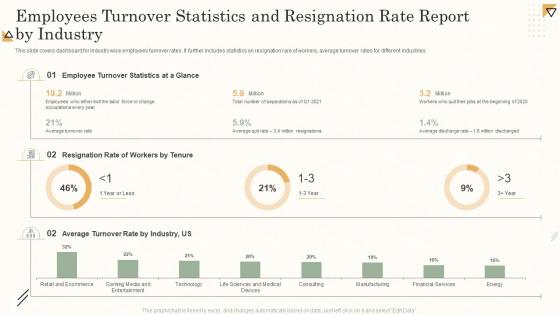
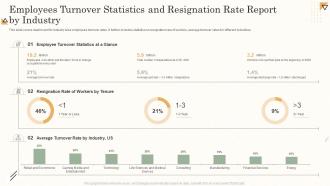
Employees Turnover Statistics And Resignation Rate Report By Industry




Try Before you Buy Download Free Sample Product
 Impress Your
 Audience
 100%
100% Editable
 Save Hours
 of Time


This slide covers dashboard for industry wise employees turnover rates. It further includes statistics on resignation rare of workers, average turnover rates for different industries.
People who downloaded this PowerPoint presentation also viewed the following :
Employees Turnover Statistics And Resignation Rate Report By Industry with all 7 slides:
Use our Employees Turnover Statistics And Resignation Rate Report By Industry to effectively help you save your valuable time. They are readymade to fit into any presentation structure.





FAQs for Employees Turnover Statistics And Resignation Rate
Employee turnover rates vary significantly by industry, with hospitality and retail averaging 75-85%, technology around 13-15%, healthcare 19-22%, manufacturing 20-25%, and financial services 12-18%. These statistics reflect industry-specific challenges like seasonal demands, skill requirements, and workplace conditions, with many organizations finding that targeted retention strategies, competitive compensation, and enhanced employee experiences can significantly reduce turnover costs.
Voluntary turnover rates typically range from 8-15% in stable sectors like utilities and government, while reaching 20-30% in retail and hospitality, compared to involuntary turnover averaging 3-7% across most industries. Healthcare and technology sectors experience higher voluntary departure due to competitive talent markets, while manufacturing and finance see elevated involuntary turnover through restructuring, ultimately impacting retention strategies and workforce planning.
Poor management, limited career advancement opportunities, inadequate compensation, lack of work-life balance, and insufficient recognition contribute most significantly to high employee turnover. These factors often interconnect, with many organizations finding that addressing compensation alone isn't enough, while companies investing in comprehensive retention strategies see significantly lower turnover rates and enhanced competitive advantage.
Employee turnover impacts organizational performance by reducing institutional knowledge, increasing recruitment costs, disrupting team dynamics, and lowering overall productivity levels. Organizations experiencing high turnover face decreased customer satisfaction, reduced operational efficiency, and diminished competitive advantage, with many companies finding that strategic retention programs ultimately deliver stronger financial performance and sustained growth.
Employee turnover statistics reveal significant demographic patterns, including higher turnover rates among younger employees, particularly millennials and Gen Z workers, increased retention challenges in remote work environments, and varying turnover rates across gender, ethnicity, and education levels. These trends enable organizations to develop targeted retention strategies, customize benefits packages, and implement demographic-specific engagement initiatives, ultimately reducing recruitment costs and enhancing workforce stability.
Companies effectively measure turnover rates through exit interviews, stay interviews, predictive analytics, employee satisfaction surveys, and performance data analysis. These approaches streamline workforce planning by identifying departure patterns, retention risks, and engagement gaps, with many organizations finding that comprehensive turnover analysis ultimately delivers improved hiring strategies, reduced replacement costs, and enhanced employee retention across departments.
Employee engagement significantly influences turnover statistics by directly impacting retention rates, job satisfaction, productivity levels, and organizational loyalty. Highly engaged employees demonstrate lower absenteeism, reduced turnover intentions, and stronger workplace commitment, while disengaged workers often seek new opportunities, ultimately delivering either enhanced retention or costly recruitment cycles for organizations.
Remote work trends have significantly reduced employee turnover rates by enhancing work-life balance, eliminating commute stress, and providing greater flexibility in daily schedules. Many organizations find that remote and hybrid models enable them to retain top talent across broader geographic areas, reduce recruitment costs, and maintain higher employee satisfaction, ultimately delivering competitive advantage in increasingly tight labor markets.
High employee turnover creates significant financial burdens including recruitment costs, training expenses, productivity losses during transitions, overtime payments for remaining staff, and reduced operational efficiency. These costs typically range from 50-200% of an employee's annual salary, with sectors like retail and hospitality experiencing particularly steep impacts, ultimately affecting profitability and competitive positioning in increasingly talent-driven markets.
Geographic locations influence employee turnover rates through cost of living variations, local job market competition, regional economic conditions, and cultural workplace expectations. Urban areas with higher living costs and competitive job markets often experience elevated turnover, while companies in smaller markets may retain talent longer, though they face challenges attracting specialized skills, ultimately requiring location-specific retention strategies.
Organizations can implement retention strategies including competitive compensation packages, flexible work arrangements, comprehensive professional development programs, regular performance feedback, and strong employee recognition initiatives. These approaches enhance workplace satisfaction by addressing career growth opportunities, work-life balance concerns, and cultural engagement, with many companies finding that strategic combinations of these elements significantly reduce turnover while improving overall organizational performance.
Higher compensation typically correlates with lower turnover rates, as competitive salaries and comprehensive benefits packages enhance job satisfaction, reduce financial stress, and increase employee retention. While compensation alone doesn't guarantee loyalty, organizations offering market-competitive wages, performance bonuses, and robust benefit structures consistently experience reduced recruitment costs and improved workforce stability.
Effective onboarding practices significantly reduce employee turnover by creating structured integration experiences, establishing clear role expectations, and building early engagement connections. Organizations with comprehensive onboarding programs typically see 50-60% improvement in retention rates, with companies like Microsoft and Google finding that systematic first-90-day processes ultimately deliver stronger performance outcomes and reduced replacement costs.
Exit interviews provide insights into compensation gaps, management effectiveness, career development limitations, workplace culture issues, and work-life balance concerns that drive employee departures. Through systematic analysis of exit feedback, organizations identify recurring patterns across departments, enabling targeted retention strategies, improved leadership training, and enhanced employee experiences, with many companies finding that addressing these insights reduces future turnover by 15-25%.
Predictive analytics helps forecast employee turnover by analyzing historical data, identifying at-risk employees, and revealing underlying patterns in departure trends. Through machine learning algorithms, organizations can proactively address retention issues, implement targeted interventions, and optimize workforce planning strategies, ultimately reducing recruitment costs and maintaining operational continuity across departments.
-
Every time I ask for something out-of-the-box from them and they never fail in delivering that. No words for their excellence!
-
Great product with highly impressive and engaging designs.