


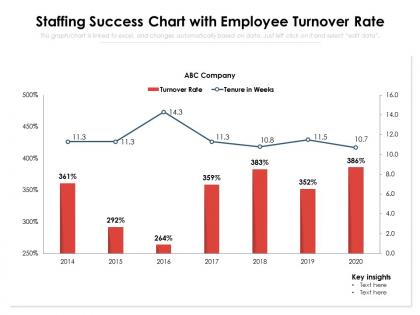
Staffing success chart with employee turnover rate




Try Before you Buy Download Free Sample Product
 Impress Your
 Audience
 100%
100% Editable
 Save Hours
 of Time


Our Staffing Success Chart With Employee Turnover Rate are topically designed to provide an attractive backdrop to any subject. Use them to look like a presentation pro.
People who downloaded this PowerPoint presentation also viewed the following :
Staffing success chart with employee turnover rate with all 2 slides:
Use our Staffing Success Chart With Employee Turnover Rate to effectively help you save your valuable time. They are readymade to fit into any presentation structure.
FAQs for Staffing success chart with
Poor management practices, inadequate compensation, limited career advancement opportunities, toxic workplace culture, and lack of work-life balance contribute most significantly to employee turnover. These factors often compound each other, with organizations in sectors like retail, hospitality, and call centers finding that addressing compensation alongside management training delivers significantly better retention rates and ultimately reduces recruitment costs.
Companies effectively measure employee turnover rate by calculating total departures divided by average headcount over specific periods, segmenting data by department, role level, and voluntary versus involuntary exits. Through comprehensive tracking systems, organizations analyze monthly, quarterly, and annual trends, benchmark against industry standards, and identify patterns in high-risk departments, ultimately enabling targeted retention strategies and improved workforce planning.
Leadership styles significantly impact employee retention through communication approaches, recognition practices, decision-making inclusivity, and career development support. Transformational leaders often see higher retention in tech and healthcare sectors, while micromanagement increases turnover, with many organizations finding that empowering, supportive leadership reduces recruitment costs and enhances team stability.
Effective onboarding processes significantly reduce employee turnover rates by enhancing job satisfaction, accelerating productivity, and building stronger organizational connections through structured training, mentorship programs, and clear expectation setting. Companies with comprehensive onboarding find that new hires are 58% more likely to remain after three years, ultimately delivering improved retention and reduced recruitment costs.
Company culture significantly influences employee satisfaction and retention by shaping workplace values, communication patterns, recognition systems, and career development opportunities. Organizations with strong, positive cultures experience lower turnover rates, with many companies finding that employees who align with cultural values demonstrate greater engagement, productivity, and loyalty, ultimately delivering reduced recruitment costs and enhanced organizational performance.
Organizations can identify at-risk employees through predictive analytics analyzing engagement scores, performance trends, absenteeism patterns, feedback sentiment, and career progression stagnation. These insights enable proactive interventions by flagging declining satisfaction, monitoring workload distribution, and tracking promotion timelines, with many companies finding that early identification reduces turnover costs while enhancing retention strategies.
High employee turnover creates significant financial burdens through recruitment costs, training expenses, lost productivity, and decreased morale among remaining staff. These costs compound quickly, with many organizations finding that replacing a single employee can cost 50-150% of their annual salary, ultimately impacting profitability and competitive advantage in increasingly talent-driven markets.
Competitive employee benefits and compensation significantly reduce turnover rates by enhancing job satisfaction, financial security, and overall employee retention. Organizations offering comprehensive healthcare, retirement plans, flexible work arrangements, and market-competitive salaries typically experience 25-40% lower turnover, with many companies finding that strategic compensation packages ultimately deliver reduced recruitment costs and improved workforce stability.
Strategies to reduce voluntary turnover include competitive compensation packages, flexible work arrangements, comprehensive professional development programs, regular performance feedback, and strong recognition systems. These approaches enhance employee engagement by addressing career growth opportunities, work-life balance concerns, and job satisfaction factors, with many organizations finding that strategic retention initiatives significantly reduce recruitment costs while improving overall productivity.
Exit interviews reveal turnover patterns by identifying recurring themes in employee departures, such as management issues, compensation concerns, limited growth opportunities, and workplace culture problems. These structured conversations enable organizations to pinpoint specific departments or roles with higher attrition rates, while tracking feedback over time helps companies address systemic issues, ultimately reducing future turnover and improving retention strategies.
Employee turnover varies significantly across industries, with hospitality, retail, and food service experiencing rates of 50-100% annually, while healthcare, finance, and technology typically see 10-25% turnover. These differences reflect factors like job satisfaction, compensation levels, career advancement opportunities, and work-life balance, with many organizations finding that industry-specific retention strategies deliver competitive advantages in talent acquisition.
High turnover creates knowledge gaps, disrupts established workflows, erodes team cohesion, and increases training burdens on remaining staff. These disruptions lead to decreased productivity, heightened stress levels, and reduced morale among survivors, with many organizations finding that remaining employees often struggle with increased workloads while adapting to constantly changing team compositions, ultimately undermining collaborative effectiveness.
Organizations can leverage technology to improve retention and engagement through AI-powered performance analytics, personalized learning platforms, real-time feedback systems, flexible remote work tools, and automated recognition programs. These technologies streamline career development, enhance communication, and deliver customized employee experiences, with many companies finding that strategic technology integration reduces turnover by up to 40% while significantly boosting workplace satisfaction.
Employee feedback significantly reduces turnover rates by identifying workplace issues, improving job satisfaction, enhancing communication between management and staff, and creating actionable improvement strategies. Through regular surveys, exit interviews, and one-on-one discussions, organizations across healthcare, retail, and financial services streamline retention efforts, ultimately delivering stronger employee engagement and reduced recruitment costs.
Job fit misalignment significantly increases turnover intentions by creating role dissatisfaction, reduced engagement, performance struggles, and career stagnation concerns among employees. When skills, values, or expectations don't match position requirements, organizations experience higher recruitment costs, knowledge loss, and productivity declines, with many companies finding that strategic role alignment and clear job descriptions ultimately enhance retention and workplace satisfaction.
-
Visually stunning presentation, love the content.
-
Very unique and reliable designs.
-
The content is very helpful from business point of view.
-
Very unique, user-friendly presentation interface.
-
Content of slide is easy to understand and edit.