


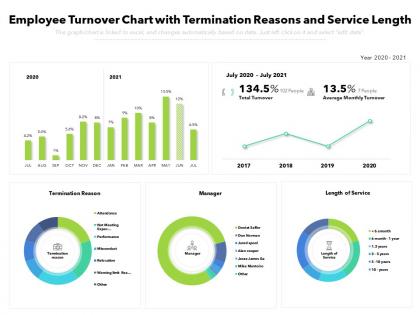
Employee turnover chart with termination reasons and service length




Try Before you Buy Download Free Sample Product
 Impress Your
 Audience
 100%
100% Editable
 Save Hours
 of Time


Our Employee Turnover Chart With Termination Reasons And Service Length are topically designed to provide an attractive backdrop to any subject. Use them to look like a presentation pro.
People who downloaded this PowerPoint presentation also viewed the following :
Employee turnover chart with termination reasons and service length with all 2 slides:
Use our Employee Turnover Chart With Termination Reasons And Service Length to effectively help you save your valuable time. They are readymade to fit into any presentation structure.

FAQs for Employee turnover chart with termination reasons
So we dug into the data and it's basically three things causing people to bail. Pay is the worst offender - especially for mid-level folks who are getting screwed at 15-20% below market. Career growth? What career growth lol. Some departments literally have zero path forward, so people feel trapped. Manager quality is all over the map too, which honestly explains why certain teams can't keep anyone. But here's the thing - none of this is rocket science to fix. Start with getting salaries right and having actual conversations about where people want their careers to go.
Ugh, high turnover is brutal for performance. You're constantly bleeding institutional knowledge and dealing with productivity dips every time someone leaves. Recruitment costs add up quick too. The culture piece is what really gets me though - remaining people get burned out or start eyeing the exit themselves. It's like dominoes falling. Your best performers who actually train people and get stuff done? They're usually first to go. But honestly, if you track turnover by department and manager, you'll spot the problem areas before they blow up. Then you know exactly where to focus your retention efforts.
So I pulled the turnover numbers - yikes. Your under-25 crew is hitting 28%, which is brutal. Remote workers aren't far behind at 22%. Entry-level spots are a revolving door too, probably because onboarding sucks tbh. The good news? Mid-career people (30-45) stick around - only 12% turnover there. Customer service and sales are way worse than engineering or finance, which makes sense I guess. I'd definitely tackle the young employees first since that's where you'll get the biggest bang for your buck.
Skip the generic stuff and go straight for what matters - their boss, growth options, workload, and what would've kept them around. People get weirdly honest once they're already gone, which is actually pretty helpful. Don't ask about general feelings - dig into specific moments or incidents that made them want out. Mix rating questions with open-ended ones so you can spot patterns later. Oh, and definitely don't have their manager do the interview - get someone neutral. The real gold is in analyzing trends across multiple exits, not just individual gripes.
Dude, engagement is seriously your best bet for keeping people. When someone actually cares about their job and feels appreciated, why would they leave? Makes total sense. Engaged people stick around because they're genuinely excited about their work - not just collecting a paycheck. Your turnover drops like crazy when employees feel like they matter. The trick is surveying them regularly about how they're feeling. But here's the thing - you actually have to DO something with that feedback or it's pointless. I've seen too many companies just collect data and ignore it.
So basically you dig into all that HR data you've got - performance reviews, salary bumps, engagement surveys, the works. Look for patterns before people actually quit. Machine learning is honestly pretty scary good at this stuff, way better than us staring at Excel sheets all day. Track things like productivity dips, more sick days, or when peer feedback starts going south. Oh and set up alerts when someone hits those red flag thresholds. That's when you swoop in with retention tactics before they're already mentally checked out.
So it really depends on your industry, but most white-collar jobs see around 10-15% turnover yearly. Tech and healthcare are brutal though - they're looking at 15-25%. Government workers barely leave (5-10%), which honestly makes sense given the job security. Retail and hospitality are just insane with 50%+ turnover. Don't compare yourself to random averages - that's useless. You need numbers from similar companies in your space. SHRM has solid benchmarking reports, or check BLS data for your sector. Pull your current turnover rate first, then see how you stack up against those industry ranges.
So your training programs are actually working pretty well! We're seeing 15% lower turnover when people finish the whole thing vs those who bail early. Around 90 days is when they really click with everything. But here's the thing - it's mostly the mentorship stuff doing the heavy lifting. Those buddy systems and casual check-ins? Way more effective than your formal training modules, honestly. If I were you, I'd double down on expanding that mentor program first. That's where you'll see the biggest bang for your buck.
Honestly, I'd start with manager training - bad bosses are literally the top reason people bail. From what I've seen, better onboarding cuts turnover by like 25-30% in the first year alone. Remote work and flexible schedules are huge wins too since everyone's obsessed with work-life balance now (and rightfully so). Career development stuff matters more than you'd think - people need to see where they're going. Oh, and regular feedback sessions instead of just annual reviews. Pick one thing first though, track your current numbers, then measure again in 6 months. Don't try to fix everything at once.
Honestly, start by just asking your current team what would make them stick around - their answers will shock you. Recognition is huge though. Don't just celebrate the big wins; call out the everyday stuff too. Nobody wants to feel invisible at work. Growth paths matter, even if it's something simple like lunch trainings or online courses. But here's the thing that really gets me - psychological safety beats everything else. Your people need to feel safe screwing up, speaking their minds, being themselves. I've seen teams fall apart when that's missing. Oh, and those three areas? They're way more connected than you'd think.
Dude, you're definitely not seeing the full picture on turnover costs. New people take forever to actually be productive - we're talking months sometimes. Your current team gets burned out picking up slack, which honestly just makes more people want to quit. Clients hate losing their main contact and will bolt. Knowledge walks out the door too, so you're basically starting from scratch on processes. The domino effect is real - one person leaves, others start wondering what they know that I don't. Track all this stuff and you'll see it's probably 150-200% of their salary, not just recruiting costs.
Honestly, comp and benefits are make-or-break for keeping people around. If your pay sucks compared to what's out there, people will bounce fast. But salary's just part of it now - good health insurance, decent PTO, 401k matching, remote work flexibility... that stuff matters way more than it used to. You really need to figure out what YOUR team actually cares about though. Maybe send out an anonymous survey? I'd focus on whatever they say matters most instead of guessing. Oh, and don't sleep on the weird perks - sometimes free lunch keeps people happier than you'd think.
Three things have worked best for me: mentorship programs, clear career paths, and cross-training opportunities. People need to see where they're going, you know? Map out advancement routes for each role first. Then pair experienced folks with newer team members - formal mentor relationships really help. Cross-training keeps things fresh and builds your internal talent pipeline. Money isn't usually why people bail - they just feel stuck. I do quarterly career chats with my team about their goals and what interests them. Sounds cheesy but it actually prevents a lot of turnover. Start by figuring out what skills gaps you need to fill for each growth path.
Honestly, good communication from leadership is like the secret sauce for keeping people. When your managers actually talk to employees - not just barking orders but giving real feedback and being transparent about what's happening - people don't want to leave. Bad communication though? That's when everyone starts job hunting because they feel left out or confused. Regular check-ins help tons. Town halls too, even if they're kinda boring sometimes. You'd be surprised how much difference it makes when leaders just... talk to people like humans? Start by looking at how often your leadership team actually has real conversations with staff beyond "get this done by Friday."
Culture's honestly everything when it comes to keeping people around. I've watched amazing employees bail from otherwise solid companies just because the vibe was off or management was terrible. When people feel respected and see actual growth opportunities, they stick around - it's that simple. Bad culture kills loyalty faster than low pay sometimes. Your team needs to feel like they belong and their work matters. High turnover? Start digging into what's actually happening through surveys and exit interviews. You might be surprised what you find.
-
Designs have enough space to add content.
-
Excellent Designs.
-
Enough space for editing and adding your own content.
-
Great designs, really helpful.
-
Great designs, really helpful.