

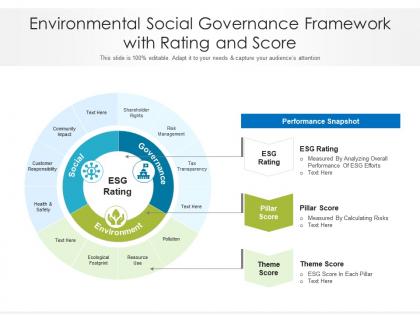
Environmental social governance framework with rating and score




Try Before you Buy Download Free Sample Product
 Impress Your
 Audience
 100%
100% Editable
 Save Hours
 of Time


Our Environmental Social Governance Framework With Rating And Score are topically designed to provide an attractive backdrop to any subject. Use them to look like a presentation pro.
People who downloaded this PowerPoint presentation also viewed the following :
Environmental social governance framework with rating and score with all 2 slides:
Use our Environmental Social Governance Framework With Rating And Score to effectively help you save your valuable time. They are readymade to fit into any presentation structure.

FAQs for Environmental social governance framework with
So basically it's Environmental (climate stuff, how you use resources), Social (how you treat workers and communities), and Governance (board oversight, ethics, being transparent). But here's the thing - they're all connected. Bad governance can cause environmental disasters which then kills your reputation. Most companies map out their biggest risks across all three areas first, then figure out metrics from there. Honestly though? Don't try tracking everything at once - you'll go crazy. Pick maybe 2-3 key things per area that actually matter for your specific business and start there.
Look, don't wait to bake ESG into your processes - do it from the start. Map out how climate regs might hit your supply chain or how better diversity could spark innovation. Honestly, most execs overthink this stuff. Set measurable targets that actually connect to your financials, then push them down through every team. Oh, and definitely tie leadership comp to ESG performance - gives them real skin in the game. The whole thing should feel organic, not like you're checking boxes. Way less painful than people expect, trust me.
ESG breaks down into three areas - environmental (carbon, water, waste), social (diversity, safety, community stuff), and governance (board makeup, exec pay, transparency). Honestly the number of frameworks out there is insane and kinda overwhelming. Most companies do a materiality assessment first to figure out what actually matters for their specific industry, which makes sense. I'd just pick like 5-10 metrics that fit your business strategy. Way better than drowning in data you'll never use. Start simple and build from there.
So regulations basically set the rules that force companies to actually do ESG stuff. Finance and energy move fastest because they're hit hardest - like those EU taxonomy rules are no joke. Other industries? They're way slower without that pressure. Here's the thing though - once regs hit a major market, companies usually just apply those standards everywhere instead of juggling different rules. Way easier that way. Oh and honestly, you can pretty much predict which sectors will move first just by looking at regulatory pressure. Keep tabs on what's coming down the pipeline in your space - it's usually your best heads up for what ESG requirements are gonna look like.
Honestly, ESG stuff can actually spark some pretty cool innovations if you don't just see it as red tape. Companies end up developing cleaner tech or finding ways to cut waste AND costs at the same time. Younger employees especially love working for places with actual purpose - and there's tons of ESG investment money floating around these days. Your brand stands out more too. I'd say pick one ESG problem in your space and think about how fixing it could make you money instead of just cost you money. Way better than scrambling when regulations hit later, you know?
So basically your stakeholders are the ones calling the shots on ESG stuff. Investors want climate data, employees push for diversity programs, customers care about ethical sourcing - you know the drill. The squeaky wheel gets the grease, honestly. Your leadership takes all that feedback and turns it into actual goals and metrics. Smart companies don't wait around for complaints though - they're out there surveying these groups regularly. I'd map out who your key stakeholders are first, then set up regular check-ins. Way better than scrambling when someone's already pissed off.
Honestly, just be real about it - transparency is everything. Don't do those vague "we're committed to sustainability" reports that make people roll their eyes. Actually track 2-3 specific metrics and share the numbers quarterly, even when they're not great. Tell real stories on your website and socials about what's working and what isn't. People (especially investors) can spot BS greenwashing instantly, so being genuine beats looking perfect. I'd rather see a company admit they're struggling with something than pretend everything's amazing, you know?
Dude, skipping ESG is basically shooting yourself in the foot. Investors are all over this now - they won't even look at you without it. Your reputation gets trashed, especially with Gen Z who actually give a damn about this stuff (and honestly, they should). Good employees? Forget it. Nobody wants to work for companies that seem sketchy on values. Oh, and governments are handing out fines left and right these days. The real kicker though? While you're sitting there doing nothing, your competitors are snatching up all the investment money and customers. Just do a quick audit of where you stand on environmental and social practices first.
Honestly, ESG is a total mess when you look at it globally. Europe's going full regulatory mode - they've got mandatory reporting and this whole EU taxonomy thing that's pretty intense. Meanwhile the US is way more chill, mostly just investor pressure plus some SEC climate stuff. Asia's basically everywhere at once. Singapore and Japan are really pushing frameworks hard, but tons of other countries are still figuring it out. The big split is whether it's required or voluntary - Europeans have serious compliance headaches while Americans deal more with market forces. If you're doing anything international, you'll need to research each region separately because there's no universal playbook here.
Ugh, the standards nightmare is real - GRI, SASB, TCFD and probably ten others all wanting different stuff. Spent forever collecting data once only to find out investors wanted something completely different. International vs local regs? Total mess. Most companies still don't have their systems talking to each other either, which makes everything harder. My advice: pick one framework that actually matches what your stakeholders care about first. Don't try to boil the ocean right away. You can always add more later once you've got the basics down.
Honestly, you don't need to blow your budget on consultants right off the bat. Look at what you're already doing - employee wellness stuff, maybe some energy-saving things - and just write it down. There's free tools out there like UN Global Compact's assessments (I know, sounds boring but they're actually helpful). Track simple stuff first: energy bills, how happy your employees are, basic policies. The whole thing is really just about paying attention to this stuff instead of ignoring it. You can get fancy later once you've got some momentum going. Baby steps beat trying to do everything at once.
Okay so there's literally a million options - Workiva, Sustainalytics, Bloomberg ESG are the big comprehensive ones. Then you've got niche players like Carbon Trust for carbon stuff or RepRisk for risk metrics. But honestly? Start with the free frameworks first - GRI standards and SASB will help you figure out what you actually need to measure. I made the mistake of diving into paid platforms too early and got totally overwhelmed. Map out your requirements with the free stuff, then pick a paid tool that fits your company size. Way less headache that way.
So ESG totally changes supply chain management - no more just grabbing the cheapest option. Now you're evaluating suppliers on environmental stuff, labor practices, governance standards. Way more complicated but honestly probably overdue. You'll be doing ESG audits, demanding sustainability certs, sometimes paying more for ethical materials. The transparency requirements are huge too - tracking metrics across your whole chain is a pain. I'd start by mapping current suppliers first, see who's already an ESG nightmare waiting to happen. That'll tell you where to focus your energy.
Dude, greenwashing will absolutely wreck your company's reputation. Investors are filing lawsuits left and right when they catch companies fudging their environmental data. Regulators aren't messing around either - they're handing out serious penalties now. Your stock price tanks, good employees won't want to work there, and customers just stop buying your stuff. People have gotten scary good at calling out fake sustainability claims too. My advice? Only publish ESG stuff you can actually back up with real data. If you can't prove it, just don't say it.
Look, the whole ESG thing is such a pain to measure properly, but AI and blockchain actually fix that mess. You can use AI to track carbon footprints and predict environmental stuff in real-time - way better than spreadsheets. Blockchain makes everything transparent so companies can't fake their green credentials anymore. Honestly, supply chain tracking was overdue for this kind of upgrade. Your stakeholders will actually trust the data for once. I'd start simple though - maybe try AI for energy monitoring first? The combo gives you solid proof of impact without the usual reporting headache.
-
Editable templates with innovative design and color combination.
-
Presentation Design is very nice, good work with the content as well.
-
Great quality product.
-
Excellent design and quick turnaround.