


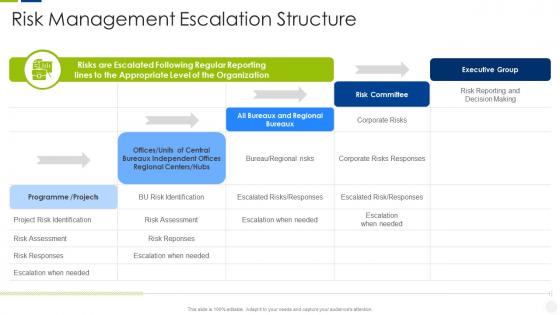
Escalation management system risk management escalation structure




Try Before you Buy Download Free Sample Product
 Impress Your
 Audience
 100%
100% Editable
 Save Hours
 of Time


Our Escalation Management System Risk Management Escalation Structure are topically designed to provide an attractive backdrop to any subject. Use them to look like a presentation pro.
People who downloaded this PowerPoint presentation also viewed the following :
Escalation management system risk management escalation structure with all 6 slides:
Use our Escalation Management System Risk Management Escalation Structure to effectively help you save your valuable time. They are readymade to fit into any presentation structure.





FAQs for Escalation management system risk
Key indicators for project escalation include scope creep exceeding predetermined thresholds, budget overruns beyond contingency limits, critical timeline delays affecting deliverables, resource conflicts impacting multiple teams, and stakeholder disagreements blocking decision-making. These warning signs enable project managers to proactively address risks before they compound, ultimately protecting project objectives and maintaining organizational confidence in delivery capabilities.
Effective communication strategies mitigate escalation scenarios by establishing clear protocols, implementing active listening techniques, providing regular status updates, and training staff in de-escalation methods. These approaches enable organizations to address concerns proactively, maintain transparency throughout resolution processes, and ultimately deliver faster conflict resolution and improved customer satisfaction, with many service-oriented businesses finding that structured communication reduces escalation frequency significantly.
Stakeholder management ensures clear communication channels, defined roles, and proper authority levels throughout the escalation process, enabling faster decision-making and resolution. Through strategic stakeholder mapping and engagement protocols, organizations streamline conflict resolution, maintain transparency across departments, and ultimately deliver better customer outcomes while minimizing operational disruptions and relationship damage.
Cultural differences significantly impact escalation processes through varying communication styles, hierarchical expectations, conflict resolution approaches, and decision-making timelines across global teams. Organizations increasingly find that successful escalation requires cultural sensitivity training, flexible protocols accommodating different regions, and clear communication channels, ultimately delivering more effective resolution processes and stronger international collaboration in diverse business environments.
Common escalation pitfalls include delayed response times, inadequate communication channels, unclear escalation criteria, insufficient stakeholder involvement, and lack of proper documentation processes. Organizations can avoid these challenges by establishing clear escalation protocols, implementing automated notification systems, and training teams on proper procedures, while ensuring regular process reviews and maintaining transparent communication channels, ultimately delivering faster resolution times and improved customer satisfaction across all operational levels.
Technology streamlines escalation management through automated routing systems, real-time alerts, integrated communication platforms, and intelligent prioritization algorithms that ensure critical issues reach appropriate stakeholders immediately. These solutions enhance response times, eliminate bottlenecks, and provide complete audit trails, with many organizations finding that automated escalation workflows reduce resolution times by 40-60% while improving accountability.
Best practices for documenting escalations include recording detailed incident timelines, capturing stakeholder communications, maintaining decision rationales, tracking resolution steps, and establishing clear ownership chains. These documentation standards streamline accountability by providing audit trails, enabling pattern analysis, and facilitating knowledge transfer, with many organizations finding that structured escalation records significantly reduce resolution times while enhancing team coordination.
A predefined escalation matrix improves response times by establishing clear protocols, designated contacts, timeframes, and decision-making hierarchies before issues arise. This structured approach enables organizations to streamline incident resolution, minimize delays, and ensure appropriate expertise addresses problems quickly, with many customer service teams finding that predefined escalation reduces resolution times by 40-60% while enhancing customer satisfaction.
Team members should have conflict resolution training, active listening skills, decision-making authority guidelines, product knowledge depth, and emotional intelligence development. These capabilities enable staff to de-escalate situations through empathy and understanding, make informed decisions quickly, and maintain customer relationships, with many organizations finding that comprehensive training reduces escalation frequency while improving resolution times and customer satisfaction.
Escalation management frameworks vary significantly across industries based on regulatory requirements, risk tolerance, and operational complexity, with healthcare prioritizing patient safety protocols, financial services emphasizing compliance deadlines, and manufacturing focusing on production continuity. These industry-specific approaches ultimately deliver faster resolution times, reduced operational costs, and enhanced customer satisfaction while ensuring sector-appropriate governance and accountability measures.
Leadership can support teams by providing clear escalation protocols, regular training on conflict resolution techniques, and accessible decision-making authority for complex situations. Through open communication channels, resource allocation, and post-escalation reviews, leaders enable teams to handle challenging scenarios confidently, ultimately delivering faster resolutions and improved customer experiences while building organizational resilience.
Organizations should track resolution time, escalation frequency, customer satisfaction scores, first-call resolution rates, and cost per escalation to analyze effectiveness. These metrics enable companies to identify bottlenecks, streamline processes, and enhance service delivery, with many businesses finding that tracking these indicators ultimately delivers faster resolution times and improved customer experiences.
Post-escalation feedback loops include root cause analysis, stakeholder debriefs, process documentation updates, staff retraining programs, and systematic monitoring protocols. These mechanisms enhance organizational learning by identifying failure points, refining escalation triggers, and strengthening preventive measures, with many companies finding that structured feedback processes reduce recurring issues by up to 40% while improving overall operational resilience.
Ethical escalation considerations include maintaining confidentiality, ensuring accuracy in reporting, protecting whistleblower rights, avoiding personal bias, and preserving stakeholder dignity throughout the process. Organizations increasingly find that transparent escalation frameworks, coupled with clear ethical guidelines and proper documentation protocols, ultimately deliver stronger compliance outcomes and enhanced organizational trust while minimizing legal risks.
Cross-departmental collaboration enhances escalation management by breaking down silos, enabling faster information sharing, and creating unified response protocols across teams. Through strategic coordination between customer service, technical support, and management departments, organizations streamline resolution timelines, reduce miscommunication, and deliver more comprehensive solutions, ultimately improving customer satisfaction while minimizing operational bottlenecks.
-
Great experience, I would definitely use your services further.
-
Unique design & color.