


Exit strategy ppt examples





Try Before you Buy Download Free Sample Product
 Impress Your
 Audience
 100%
100% Editable
 Save Hours
 of Time


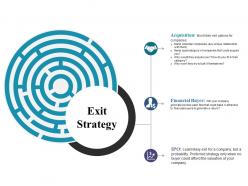
Planning to create an innovative presentation design for your next business presentation. If yes then use our exit strategy PPT examples presentation design. This wonderful slide show comes with the graphic of a maze visual along with icons and text boxes. To show the business data, you need to ensure that you are showing it in the best possible way. Giving importance to facts and figures you show in the slide is crucial as your team needs to understand the significance of these facts. Apart from this, these PPT visuals are designed by keeping in mind the need for every organization. Moreover, they have time-saving capabilities and are extremely spacious to include vast content under single screen view. Just download this exit strategy presentation graphic, insert it in your presentation and then share it with who so ever you are looking to share with. You may check other presentation slides to find the perfect design for your business presentation. You have seen some of the best places to work. Capture their ethos on our Exit Strategy Ppt Examples.
People who downloaded this PowerPoint presentation also viewed the following :
Exit strategy ppt examples with all 5 slides:
Enable children to indulge in their favourite games with our Exit Strategy Ppt Examples. Give them a gift of joy.




FAQs for Exit
Key components include clear valuation metrics, financial documentation, legal compliance, timing optimization, and stakeholder alignment. These elements work together by establishing market readiness, demonstrating growth potential, and ensuring regulatory adherence, with many successful startups finding that strategic preparation and professional advisory support ultimately deliver higher acquisition values and smoother transitions.
Business owners can determine optimal exit timing by evaluating market conditions, financial performance, industry trends, personal readiness, and strategic positioning within their sector. While factors like peak valuations, strong operational metrics, and favorable buyer markets signal opportunity, owners must also consider their long-term goals, succession planning readiness, and whether the business can sustain growth without their direct involvement, ultimately balancing market timing with personal and strategic objectives.
Key valuation factors include financial performance, market position, growth potential, asset quality, and industry multiples. Strategic buyers often pay premiums for synergies, operational efficiencies, and market expansion opportunities, while financial buyers focus on cash flow predictability and scalability, ultimately determining whether the exit delivers maximum shareholder value and competitive positioning.
Different exit strategies create distinct stakeholder impacts, with acquisitions typically offering immediate liquidity but potentially limiting employee autonomy, IPOs providing public market access while introducing regulatory compliance burdens, and mergers delivering strategic synergies alongside cultural integration challenges. These approaches vary significantly in timeline, control retention, and financial outcomes, with many organizations finding that employee equity participation, customer relationship continuity, and investor return expectations require careful alignment regardless of the chosen exit path.
Market research plays a crucial role in exit strategy development by identifying optimal timing, target buyers, valuation benchmarks, competitive positioning, and market conditions. Through comprehensive analysis, businesses can assess buyer demand, understand industry consolidation trends, and evaluate strategic acquirers, ultimately enabling informed decisions that maximize exit value and minimize execution risks.
Companies can prepare for smooth exit transitions by establishing clear documentation, training key personnel, maintaining updated financial records, and creating comprehensive operational procedures. Strategic preparation includes succession planning, stakeholder communication protocols, and knowledge transfer systems, with many organizations finding that early preparation significantly reduces transition risks while maximizing valuation and ensuring business continuity.
Legal considerations for exit strategies include due diligence requirements, regulatory compliance, tax implications, contractual obligations, and intellectual property protections. These considerations vary significantly across industries, with healthcare and financial services facing stricter regulatory oversight, while technology companies focus more on IP transfers and employment agreements, ultimately ensuring smoother transactions and minimizing legal risks.
Common pitfalls include inadequate due diligence preparation, unrealistic valuation expectations, poor timing decisions, insufficient legal documentation, and neglecting stakeholder communication throughout the process. These oversights often result in reduced transaction values, extended negotiation periods, and compromised deal structures, with many business owners finding that thorough preparation and professional guidance ultimately deliver smoother transitions and optimized outcomes.
An effective exit strategy significantly impacts employee morale by providing clarity, transparency, and career development opportunities throughout the transition process. When employees understand the strategic vision, succession plans, and their roles in organizational continuity, retention improves substantially, with many companies finding that proactive communication and retention incentives ultimately preserve institutional knowledge and maintain operational stability.
**INPUT**: What financial metrics are crucial for investors when evaluating an exit opportunity? **OUTPUT**: Crucial financial metrics include revenue growth rates, EBITDA margins, return on invested capital, cash flow generation, and market valuation multiples. These metrics enable investors to assess profitability trends, operational efficiency, and competitive positioning, with many finding that strong fundamentals across these areas ultimately deliver higher exit valuations and maximize returns. [Word count: 52 words]
Entrepreneurs should communicate exit strategies transparently during initial investor discussions, regular board meetings, and strategic team updates, emphasizing timeline expectations, valuation targets, and stakeholder benefits. Through clear documentation and phased discussions, leadership teams enable smoother transitions, maintain investor confidence, and preserve team morale, with many organizations finding that early transparency ultimately delivers stronger valuations and competitive positioning.
A contingency plan within an exit strategy provides essential backup options when primary exit routes face unexpected obstacles, market downturns, or buyer complications. This strategic preparation enables business owners to pivot quickly between sale processes, IPO timing, or succession plans, ultimately protecting company valuation and ensuring smoother transitions regardless of economic conditions.
An exit strategy significantly shapes a company's long-term business model by driving decisions around scalability, operational efficiency, and market positioning to maximize valuation. Companies planning IPOs focus on revenue growth and transparency, while those targeting acquisitions emphasize strategic partnerships and streamlined operations, ultimately aligning daily operations with future transition goals and investor expectations.
Due diligence serves as the comprehensive evaluation process that validates a company's financial, legal, and operational health during exit transactions, covering areas like financial records, intellectual property, contracts, and regulatory compliance. This thorough assessment enables buyers to make informed decisions while helping sellers identify and address potential issues beforehand, ultimately streamlining negotiations and maximizing transaction value.
Presenting a clear exit strategy demonstrates strategic planning and provides investors with transparency about potential returns and timelines, reducing perceived risk while building confidence. This approach enhances investor relations by showing management's commitment to delivering value through IPOs, acquisitions, or strategic partnerships, ultimately facilitating fundraising discussions and enabling faster investment decisions across venture capital and private equity sectors.
-
Great designs, really helpful.
-
Nice and innovative design.