


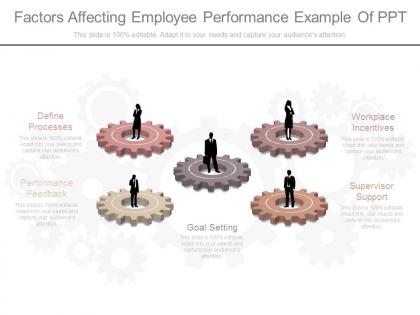
Factors affecting employee performance example of ppt




Try Before you Buy Download Free Sample Product
 Impress Your
 Audience
 100%
100% Editable
 Save Hours
 of Time


Our Factors Affecting Employee Performance Example Of Ppt have great carrying capacity. They can handle a heavy burden.
People who downloaded this PowerPoint presentation also viewed the following :
Factors affecting employee performance example of ppt with all 7 slides:
Forward is the way to go with our Factors Affecting Employee Performance Example Of Ppt. Your career will never look back.


FAQs for Factors affecting employee performance
Key performance metrics include goal achievement rates, quality of work output, productivity measurements, customer satisfaction scores, and peer collaboration effectiveness. These metrics enable organizations to assess individual contributions comprehensively, with many companies finding that combining quantitative data with qualitative feedback streamlines performance reviews while delivering more accurate evaluations and strategic talent development insights.
Employee engagement influences performance outcomes by fostering higher productivity, reducing turnover rates, and improving service quality through increased motivation and commitment. Engaged employees deliver superior customer experiences, drive innovation within their roles, and contribute to stronger team collaboration, with many organizations finding that engagement initiatives ultimately enhance operational efficiency and competitive advantage.
Feedback serves as a critical performance catalyst by providing clear direction, identifying skill gaps, recognizing achievements, and establishing improvement pathways. Through regular performance reviews and real-time coaching, organizations in sectors like retail and healthcare enhance employee engagement, accelerate professional development, and ultimately deliver improved productivity and retention rates.
Goal-setting frameworks enhance individual performance by providing clear direction, measurable objectives, and structured accountability systems that align personal efforts with organizational priorities. Through methodologies like OKRs and SMART goals, employees experience increased motivation, better time management, and enhanced focus on high-impact activities, ultimately delivering improved productivity and career advancement opportunities.
Organizations can implement merit-based bonuses, public recognition programs, career advancement opportunities, flexible work arrangements, and personalized development plans to reward high performers. These strategies enhance employee engagement and retention by acknowledging individual contributions, while many companies find that combining monetary and non-monetary incentives ultimately drives sustained performance and competitive advantage.
Workplace culture and environment significantly impact employee productivity by influencing engagement levels, collaboration patterns, and overall job satisfaction. Organizations with positive, supportive cultures see enhanced communication, reduced turnover, and streamlined workflows, with many companies finding that investing in collaborative spaces and inclusive practices ultimately delivers higher output and competitive advantage.
Professional development significantly enhances employee performance by expanding skill sets, increasing job satisfaction, and improving productivity levels. Through targeted training programs, mentorship opportunities, and continuous learning initiatives, organizations enable employees to deliver higher-quality work, adapt to evolving market demands, and contribute more strategically, ultimately driving competitive advantage and operational efficiency.
Effective communication enhances team performance by fostering clarity in goals and expectations, reducing misunderstandings, and enabling seamless collaboration across departments and projects. Through regular feedback loops and transparent information sharing, organizations streamline decision-making processes, accelerate project timelines, and ultimately deliver improved productivity and employee engagement across all operational levels.
Psychological factors influencing employee motivation and performance include recognition and appreciation, sense of autonomy and control, clear goal setting, psychological safety, and opportunities for growth and development. These factors enhance workplace engagement by boosting confidence, reducing stress, and fostering intrinsic motivation, with many organizations finding that addressing psychological needs ultimately delivers higher productivity and employee retention.
Diversity and inclusion enhance team performance by fostering varied perspectives, improving problem-solving capabilities, reducing groupthink, and increasing innovation through different cultural backgrounds and experiences. These approaches streamline decision-making processes while enhancing creativity, with many organizations finding that diverse teams deliver superior financial results, faster product development, and better customer understanding, ultimately providing significant competitive advantage.
Technology streamlines performance evaluation through automated data collection, real-time feedback platforms, AI-powered analytics, digital goal tracking, and integrated communication systems. These tools enhance accuracy by eliminating manual errors, accelerating review cycles, and providing comprehensive performance insights, with many organizations finding that automated evaluations deliver more objective assessments and significantly improved operational efficiency.
Best practices for conducting performance reviews include setting clear expectations, gathering 360-degree feedback, focusing on specific examples, creating development plans, and maintaining regular check-ins throughout the year. These approaches enhance employee engagement by providing transparent communication, actionable insights, and growth opportunities, with many organizations finding that structured review processes ultimately deliver improved retention and productivity.
Work-life balance and flexibility significantly enhance employee performance by reducing burnout, increasing job satisfaction, and improving focus during productive hours. Organizations offering remote work options, flexible schedules, and wellness programs typically experience higher retention rates, reduced absenteeism, and increased productivity, with many companies finding that balanced employees deliver more innovative solutions.
Leadership style significantly impacts team performance through communication approaches, decision-making processes, motivation techniques, and feedback mechanisms that directly influence productivity and engagement. Transformational leaders in organizations like tech startups and manufacturing companies often see improved collaboration, innovation, and retention rates, while autocratic approaches may deliver faster short-term results but potentially reduce long-term team morale and creativity.
Peer assessments contribute to holistic employee performance evaluation by capturing collaboration skills, teamwork effectiveness, communication abilities, and day-to-day work behaviors that managers may not directly observe. These multi-perspective evaluations provide insights into how employees interact with colleagues, support team goals, and contribute to workplace culture, ultimately delivering more comprehensive performance data and enabling organizations to make better-informed decisions about development, recognition, and career advancement opportunities.
-
Helpful product design for delivering presentation.
-
Excellent work done on template design and graphics.