


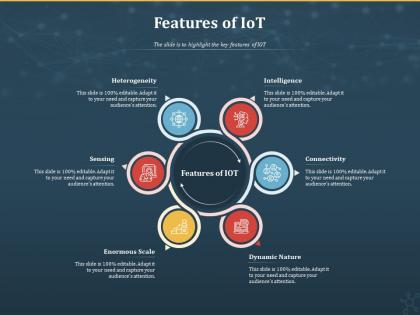
Features of iot internet of things iot ppt powerpoint presentation styles microsoft




Try Before you Buy Download Free Sample Product
 Impress Your
 Audience
 100%
100% Editable
 Save Hours
 of Time


The slide is to highlight the key features of IOT.
People who downloaded this PowerPoint presentation also viewed the following :
Features of iot internet of things iot ppt powerpoint presentation styles microsoft with all 2 slides:
Use our Features Of IoT Internet Of Things IOT Ppt Powerpoint Presentation Styles Microsoft to effectively help you save your valuable time. They are readymade to fit into any presentation structure.

FAQs for Features of iot internet of things iot ppt powerpoint
Honestly? Real-time dashboards are your best bet - people love seeing live data they can actually click around in. Heat maps are perfect for IoT stuff since they're super visual and executives get them instantly. I always tell people to focus on business impact, not the technical weirdness that we find fascinating. Before/after comparisons are clutch for showing ROI. Oh, and don't dump every single metric on them at once - pick a solid use case first, then build your story around that. Charts should support what you're saying, not overwhelm everyone in the room.
Honestly, storytelling is a game changer for IoT stuff. Picture this - instead of boring people with "sensors collect data," you tell them about Sarah getting a text that her elderly mom hasn't opened the fridge all day. That hits different, right? Our brains just work better with characters and actual problems than tech jargon. I always walk people through someone's whole day first - show what sucks, then how IoT fixes it. Try starting with "What if..." next time. Trust me, you'll see way more lightbulbs going off in the room.
Dude, visuals are seriously clutch for IoT stuff. People's eyes glaze over the second you mention sensor networks - I've seen it happen so many times. Network diagrams actually show how devices talk to each other instead of just describing it. Flowcharts make data processing way less abstract. And dashboards? They're perfect for showing real results that stakeholders can actually get excited about. I mean, nobody wants to sit through another boring tech presentation where they're totally lost. Make it visual and suddenly everyone's following along. Trust me on this one.
Dude, you gotta read the room completely differently each time. Executives? Hit them with ROI and market opportunities - they don't care about your tech stack. Engineers are the opposite though, they want all the nitty-gritty architecture stuff. Sales people need those competitive angles they can actually use in pitches. And end users just want to know how it fixes their annoying daily problems without any jargon. I bombed this so many times watching people's eyes glaze over in meetings. Now I always think: what's this group actually stressed about? What matters to them? Makes such a difference.
Start with stuff they actually know - like when Ring cameras get hacked or their Alexa starts acting weird. Real examples hit way harder than just rattling off threat types. Show actual dollar amounts from breaches, not just "it could be bad." For solutions, skip the crypto jargon - nobody cares about encryption details when they're trying to secure their factory floor. I do this thing where I ask "who's got smart home stuff?" and literally everyone raises their hand. Makes the whole thing click. Oh, and give them something useful they can walk away with - like a checklist they'll actually screenshot. People love that stuff.
Dude, interactive stuff is a game changer for IoT presentations. People need to *see* the tech working, not just hear you talk about it. Live demos work great - or even just showing a dashboard updating in real-time. I've watched so many presenters bomb when they just describe sensor data (honestly kinda painful to watch). But the second you show actual data flowing? Everyone perks up. Polls help too. Break up your heavy technical stuff every 5-7 minutes with something hands-on. Your audience will actually remember the concepts instead of zoning out.
Honestly, live demos are the way to go - get some temperature sensors or motion detectors that people can actually mess with during your presentation. Split screen works great so they see the physical thing AND the dashboard updating. Always have a backup video though because IoT will absolutely screw you over when it matters most (learned that one the hard way). The interactive stuff is gold - when people can wave their hand and watch the data change, that's when they really get it. Oh and test your wifi twice, maybe three times. Nothing worse than dead air while you're frantically trying to reconnect.
Make a comparison chart showing the main stuff - scalability, security, pricing, integrations. Way easier to scan than reading paragraphs. Pick 3-4 things that actually matter for your situation and rate each platform against those. I always cringe when people just go through each option separately because nobody remembers all that info. Oh, and throw in some real examples if you've got them. Your audience will definitely appreciate not having to decode a million bullet points. Trust me, a clear scoring system beats feature overload every time.
Honestly, live demos are super engaging - people love seeing IoT stuff work in real time. But tech has this magical ability to break right when you're presenting lol. Slides are way safer since you control everything and can show perfect data without worrying about wifi dying. My vote? Do mostly slides for background stuff, then a quick live demo of your main features. Maybe 70/30 split. Oh and definitely record a backup video of your demo working perfectly beforehand. I learned that the hard way when my sensor decided to have an attitude during a big presentation.
Okay so presentation software actually matters way more than you'd think for IoT demos. PowerPoint tends to choke when you're running real-time dashboards or sensor animations - super annoying. I'd go with Prezi or Google Slides instead, they handle multimedia better. Cloud-based is definitely the way to go since you can update live data without dealing with file versions everywhere. Oh, and definitely test everything with actual data streams first. Nothing worse than your integration diagrams freezing up mid-pitch when you're trying to show how everything connects.
Ditch the jargon and use normal comparisons - sensors become "digital eyes and ears" instead of fancy tech terms. Always spell out acronyms first. Break complicated stuff into bullet points because nobody wants to decode paragraphs of technical mumbo jumbo. Real examples beat abstract explanations every time. Honestly, specs are boring unless you absolutely need them. Test your explanation on your non-techie friends first - if they're glazing over, you're still being too complex. The whole point is making people understand, not showing off how smart you sound.
Don't just stick all your case studies at the end - spread them out! I'd start with a problem everyone gets, then boom - show how IoT fixed it. John Deere's sensor stuff for farming is solid, or hospitals tracking their equipment. Before/after examples work great because people can actually picture the difference. Break down what tech made it happen (sensors, data, whatever) and connect it back to your main points. Honestly, skip the boring Fortune 500 stuff unless your audience is into that. Find 2-3 cases they'll actually care about and go deep instead of rushing through a million examples.
Dude, make it demo-heavy - investors need to see your IoT thing actually working, not just slides. Start with the problem, then boom, live demo right away. I've watched so many IoT pitches crash because they dove into technical specs instead of showing market traction. Architecture slides? Keep them light but ready for questions. Here's what really matters though - your data advantage and network effects. That's how you stay competitive. Oh, and definitely have a backup demo video ready because Murphy's Law hits hardest during investor meetings. Trust me on that one.
Watch people during your presentation - are they nodding and taking notes? Good questions mean they're engaged, but if they're asking super vague stuff, you've probably lost them. Surveys are okay but everyone just picks 7 anyway lol. The real measure is what happens after. Do they actually use what you taught them? Two weeks later, shoot them a quick message asking what they remember. That's honestly the only way to know if it stuck. Also check if they bring up your points in other meetings - that's when you know you nailed it.
Honestly, the worst thing you can do is jump straight into protocols and technical stuff - people's eyes glaze over immediately. Lead with why they should care and what problems it solves. Half the executives I've met don't even know what IoT stands for, so don't assume anything. Skip the boring "smart homes" examples too. Instead, find specific pain points they actually deal with in their industry. Oh, and focus on business results, not how cool the tech is. Start simple with relatable examples, then gradually get more technical once they're hooked. Works way better.
-
Editable templates with innovative design and color combination.
-
The Designed Graphic are very professional and classic.