


Challenges of iot internet of things iot ppt powerpoint presentation pictures slides




Try Before you Buy Download Free Sample Product
 Impress Your
 Audience
 100%
100% Editable
 Save Hours
 of Time


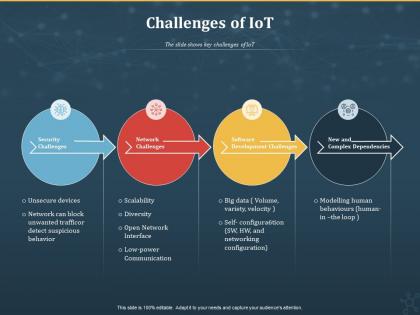
The slide shows key challenges of IoT.
People who downloaded this PowerPoint presentation also viewed the following :
Challenges of iot internet of things iot ppt powerpoint presentation pictures slides with all 2 slides:
Use our Challenges Of IoT Internet Of Things IOT Ppt Powerpoint Presentation Pictures Slides to effectively help you save your valuable time. They are readymade to fit into any presentation structure.
FAQs for Challenges of iot internet of things iot ppt powerpoint
First things first - change those default passwords right away, seriously half these devices ship with "admin123" or whatever. Update your firmware regularly and turn on two-factor authentication anywhere you can. Here's what most people don't do but should: put all your smart stuff on its own network, separate from your main wifi. It's honestly such a simple fix but makes a huge difference. Also grab some network monitoring tools to spot weird activity early. Oh and make sure everything's encrypted when it sends data around. Quick weekend project - just figure out what you actually have connected first, then update all that stuff that's been sitting there forever.
Oh man, privacy issues will kill your IoT app faster than anything else. People are already paranoid about smart speakers listening in or their Fitbit selling health info to insurance companies - can't really blame them tbh. Once users start doubting what you're doing with their data, you're basically done. Nobody wants their personal stuff getting breached or shared without permission. Your best bet? Just be super upfront about what data you're collecting and why. Give people actual control over their settings right from the start, not buried in some menu they'll never find.
Ugh, IoT compatibility is such a pain. Basically you've got devices that can't talk to each other because they use different protocols - WiFi, Zigbee, LoRaWAN, whatever. It's honestly like everyone's speaking different languages at the same party. Plus every manufacturer formats their data differently, which makes everything worse. I learned this the hard way on my last project. Your best move? Set up middleware solutions from day one and try to stick with vendors who actually use open standards. Trust me on this one.
Ugh, scaling IoT is such a pain. When you're talking thousands or millions of devices, your network just dies under all that data. Bandwidth gets crushed, processing can't keep up, and don't even get me started on storage issues. Firmware updates across that many devices? Total headache. The thing is, most cloud setups weren't built for this kind of volume - honestly feels like trying to fit a fire hose through a straw sometimes. You'll see crazy latency and crashes. My advice? Start with edge computing and distributed processing right away instead of scrambling to fix it later.
So edge computing is basically processing data right next to your IoT devices instead of shipping everything off to some cloud server miles away. Your smart factory sensors need instant responses - can't wait around for that 100-200ms cloud delay. Edge nodes handle stuff locally, we're talking milliseconds here. Game changer for real-time apps, honestly. I dealt with this at my last job and the difference is wild. For your IoT setup, figure out which processing tasks you can move to edge infrastructure closest to your devices. You'll see the speed boost immediately.
Start with encryption - both for data moving around and stored data. That's like your baseline security. Then add checksums or digital signatures so you'll know if someone messed with your data during transmission. Real-time monitoring helps you catch weird stuff happening right away. Oh, and don't forget firmware updates - I know they're annoying but they matter. Secure communication protocols are pretty much mandatory too. Honestly, if you're just getting started, focus on encrypting your most critical data streams first. That'll give you the most protection without going completely insane trying to do everything at once.
Yeah, those little IoT gadgets are sneaky energy vampires - they're constantly sipping power even when you think they're "off." My smart doorbell probably uses more juice than I realized until I saw my electric bill lol. But honestly, some of them actually help cut energy waste. Smart thermostats are clutch for this. Same with those lighting systems that learn your schedule. I'd say pick the ones that'll save you more than they cost to run. Skip the random "smart" stuff that's just flashy but doesn't really do much for efficiency.
So basically, ML lets your IoT stuff actually think instead of just sitting there collecting data. Your smart thermostat figures out when you're home without you teaching it anything - which honestly blew my mind when I first got one. These devices can spot problems before they break and predict when they'll need fixing. Real-time analysis means better energy savings and way less downtime. The personalization is pretty sweet too. I'd say grab something simple that already has ML baked in and just mess around with it. You'll get it once you see how it adapts to your habits.
Dude, IoT costs are brutal - hardware's just the beginning. Monthly data fees will kill your budget, trust me. Then there's cloud storage, security software, maintenance... it never ends. You'll definitely need IT people to babysit everything, which isn't cheap. Here's the kicker though - scaling gets crazy expensive fast. Like, way more than you'd expect per device. Honestly? Test it small first. Pick maybe 10-20 devices, see what you're actually spending monthly, then decide if you can stomach a bigger rollout. Way better than diving in blind.
Dude, basically these regulations make developers bake privacy and security right into their IoT stuff instead of slapping it on later. GDPR makes you get real consent before grabbing people's data. FDA has crazy hoops for medical devices. It's annoying but honestly pushes everyone to not suck at this stuff. Can't meet the rules? You're totally locked out of entire markets. Oh and compliance retrofitting will absolutely murder your budget - I've seen it happen. Build it in from day one or you'll hate yourself later. Trust me on this one.
Okay so three things have worked for me with IoT data madness. Edge computing is huge - process stuff right on the devices instead of dumping everything into the cloud. Second, filter and aggregate at the source so you're not drowning in useless data. Real-time analytics helps tons here. Also do tiered storage - keep recent data accessible and shove old stuff into cheap archives. Honestly though, start by checking what you actually use versus what you collect. I bet half of it's just junk data nobody looks at anyway.
Honestly, cultural differences are a nightmare for IoT rollouts. Privacy expectations are all over the map - Asians generally don't mind surveillance devices, Europeans freak out over data collection (thanks GDPR), and Americans just want stuff that works easily. Even UI preferences can tank your product if you get them wrong. Religious norms matter too, like what's actually acceptable in people's homes. Oh, and social attitudes vary tons between regions. My advice? Don't assume what works in one market will fly elsewhere. Research local attitudes first and tweak your privacy messaging for each region.
Ugh, consent and privacy compliance are the worst part. GDPR and CCPA require explicit permission before you collect personal data, but most IoT devices vacuum up way more info than people think - location, usage patterns, you name it. If you can't prove users actually agreed to all that? You're screwed. Plus there's data breach notifications, cross-border transfer rules, and the fun possibility of getting sued if something goes wrong. Oh, and don't even get me started on trying to retrofit privacy compliance after launch. Get lawyers involved during design phase, trust me on this one.
Dude, get your processes sorted from the start - onboarding, updates, monitoring, the whole thing. Most companies just wing it and then hate themselves later when they're drowning in devices. Get a central platform that tracks everything - status, patches, performance stuff. Set up automated updates (trust me on this one), watch for weird behavior, and actually plan when you'll replace things before they become giant security holes. Oh and document everything now, even if you only have like 10 devices. Future you will be so grateful when you're dealing with thousands.
Oh man, IoT testing is such a pain compared to regular software. You're dealing with tons of different devices that all have random specs, plus sketchy network conditions everywhere. I'd start with a basic test matrix covering your main device-network-cloud combos, then build out from there. Security testing is huge - definitely do penetration tests. Also test how everything handles crappy connectivity because that's real life. Battery drain testing too, obviously. The end-to-end data flow stuff can get messy but you gotta validate it all works together. It's way more complex than people think.
-
Very unique and reliable designs.
-
Informative design.
-
Perfect template with attractive color combination.
-
Best Representation of topics, really appreciable.