


Financial Job Family Matrix With Pay Structure




Try Before you Buy Download Free Sample Product
 Impress Your
 Audience
 100%
100% Editable
 Save Hours
 of Time


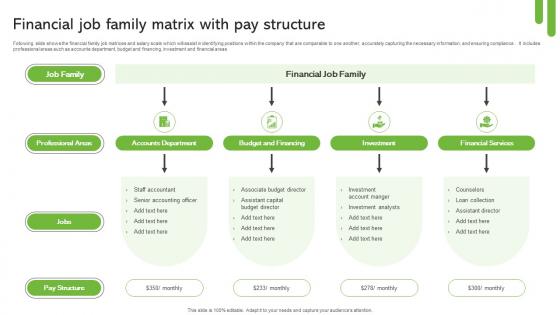
Following slide shows the financial family job matrices and salary scale which will assist in identifying positions within the company that are comparable to one another, accurately capturing the necessary information, and ensuring compliance . It includes professional areas such as accounts department, budget and financing, investment and financial areas.
People who downloaded this PowerPoint presentation also viewed the following :
Financial Job Family Matrix With Pay Structure with all 6 slides:
Use our Financial Job Family Matrix With Pay Structure to effectively help you save your valuable time. They are readymade to fit into any presentation structure.





FAQs for Financial Job Family Matrix
So the Financial Job Family Matrix has pretty much every finance role you can think of - Financial Analysts, Senior Analysts, Finance Managers, Directors, VPs. Plus all the specialized stuff like Budget Analysts, FP&A, Treasury, Tax people. Goes from entry-level all the way up to C-suite. What's actually useful about it is how it maps out progression paths between roles and shows you what skills you need for each level. Honestly, the competency breakdowns are pretty detailed. I'd definitely compare your current role to see what gaps you might have for moving up - it's like a roadmap for your next promotion.
So you basically figure out what your company actually needs to hit this year - growth stuff, cutting costs, whatever. Then work backwards to see which finance roles directly help those goals. Map each position to specific KPIs that actually matter. The matrix shows you where you're missing skills or need to move people around. Like if you're going international, you'll want more FP&A people who know regional markets instead of just basic accounting. Honestly, most companies skip this step and wonder why their finance team feels disconnected. Check it quarterly and shift things as needed.
Honestly, it depends on what level you're targeting, but there's definitely some overlap. You'll need the basics like financial analysis and budgeting no matter what. Communication gets way more critical once you hit senior roles - suddenly you're in front of executives all the time. Problem-solving and being detail-oriented? Non-negotiable across the board. Strategic thinking really ramps up around manager level. Some specialties like treasury or compliance care more about risk management stuff. Oh, and systems proficiency is pretty much expected everywhere now. I'd dig into the specific competency matrix for whatever role you want since they break down must-haves versus nice-to-haves.
So basically the Matrix shows you exactly what skills you need to climb up in finance - no more guessing what your boss actually wants from you. You can spot your weak areas and figure out what training to get. Managers use it to find people with potential too. Everything's standardized so you won't get mixed signals from different supervisors, which honestly is such a relief. I'd look at where you are now versus the matrix and pick maybe 2-3 things to work on. Way better than just hoping someone notices your hard work.
Start with a basic skills inventory - that's honestly the easiest way to get going. Competency assessments and skills gap analyses work well for mapping people against your Financial Job Family matrix. Role benchmarking tools are pretty solid too since they let you compare what people actually do versus the standard job descriptions. 360-degree feedback is where you'll get the real gold though - gives you the whole picture of performance gaps. Oh, and don't forget career progression mapping tools for spotting development opportunities. Performance evaluations help round everything out. Build it step by step from there.
Honestly, I'd use the matrix like a talent inventory - map out what skills and experience you actually need, then see how your current team stacks up. You'll probably find some weird gaps, like too many junior people but no senior expertise, or maybe you're missing specialists in areas like compliance (which is always a pain to hire for). It's also super helpful for budgeting since each level has different salary ranges. I'd start by just auditing who you have now against the matrix. Trust me, you'll find surprises about where the real gaps are hiding.
Do quarterly benchmarks against industry surveys - Radford or McLagan have solid data. Your recruitment team is gold here since they're seeing what's actually happening in real-time during interviews. Finance moves crazy fast now with all the fintech stuff shaking things up! Set alerts for big market shifts and work with HR to track competitor pay. Schedule these reviews ahead of time instead of waiting until people start jumping ship. Short sentences help. Also create feedback loops so you're not just reacting to problems. Make it systematic and you won't be scrambling later when talent walks.
So most companies just tweak the basic framework to fit their industry. Healthcare orgs usually beef up compliance and cost accounting since they're drowning in regulations. Tech companies go heavy on FP&A and strategic stuff. Banking's obviously its own beast with all those specialized roles you won't find anywhere else. Manufacturing sometimes adds extra senior analyst levels because their operations get crazy complicated - honestly makes sense when you think about it. Best bet? Look at how 2-3 companies in your space handle it. You'll spot the patterns pretty quickly and see what actually matters for your sector.
So basically this matrix gives you super clear guidelines for what each finance role actually needs - skills, experience, all that stuff. No more random job descriptions that don't make sense. Honestly, the bias reduction alone makes it worth using. You're comparing everyone against the same standards instead of just going with your gut (which let's be real, we all do sometimes). Hiring moves way faster too since you know exactly what boxes need checking. I'd definitely use it for everything - posting the job, interviews, the whole process. Makes life so much easier.
Track your goal achievement rates and skill assessments first - those are your bread and butter metrics. Employee satisfaction scores matter too, especially for each matrix position. I'd also look at promotion readiness since that shows if people are actually growing like you planned. Productivity measures and retention rates will tell you a lot. Don't forget to survey folks about role clarity though - confused employees are basically dead weight. Start with baseline measurements for current roles, then check quarterly progress. Honestly, if people don't know what they're supposed to be doing, nothing else really matters.
Honestly? Finance leaders will be your biggest pain point - they're convinced their roles are way too special for any standard framework. And look, sometimes they're not totally wrong. Getting decent data from different departments is brutal too, like everyone suddenly becomes terrible at explaining what they actually do. Oh, and don't even get me started on maintenance - finance roles change constantly with new regulations and tech stuff. My advice? Start with just the basic core roles first. Once you can show it actually works instead of being another useless HR project, then you can expand from there.
So it's basically like a roadmap showing what skills each finance role actually needs. You compare that against what your people currently have, and the gaps just jump out at you. Pretty straightforward honestly. It breaks down everything - technical stuff like financial modeling, plus the softer skills like leadership and communication. Way better than just saying "our analysts suck" you know? Then you can figure out which gaps matter most and actually train people on stuff that'll help, instead of wasting time on random workshops that nobody remembers anyway.
Dude, the whole Financial Job Family Matrix thing is getting turned upside down by tech. Finance roles now need skills like Python and Tableau - stuff that didn't even exist in finance five years ago, which is honestly kind of crazy when you think about it. New hybrid positions keep popping up that mix finance with IT and operations. Your job descriptions probably look outdated already. The matrix has to be way more flexible now. I'd say review role definitions every quarter or you'll fall behind fast. These changes aren't slowing down anytime soon.
Honestly, having that matrix makes compliance so much cleaner because everyone knows their exact responsibilities. No more finger-pointing when something goes wrong. You can assign specific risk controls to the right people at the right levels, which auditors absolutely love to see. Plus it really cuts down on operational risk since you've got clear segregation of duties built in. I'd start by checking your current team setup against the matrix - you'll probably find some coverage gaps you didn't even know existed. Makes demonstrating controls to regulators way less stressful too.
Honestly, start by explaining what this matrix thing actually is - nobody likes surprises at work. Train your managers first so they're not caught off guard when people have questions. Rolling it out everywhere at once sounds like a nightmare, so maybe pilot it with one team? That way you can fix the inevitable problems before they blow up company-wide. Connect it directly to promotions and raises or people will think it's just busy work. Oh, and ask for feedback constantly - your team will catch stuff you totally missed. Trust me on that one.
-
The templates are easy to get, and the chat customer support is excellent.
-
Amazing product with appealing content and design.