

Financial Planning And Budget Variance Analysis Table




Try Before you Buy Download Free Sample Product
 Impress Your
 Audience
 100%
100% Editable
 Save Hours
 of Time


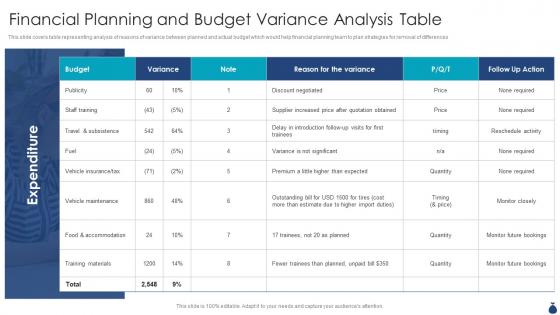
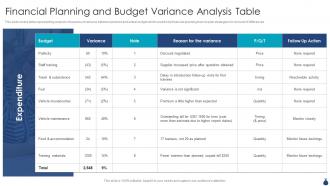
This slide covers table representing analysis of reasons of variance between planned and actual budget which would help financial planning team to plan strategies for removal of differences
People who downloaded this PowerPoint presentation also viewed the following :
Financial Planning And Budget Variance Analysis Table with all 6 slides:
Use our Financial Planning And Budget Variance Analysis Table to effectively help you save your valuable time. They are readymade to fit into any presentation structure.





FAQs for Financial Planning And Budget
A comprehensive financial plan includes budgeting and cash flow analysis, investment strategies, retirement planning, insurance coverage, tax optimization, and estate planning. These components work together by providing financial security, maximizing wealth accumulation, and minimizing risks, with many organizations and individuals finding that strategic integration ultimately delivers long-term stability and competitive advantage.
Individual financial goals serve as the foundation for all planning decisions, influencing asset allocation, risk tolerance, investment timelines, and savings strategies throughout the process. These personalized objectives enable financial advisors to create tailored portfolios and strategic approaches, with clients pursuing homeownership, retirement, or education funding finding that goal-specific planning ultimately delivers more focused outcomes and measurable progress.
Personal financial planning tools include budgeting apps like Mint and YNAB, investment platforms such as Personal Capital and Betterment, retirement calculators, expense trackers, and comprehensive software like Quicken. These technologies streamline financial management by automating expense categorization, providing real-time portfolio analysis, and delivering personalized investment recommendations, ultimately enabling individuals to optimize their financial strategies and achieve long-term wealth-building goals more efficiently.
Budgeting techniques significantly enhance long-term financial health by establishing spending discipline, enabling systematic savings, and creating investment opportunities for wealth building. Through strategic allocation methods, individuals and businesses streamline cash flow management, minimize unnecessary expenses, and accelerate goal achievement, with many finding that consistent budgeting practices ultimately deliver financial stability and competitive positioning.
Risk assessment serves as the foundation of effective financial planning by evaluating potential market volatility, inflation impacts, liquidity needs, and investment uncertainties that could affect long-term goals. Through comprehensive risk analysis, financial advisors and institutions can develop diversified portfolios, establish appropriate emergency reserves, and create adaptive strategies, ultimately delivering more resilient financial outcomes and enhanced client confidence in an increasingly volatile economic landscape.
Retirement planning is crucial for maintaining financial security and independence in later years, requiring consideration of inflation, healthcare costs, desired lifestyle, and investment timeframes. Through strategic asset allocation and compound growth, individuals can build substantial nest eggs, with many finding that starting early and maximizing employer contributions significantly enhances their long-term financial outcomes.
Effective debt management strategies include creating comprehensive repayment plans, consolidating high-interest debts, negotiating payment terms with creditors, prioritizing debts by interest rates, and establishing emergency funds to prevent additional borrowing. These approaches streamline financial obligations by reducing monthly payments, minimizing interest costs, and improving cash flow, with many individuals and businesses finding that strategic debt restructuring ultimately delivers greater financial stability and accelerated wealth building.
Market conditions significantly affect financial planning decisions by altering investment strategies, risk assessments, and asset allocation approaches, requiring continuous portfolio adjustments and timeline modifications. During volatile periods, financial advisors help clients rebalance portfolios, diversify investments, and adjust savings goals, with many finding that flexible planning strategies ultimately deliver better long-term outcomes and financial resilience.
An emergency fund provides financial security by covering unexpected expenses like medical bills, job loss, or major repairs without disrupting long-term investments or accumulating debt. This strategic reserve typically covering three to six months of expenses enables individuals and families to maintain financial stability during crises, ultimately protecting their broader financial goals and delivering peace of mind in an increasingly uncertain economic landscape.
Tax planning enhances overall financial strategy by optimizing deductions, timing income recognition, and leveraging tax-advantaged accounts to minimize liabilities while maximizing wealth accumulation. Through strategic approaches like retirement contributions, investment timing, and business expense optimization, individuals and organizations streamline their financial efficiency, ultimately delivering enhanced cash flow and accelerated long-term wealth building in an increasingly complex tax landscape.
Working with a certified financial planner delivers comprehensive investment strategies, personalized retirement planning, tax optimization, risk management, and estate planning guidance. These professionals streamline complex financial decisions by analyzing your complete financial picture, identifying growth opportunities, and creating actionable roadmaps, ultimately enabling families and individuals to achieve long-term wealth building and financial security more efficiently.
Investment diversification should balance risk across asset classes, geographic regions, and investment timeframes, incorporating stocks, bonds, real estate, and alternative investments based on individual risk tolerance and goals. Strategic diversification enables investors to minimize portfolio volatility while maximizing growth potential, with many financial advisors recommending regular rebalancing to maintain optimal allocation ratios and capitalize on market opportunities.
Estate planning factors include asset valuation, tax implications, beneficiary designations, healthcare directives, and succession planning strategies. These considerations enable families and business owners to minimize estate taxes, ensure smooth wealth transfers, and protect beneficiaries' interests, with many finding that comprehensive planning ultimately delivers financial security and reduces legal complexities for heirs.
Financial education empowers better decision-making by building understanding of budgeting, investment principles, risk assessment, and long-term planning strategies. Through comprehensive financial literacy programs, individuals and organizations develop skills to evaluate opportunities, minimize costly mistakes, and optimize resource allocation, with many finding that structured education ultimately delivers greater financial stability and competitive advantage in increasingly complex markets.
Common financial planning pitfalls include neglecting emergency funds, underestimating inflation impact, inadequate insurance coverage, emotional investment decisions, and failing to diversify portfolios. These oversights can significantly derail long-term financial goals, with many individuals finding that proactive planning, regular portfolio reviews, and professional guidance ultimately deliver better outcomes and enhanced financial security.
-
“Excellent information with easy access.”
-
Understandable and informative presentation.