

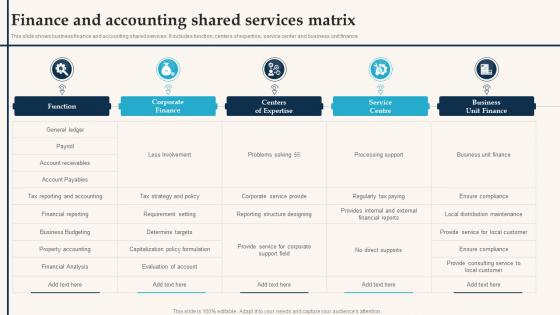
Finance And Accounting Shared Services Matrix




Try Before you Buy Download Free Sample Product
 Impress Your
 Audience
 100%
100% Editable
 Save Hours
 of Time


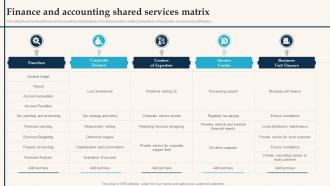
This slide shows business finance and accounting shared services. It includes function, centers of expertise, service center and business unit finance.
People who downloaded this PowerPoint presentation also viewed the following :
Finance And Accounting Shared Services Matrix with all 6 slides:
Use our Finance And Accounting Shared Services Matrix to effectively help you save your valuable time. They are readymade to fit into any presentation structure.





FAQs for Finance And Accounting
Honestly, the money savings alone make it worth it - we're talking 20-30% off your finance ops costs. Everything gets way more standardized too, which sounds boring but actually saves everyone from constant headaches between departments. Your data quality goes through the roof since you're not dealing with ten different systems anymore. Business units can finally focus on real strategy stuff instead of drowning in boring accounting work. Oh, and definitely start with accounts payable and expense management first - they'll give you the fastest payback. Trust me on that one.
So basically, you take all your boring financial stuff - payroll, invoices, accounts payable - and dump it with one specialized team instead of having everyone do their own. Works way better honestly. Processing gets faster, fewer mistakes happen, and your actual teams can focus on their real jobs instead of dealing with expense reports (which nobody enjoys anyway). You get cleaner data too since everything's standardized. Compliance becomes less of a headache. Really though, it just frees people up to work on things that actually matter for growth instead of getting bogged down in paperwork.
Honestly, the toughest part is gonna be your teams fighting you on it - people hate change, especially when they're comfortable with how things work now. Data migration will be a nightmare, no sugar-coating that one. Plus you'll see productivity tank for a while as everyone figures out the new processes. Service quality might slip too while people get trained up. Oh, and communication between different locations? Total mess at first. My advice is pad your timeline way more than you think you need and get ready to babysit everyone through it. First few months are brutal.
Honestly, getting the right tech setup for your shared services is huge. RPA handles all that boring invoice stuff automatically. Cloud platforms let you centralize everything - way easier than juggling multiple locations. The workflow automation is where things get really good though, cuts out all those annoying handoffs between teams. I know companies that slashed processing time by 60% just from fixing their tech stack. Oh and start with whatever processes you do most often - that's your quickest win and you'll actually see results fast enough to keep people interested in the whole digital thing.
Honestly, data analytics is like having x-ray vision for your Finance and Accounting Shared Services. Track your cycle times and error rates first - I swear those two metrics alone will blow your mind with optimization ideas. You can spot process bottlenecks, predict when workloads are gonna spike, and pinpoint exactly where you're wasting time or cash. The crazy part? You're probably already sitting on all this data. Use it to automate routine decisions and catch mistakes before they explode into bigger issues. Plus leadership loves seeing concrete proof of where tech investments actually pay off.
Honestly, shared services help more than hurt with compliance. Centralized controls mean everyone's doing things the same way instead of each department making up their own rules. Auditors actually prefer it since all the records are in one spot - makes their job easier. The shared services team can focus on staying up-to-date on regulations while your other finance people handle day-to-day stuff. Your reporting gets more accurate too. Just make sure you set up solid governance with the team from the start so you actually get these benefits.
Focus on cost per transaction first - that's the big one. Track what each invoice or payment actually costs to process. Month-end close times are solid too, plus accuracy rates and how happy your business units are. Honestly, cycle time improvements will probably be your easiest early wins. FTE reductions and compliance stuff matter, but don't overcomplicate the metrics at the start. Simple beats fancy every time. Get your baseline numbers locked down before you change anything. Then check quarterly - leadership loves seeing that kind of concrete progress.
Honestly, you can't just rely on one thing - gotta stack multiple layers. Multi-factor authentication is absolutely essential (passwords by themselves are basically useless now). Set up proper access controls so only the right people see financial stuff. Encryption for everything - stored data and when it's moving around. Your shared service provider better have SOC 2 compliance too. Regular security audits are huge, maybe quarterly reviews? Oh and data governance policies - that's boring but necessary. I know it sounds like a lot, but hackers are getting way too clever these days.
Start with getting everyone on the same page - same processes across all service lines. Cross-training is huge so people can jump in during busy periods. Role-playing different client situations really builds confidence (sounds cheesy but it works). Your documentation needs to actually be readable, not those terrible corporate binders that collect dust. Pair up new hires with experienced staff for mentoring. Oh, and don't treat training like a one-and-done thing. Finance regulations change constantly, so you'll need ongoing sessions to keep everyone sharp. Regular check-ins help catch problems before they blow up.
So here's the thing - when you integrate finance and accounting, you finally get one clean version of your financial data instead of dealing with conflicting reports from different teams. Game changer, honestly. Your finance people can actually spot trends quickly and find ways to cut costs because they're not wasting time reconciling messy data from everywhere. Real-time insights become possible when you ditch those annoying silos that bog everything down. I'd start by figuring out where all your data currently sits and finding the biggest gaps first. Trust me, decisions get so much easier when you're working with complete info.
So with globalization, you can basically pull talent from anywhere and run multiple regions from one spot. Cost savings are solid if you set up shop somewhere cheaper. Time zones though? Total nightmare to coordinate - learned that the hard way. The real benefit is getting all your financial processes standardized everywhere. You'll be juggling different currencies and tax rules for each country, which gets messy fast. Honestly, don't try to go global all at once. Test it out in maybe two regions first and figure out what breaks before expanding further.
Don't try to force everything into one process - that's a recipe for disaster. Build your standards to handle the easy stuff (maybe 80% of transactions) then create clear escape routes for the weird cases. Map out what you're actually dealing with first though, because people always think their situation is more "special" than it really is. Set up different lanes - automated for routine transactions, human review for the complex ones. The trick is writing down exactly when someone can break the rules and how they do it. Otherwise you'll end up with chaos disguised as flexibility.
Honestly, leadership makes or breaks this whole thing. They're the ones setting vision and getting buy-in from all the different business units. Without them, people just go rogue and keep doing their own thing instead of using shared services. You'll definitely face pushback - departments hate losing "their" resources and all the politics that come with it. Strong leaders can navigate that mess and actually explain why it's worth it. They also invest in proper change management and tech. Here's the thing though - without real executive sponsorship, you're just building another expensive IT project nobody wants. Set up a steering committee with actual decision-making power from day one.
Start by mapping out what you're actually doing now versus what you think you should be doing - that's usually eye-opening. Look for bottlenecks and waste in stuff like your month-end close. Automate the boring repetitive tasks if you can. Those Kaizen brainstorming sessions are actually pretty fun when everyone gets involved. Track simple metrics like how long things take and error rates. The trick is picking ONE process this quarter and just... doing it. Don't try to fix everything at once or you'll burn out. Small changes add up way faster than you'd expect.
Dude, the whole industry's shifting fast. AI's eating up all the boring stuff - invoice processing, reconciliations, you name it. Everything's moving to cloud platforms too, which honestly makes sense. Real-time analytics are everywhere now, and business teams can finally pull their own reports instead of constantly hitting up finance (thank god). Oh, and ESG reporting's become this massive thing, so shared services teams are doing way more than just accounting now. If I were you? Figure out what processes you can automate first. That's where you'll actually see results quickly.
-
Much better than the original! Thanks for the quick turnaround.
-
“I've always gotten excellent slides from them and the customer service is up to the mark.”