Salary Grading Structure With Management Classification

Rating:
90%
Salary Grading Structure With Management Classification
Slide 1 of 6
Favourites Favourites

Try Before you Buy Download Free Sample Product

Audience Impress Your
Audience
Editable 100%
Editable
Time Save Hours
of Time
The Biggest Sale is ending soon in
0
0
:
0
0
:
0
0
Rating:
90%
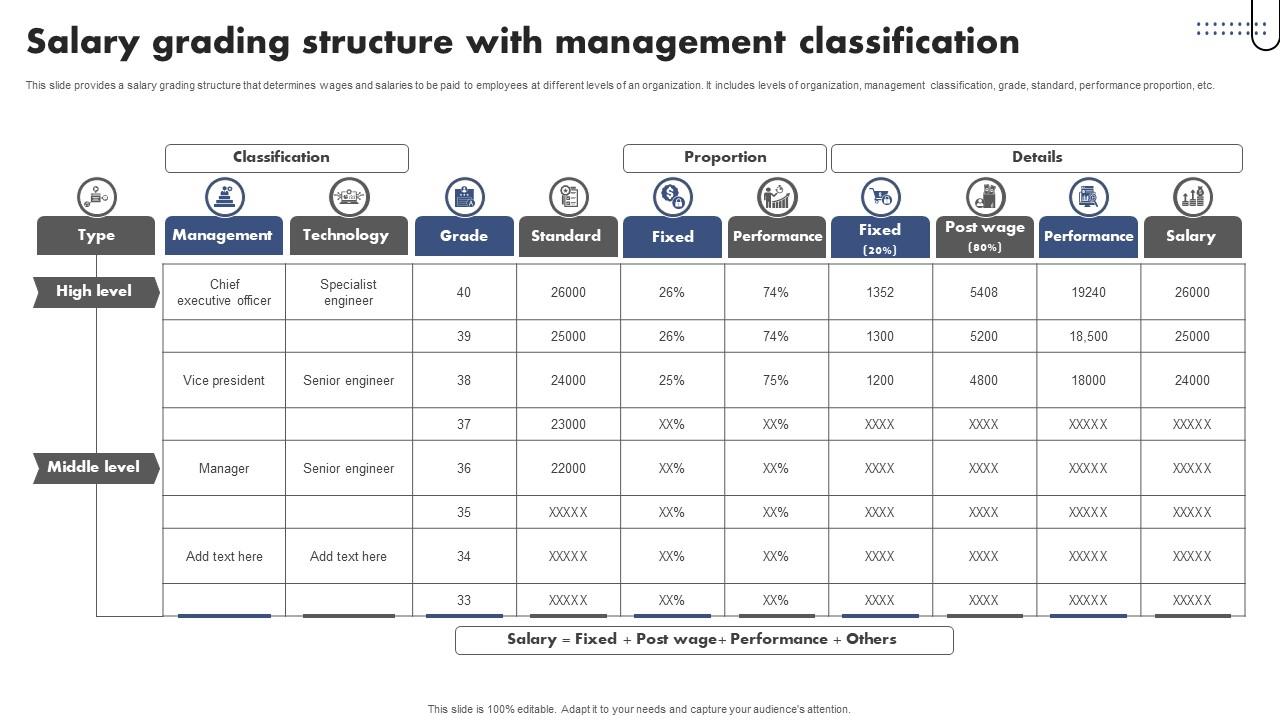
This slide provides a salary grading structure that determines wages and salaries to be paid to employees at different levels of an organization. It includes levels of organization, management classification, grade, standard, performance proportion, etc. Introducing our Salary Grading Structure With Management Classification set of slides. The topics discussed in these slides are Management, Technology, Performance. This is an immediately available PowerPoint presentation that can be conveniently customized. Download it and convince your audience.

People who downloaded this PowerPoint presentation also viewed the following :

FAQs for Salary Grading Structure

So first things first - you gotta evaluate all your current jobs and rank them by how complex they are. Then benchmark against what other companies are paying (this part's honestly kind of a pain but super necessary). Build clear salary bands with ranges for each level. People need to know exactly what it takes to get promoted, otherwise you'll get complaints forever. Markets change pretty quickly these days, so plan on reviewing this stuff regularly. Map what you have now against market data first. Way easier than rebuilding everything from scratch - trust me on that one.

So first thing - grab data from PayScale, Glassdoor, or those industry surveys everyone uses. Compare your pay ranges to similar companies in your area and sector. Here's the catch though: job titles are total BS half the time. Look at actual responsibilities and skills instead. Found some gaps? Don't go crazy adjusting everything overnight - do it gradually. My old boss made that mistake once and finance nearly had a heart attack. Do this whole exercise annually and definitely loop in your finance team early since it gets expensive fast. Trust me on that one.

So job evaluation is where you figure out what each role is actually worth compared to others. You're looking at stuff like skills needed, responsibilities, how much decision-making power they have - then you assign point values to everything. It's like ranking jobs but with real data backing it up instead of just winging it. Honestly, this part can feel tedious but it's worth doing right. Once you've got those scores, group similar ones into salary grades and set your pay ranges. Get this foundation solid upfront and your whole system won't fall apart later when people start questioning things.

So basically, you rank all the jobs by how complex they are, what skills they need, responsibility level - that stuff. Then you create pay bands for each level. That way everyone doing similar work gets paid in the same ballpark. Honestly, it's a game changer for avoiding those awkward "wait, why does Sarah make 15K more than me?" moments. Takes all the guesswork out of it. Your team will actually see there's logic behind their paychecks instead of thinking you're just pulling numbers out of thin air. I'd start by looking at what you're paying people now versus what they actually do - you might be surprised what you find.

Yeah, salary grading can definitely help with motivation - your people get clear visibility into how pay progression works and what they need to hit to move up. No more guessing if promotions are just about being the boss's favorite (which honestly happens way too often). Retention improves too since folks can actually see their earning potential instead of bailing for some unknown opportunity. Just make sure your grades match what the market's paying and you're crystal clear about the criteria. Otherwise it turns into pointless bureaucracy that'll annoy everyone.

Once a year minimum, but honestly twice yearly if you're in tech or anything that moves fast. Markets shift so quickly now - waiting longer just puts you behind. I'd also do spot checks whenever you're restructuring or adding roles, because that's usually when pay gets weird. The trick is staying ahead of it instead of scrambling when someone asks why their band is outdated. Oh, and set a calendar reminder right now or you'll totally forget until it's crunch time. Being proactive saves so much headache later.

Ugh, brace yourself for the employee drama first - people freak out over pay changes even when it helps them. Budget's gonna be messy too since you'll have awkward salary gaps that don't fit the new bands cleanly. The data side is honestly such a pain, like trying to solve a puzzle with half the pieces missing. Oh and don't forget managers need coaching on how to actually explain this stuff without sounding clueless. Start talking about it now though - way before you roll it out. Maybe test it with just one team? That way you can fix the inevitable disasters before going company-wide.

Yeah, this is honestly one of the trickiest parts of global comp. Living costs are all over the place - your Grade 5 engineer in SF might make $150K while Prague pays $50K for identical work. Kinda brutal when you think about it. Most companies solve this with global job grades but different salary bands per location. They use market data and cost of living stuff to set those ranges. Definitely talk to your comp team about how your geographic multipliers work. Oh, and make sure you're benchmarking against the right local markets when you're making offers - that part trips people up.

Just be upfront about it, honestly. Don't leave people wondering where they stand - that's the worst. Explain how your grading system actually works and what band they're in. Regular one-on-ones help a ton for discussing their current grade and what's next. Oh, and train your managers properly so they're not fumbling through these conversations. Put the whole framework somewhere people can actually find it too. I've watched companies guard this info like it's top secret, which is so dumb. Clear communication stops the guessing games and shows people there's actually a path forward.

So HRIS platforms can automate a ton of this stuff - they'll slot jobs into grades based on skills and experience without you having to do it manually. The real game-changer is pulling live market data automatically (saves me like 3 hours every time). You can run budget scenarios super easily too. Plus everything's tracked for compliance which is honestly pretty clutch. I'd start by figuring out what takes you forever right now - like are you spending ages on benchmarking? Then find tools that fix exactly those headaches. Some systems integrate everything so you're not jumping between platforms constantly.

Honestly, pay equity is where you'll get burned if you mess up. Document how you set grades and salary ranges - seriously, write it all down. Your system can't discriminate based on gender, race, age, all that protected stuff. Clear criteria for each grade level is huge because then you can prove your decisions aren't just random bias. Oh and check your state laws too - California's crazy strict about salary transparency in job postings now. Some other states are jumping on that bandwagon. Bottom line: transparent, defensible criteria will save your butt if someone challenges your pay structure.

Honestly, salary grading takes all the awkward guesswork out of pay decisions. You create these transparent bands for each role level with clear criteria - suddenly everything's way more objective and less about who's the smoothest negotiator (which always bugged me). It's probably the fastest way to fix pay equity issues too. Once people can actually see the ranges and what it takes to move up, there's real accountability. Plus you'll catch existing pay gaps when you audit your current structure. The data usually shows some pretty eye-opening stuff you didn't expect.

Honestly, you need to watch a few things or you'll be flying blind. Check if people doing the same job are getting paid fairly across different grades - internal equity is everything. Pay compression will bite you (when your senior people barely make more than newbies). Track turnover by grade level, how long it takes to fill spots, and what employees actually think about their pay. Compare your grades to what's out there in the market too. Pull this stuff every quarter and show leadership - way easier to fix problems before people start walking out the door.

Your performance review is basically what determines where you fall on the pay scale. Good scores can get you promoted to higher grades or at least bumped up within your current one. Though honestly, I thought it was automatic my second year and was totally wrong about that. The grading system sets the ranges, but your actual review decides which end you land on. HR uses those ratings to back up any pay changes too. My advice? Really focus on crushing that performance review - it's your ticket to better salary grades.

Your salary system is basically useless without employee feedback, honestly. People will straight up tell you when roles are misclassified or pay bands are completely off from market rates. Skip-level chats work great for this - way better than formal surveys sometimes. Jobs evolve constantly, and someone's responsibilities can blow past their grade before you even notice. I've seen it happen where entire departments were underpaid for months because nobody was actually listening. Set up quarterly check-ins or pulse surveys. Otherwise you're just running a static system that ignores reality.

Ratings and Reviews

90% of 100
Review Form
Write a review
Most Relevant Reviews
  1. 100%

    by Duane Ray

    The service is fast, and I could access any presentation after buying the subscription. I don’t think I’ll ever have to worry about a presentation in my life.
  2. 80%

    by George Miller

    Loved the templates on SlideTeam, I believe I have found the go to place for my presentation needs! 

2 Item(s)

per page: