

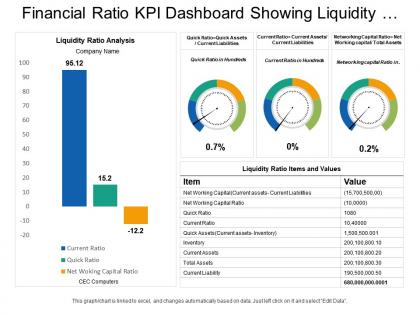
Financial ratio kpi dashboard showing liquidity ratio analysis current ratio and quick ratio




Try Before you Buy Download Free Sample Product
 Impress Your
 Audience
 100%
100% Editable
 Save Hours
 of Time


Our Financial Ratio Kpi Dashboard Showing Liquidity Ratio Analysis Current Ratio And Quick Ratio enable consensus to emerge. Focus on areas of agreement.
People who downloaded this PowerPoint presentation also viewed the following :
Financial ratio kpi dashboard showing liquidity ratio analysis current ratio and quick ratio with all 6 slides:
Analyze each detail to the fullest with our Financial Ratio Kpi Dashboard Showing Liquidity Ratio Analysis Current Ratio And Quick Ratio. They enable comprehensive examination.




FAQs for Financial ratio kpi dashboard showing liquidity ratio analysis current ratio
So for your dashboard, I'd start with profitability stuff - gross margin, net margin, ROE. Those show if you're actually making money efficiently. Current ratio and quick ratio are clutch for cash flow health. Debt-to-equity tells you how risky things are getting financially. Oh, and don't sleep on operational metrics like inventory turnover and receivables turnover - honestly, those catch problems way earlier than I expected when I first started tracking them. Activity ratios are solid for spotting issues before they blow up. You can always add industry-specific ones later once you see what your stakeholders actually look at.
Honestly, charts are a lifesaver when you're presenting financial ratios. Most people's eyes glaze over the second they see a spreadsheet full of numbers. Bar charts let you compare ratios side by side really easily, and line graphs show trends that might not be obvious otherwise. Color coding helps too - like red for areas that need work. I always throw in industry benchmarks for context since ratios don't mean much in a vacuum. The whole point is making data that people can actually digest instead of just nodding along while secretly checking their phones during your presentation.
So liquidity ratios are like your heads-up for cash problems - they tell you if a company can pay bills over the next year. Watch the current ratio and quick ratio mainly. Below 1.0? That's trouble. Above 2.0 means they're probably hoarding cash (which isn't terrible but weird). These ratios just check if there's enough liquid stuff to cover short-term debt. Honestly, I'd focus more on the trend than one-off numbers - like, are things getting better or worse over a few quarters? Way more useful than a single snapshot.
So basically, the debt-to-equity ratio shows how much debt a company has compared to equity - and yeah, investors definitely pay attention to this stuff. High ratios can freak people out because it looks risky. I've actually seen solid companies get hammered just because their numbers looked bad on paper. But here's the thing: some industries just naturally run higher debt levels, and sometimes debt can actually help growth if they're smart about it. Don't just look at one number though. Compare it to similar companies and see if it's getting better or worse over time. That context matters way more than whatever random ratio pops up.
So profitability ratios show how well a company turns revenue into actual profit. Gross margin tells you if they're pricing right and controlling production costs. Operating margin? That's about managing daily expenses like payroll and rent. Net margin is tricky though - sometimes gets weird with one-time charges but still matters. Here's the thing: don't just look at one quarter. Track trends over time instead. When margins keep dropping, that's your warning sign something's wrong with their cost structure. I learned this the hard way watching a stock tank because I ignored declining margins for too long.
Dude, context is everything with these ratios. That 0.5 debt-to-equity might look conservative for a tech startup, but it's terrible news for utilities who usually run 2.0+. Same goes for inventory turnover - grocery stores vs car manufacturers? Totally different worlds. I learned this the hard way when I first started looking at financials. Always throw industry benchmarks right next to your company numbers on the dashboard. Set different ranges for each industry you're tracking, and toss in some quick notes so people don't completely misread what they're seeing.
Dude, looking at financial ratios over time is way more useful than just checking one year. Like, a company's profit margin might seem fine right now, but if you chart it over 3-4 years and see it's been steadily dropping? That's a totally different story. Single snapshots are basically useless - you need the whole trend to see what's really happening. I always set up at least 3 years of data when I'm analyzing anything. You'll spot problems way earlier that way. Plus you can tell if something weird happened just once or if it's part of a bigger pattern. Makes all the difference honestly.
Honestly, dashboards are a game-changer for this stuff. You can see your profit margins, debt ratios, all that financial data right next to your competitors' numbers instead of switching between a million Excel tabs (which drives me crazy). Spot trends super fast when everything's visual like that. Set up notifications too so you know when their metrics change dramatically. Oh, and start small - pick your biggest 3-5 competitors first. Focus on whatever ratios matter most in your industry or you'll get overwhelmed trying to track everything at once.
Honestly, the worst thing you can do is throw like 15 ratios on one dashboard - nobody's gonna look at that mess. Also don't just show random numbers without any context or benchmarks, because 2.5x profit margin could be amazing or terrible depending on your industry. Make sure you're using the same time periods too, otherwise you're comparing apples to oranges. Oh and explain what "good" actually looks like for each one since a healthy debt ratio for tech is way different than manufacturing. Stick to maybe 5-7 ratios tops with clear explanations so people actually understand what they're looking at.
Honestly, real-time data integration is a game changer for your dashboard. You're getting actual current numbers instead of working with outdated info. No more manually updating those annoying spreadsheets every week. Your ratios update automatically when new transactions hit - which is clutch for liquidity ratios since you'll catch cash flow problems right as they're happening. Way better than finding out weeks later when you're already screwed. The accuracy improvement alone makes it worth it. Get automated feeds set up from your accounting system if you can swing it.
Honestly, forget about the fancy profitability ratios that big companies worry about. You're probably burning cash anyway, so focus on burn rate and runway first - that's what keeps you alive. CAC to LTV is huge too, VCs get excited when they see that improving. ROE and debt ratios? Pretty much useless at your stage. I'd track cash stuff first, then add growth metrics. Oh and cash conversion cycle - sounds boring but it'll save your ass. Unit economics tell the real story anyway. Most founders obsess over vanity metrics when they should be watching the money flow.
So cash flow ratios are like your business's pulse check - they tell you if there's actually money flowing in to pay bills and keep things running. Strong operating cash flow? Go ahead and plan that expansion or new equipment. Weak numbers mean hit the brakes on spending, honestly. The cash coverage ratio shows how long you can keep the lights on, which is super helpful for timing big moves. I check mine monthly because they're way more accurate than profit margins when you're actually trying to plan stuff. They'll help you figure out realistic timelines for whatever you're trying to pull off next.
Honestly, dashboards are game-changers for catching problems early. You'll see liquidity issues brewing when your current ratio starts dropping, or debt getting out of hand before it's too late. The visual stuff makes it way easier to spot weird patterns compared to staring at spreadsheets all day. Set up alerts so you don't have to babysit everything 24/7. Start with current ratio, debt-to-equity, ROE, and interest coverage - those four will catch most problems. Then just add more ratios based on whatever's relevant to your specific business. Trust me, it beats scrambling when things go sideways.
Honestly, visualization software is a game-changer for this stuff. It connects to your accounting systems and does all the ratio calculations automatically - no more Excel hell. Tableau and Power BI are solid options, but I'd just go with whatever your company already has set up. Way less headache that way. The cool part is everything updates in real-time, so you're not dealing with outdated numbers or calculation mistakes. Current ratios, debt-to-equity, all that gets handled behind the scenes. You just focus on what the numbers actually mean instead of crunching them yourself.
Dude, you absolutely need to talk to your users first. Different people want totally different things from the same data - like your CFO probably just wants the big picture trends, but analysts need to dig deep into specific ratios. I've watched so many dashboards get built in a vacuum and then literally nobody uses them (such a waste). Interview your key people early on. Figure out their workflows, what's frustrating them, how they make decisions. Ask what ratios they check daily vs monthly, how they're currently getting this data, what questions they're trying to solve. Then mock up some prototypes and actually test them before you build the real thing.
-
Topic best represented with attractive design.
-
Perfect template with attractive color combination.