


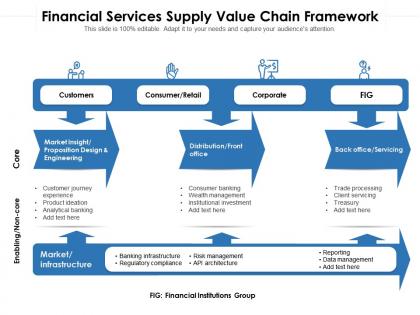
Financial services supply value chain framework




Try Before you Buy Download Free Sample Product
 Impress Your
 Audience
 100%
100% Editable
 Save Hours
 of Time


Our Financial Services Supply Value Chain Framework are explicit and effective. They combine clarity and concise expression.
People who downloaded this PowerPoint presentation also viewed the following :
Financial services supply value chain framework with all 2 slides:
Give your audience a fulfilling experience. They will find our Financial Services Supply Value Chain Framework elevating.

FAQs for Financial services supply
So the financial services value chain has four key pieces: origination (getting customers), processing (handling transactions), risk management (checking for problems), and distribution (getting products out there). Picture it as a pipeline, honestly. You bring people in, handle what they need, make sure nothing's gonna blow up on you, then deliver your services. Each part can be tweaked on its own, or you can look at the whole thing together. I'd map out where your company actually sits first - like what do you handle vs. what you outsource? That'll show you the gaps.
Dude, tech integration is a total game-changer for financial services. Payment processing that used to take forever now happens instantly. Same with risk assessment and customer onboarding - we're talking minutes instead of days. APIs are probably the best part because different systems can actually communicate without breaking everything. I know it sounds nerdy, but mapping out where you're still doing manual work is honestly your best starting point. Once you automate those repetitive tasks, your team can focus on stuff that actually matters. Back-office operations become so much smoother when everything's connected properly.
Regulations are basically the rulebook for every step of your financial services chain - they control customer onboarding, risk management, product distribution, all of it. Different rules overlap constantly and sometimes contradict each other, which is honestly a pain. You've got to build compliance into your processes from day one instead of trying to add it later. Trust me on this - map out which regulations affect each part of your value chain right away. I learned this the hard way when a client tried to retrofit compliance and it was a nightmare. Short-term planning here will save you so much trouble later.
Honestly, data analytics can transform pretty much every part of your financial services business. I'd start with customer acquisition - dig into behavioral data to spot high-value prospects and personalize marketing. Transaction patterns are gold for risk assessment and catching fraud during onboarding. For current customers, predictive analytics helps you anticipate what they'll need next and cross-sell smarter. Operations-wise, you can automate compliance reporting (thank god) and streamline processes based on actual performance data. The possibilities really are endless once you get going. My take? Don't try to boil the ocean - pick one area, prove it works, then expand from there.
Ugh, honestly the worst part is how everything's connected - one weak spot and it all falls apart. Your onboarding talks to transaction processing, which feeds into compliance reporting, and suddenly you're chasing problems everywhere. Legacy systems trying to work with new APIs? Total nightmare. Plus you need monitoring that actually works in real-time across the whole mess. I'd focus on building backup controls and having solid escalation plans ready. Because something WILL break - it's not an if situation, it's when. At least then you can jump on it fast instead of scrambling.
Honestly, customer experience is what separates the winners from the losers in financial services. You know how you'll straight up leave a website if the sign-up process sucks? That's acquisition right there. Once they're in, good service keeps them around and gets them buying more products. Here's the thing though - even your boring back-office stuff matters because inefficient operations = frustrated customers on the front end. I'd start by actually mapping out what your customers go through, then fix the pain points one by one. The ripple effect is real.
DeFi's the biggest game changer - people are completely cutting out banks for lending and trading. Wild stuff. Embedded finance is everywhere now too, like how Shopify and Uber just built banking right into their apps. Your customers don't even need to go elsewhere anymore. Open banking APIs are forcing the old guard to actually share their data (finally), and robo-advisors are handling wealth management for way more people than before. Honestly, you should probably figure out where this stuff overlaps with what you're already doing because it's not slowing down.
Dude, collaboration in financial services isn't just nice to have - it'll literally make or break your project. Payment processors, compliance, tech vendors, distribution partners... when they're all doing their own thing in silos, you're screwed. The whole value chain is so connected that one person hoarding data or missing deadlines creates chaos everywhere else. Like, a basic loan approval hits credit bureaus, underwriters, regulatory systems, funding sources - it's honestly a nightmare if people aren't talking. My advice? Map out your key players from day one. Set up regular check-ins with shared metrics so everyone's actually rowing in the same direction.
AI is basically taking over everything - underwriting, customer service, you name it. Meanwhile companies that aren't even banks are offering financial products now through embedded finance. Open banking means traditional banks have to share their data, which still feels super weird to me but customers love it. Going digital isn't optional anymore, it's just expected. Regulatory stuff keeps pushing for more transparency too. That whole "control every customer touchpoint" mentality? Dead. Honestly, just focus on what you're actually good at instead of trying to own everything.
So basically you can split up your business operations and put different parts wherever makes the most sense cost-wise. Like sending your data processing stuff to cheaper locations while keeping customer service in-house. Pretty cool how it totally reshapes the whole geography thing - though I feel like everyone's doing it now. The trick is knowing what needs to stay close to your customers vs what can be standardized and shipped off. Just don't outsource anything that's actually your secret sauce or needs real local expertise.
Hey! So three main things to focus on: automation, integration, and customer experience. Automate the boring stuff first - data entry, compliance checks, all that tedious work. Frees up your team for actual strategic thinking. Next, get your systems talking to each other so data isn't trapped everywhere. I swear half the industry still runs on Excel somehow. Customer journey mapping is huge too - find where people are waiting around or repeating the same info over and over. Pick one process, see how much you improve it, then roll that approach out. You'll be shocked how much low-hanging fruit there is.
Banks are totally flipping their lending standards to include ESG scores everywhere. Investment firms can't launch green funds fast enough, and insurance companies are pricing climate risk into basically everything now. Even boring back-office stuff is going paperless - honestly didn't see that coming so quickly. Asset managers are getting crushed by client demands to prove they're actually sustainable, not just greenwashing. Meanwhile regulatory teams are losing their minds trying to keep up with all the new environmental reporting rules. Pro tip: start paying attention to which sustainability metrics your clients keep asking about. That's where you'll find the real money.
Honestly, you want to use customer data everywhere - but smartly. Tailor onboarding based on their goals and risk tolerance first. Transaction history helps you suggest better products that actually fit their life stage. Here's where it gets cool though - adjust pricing and terms based on how they behave. Communication preferences too (some people hate phone calls, right?). Predictive stuff works great for ongoing service. Like bumping credit limits before they ask, or tweaking insurance coverage. The trick is making sure each interaction builds on previous ones. Otherwise you'll just annoy them with random "personalized" nonsense that feels robotic.
Track your efficiency stuff first - processing times, cost per transaction, error rates. That shows if things are actually working. Customer metrics matter more though: satisfaction scores, conversion rates, how fast you solve problems. Revenue per customer is obvious but don't sleep on cross-selling rates. Since you're in financial services, compliance and fraud detection accuracy aren't optional. Honestly, most people try to measure everything and end up measuring nothing useful. Pick 3-4 metrics per stage max. Start with whatever directly hits your customers and your bottom line - you can always add more later.
Look, mapping out the financial services chain is basically your cheat sheet for finding where you actually belong. Big players always leave gaps - that's where you swoop in. I'd honestly start by sketching out who does what in your space and follow the money trail. You'll probably spot 2-3 sweet spots where you could either do it better or try something totally different. Plus you might find businesses to partner with instead of getting crushed trying to compete with the big guys. Way smarter than just winging it.
No Reviews