


Financial treasurer and controller org chart




Try Before you Buy Download Free Sample Product
 Impress Your
 Audience
 100%
100% Editable
 Save Hours
 of Time


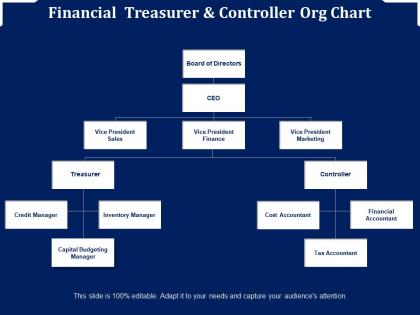
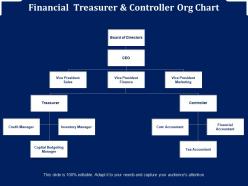
An organizational chart is one of the best way to represent the structure of an organization team. If you are planning to outline a professional presentation to highlight your financial team members, then we would recommend you to download our predesigned financial treasurer and controller org chart PowerPoint template slide designed by presentation designers at SlideTeam. The financial treasurer and controller org structure diagram in this PPT template will help you in defining the role of each member at a different designation. Using this economic team org chart template slide, you will easily able to differentiate the functionality of a treasure and a controller. This organization structure PPT diagram illustrates six level position of the team which is board of directors, CEO, vice president sales, vice president finance, vice president marketing, treasure, controller, credit manager, inventory manager, capital budgeting manager, cost accountant financial accountant, and tax accountant. The layout of this org hierarchy chart template is designed merely to ease your presentation work. Hurry up and download this editable financial treasurer and controller org chart presentation template slide. Address the dilemma with our Financial Treasurer And Controller Org Chart. Figure out the factors causing doubt.
People who downloaded this PowerPoint presentation also viewed the following :
Financial treasurer and controller org chart with all 5 slides:
Ensure the fearless get their due with our Financial Treasurer And Controller Org Chart. It allows you to applaud the intrepid.




FAQs for Financial treasurer and
Key components of a financial organization structure include the board of directors, executive management, treasury, accounting and finance departments, risk management, compliance, and audit functions. These components work together by ensuring proper governance, maintaining financial controls, managing liquidity and capital allocation, while enabling regulatory compliance and strategic decision-making across banking, insurance, and investment sectors.
Different financial structures impact decision-making by determining authority levels, resource allocation processes, and accountability frameworks within organizations. Centralized structures enable faster strategic decisions but may slow operational responses, while decentralized approaches empower departments with budget autonomy, ultimately delivering more agile decision-making and enhanced responsiveness to market opportunities.
Compliance plays a central role in shaping financial organization structures by requiring dedicated risk management departments, audit functions, regulatory reporting teams, and internal control frameworks. These compliance requirements drive organizations to establish clear hierarchies, segregated duties, and specialized roles across banking, insurance, and investment sectors, ultimately ensuring regulatory adherence while maintaining operational efficiency and stakeholder trust.
A well-defined financial organization structure enhances operational efficiency by establishing clear reporting lines, segregating duties effectively, and streamlining decision-making processes across departments. Through strategic role allocation and accountability frameworks, organizations minimize redundancies, accelerate financial reporting cycles, and ensure compliance, with many financial institutions finding that structured hierarchies ultimately deliver faster transaction processing and improved resource management.
Centralized financial structures deliver enhanced control, standardized processes, cost efficiency, and simplified compliance oversight, while decentralized structures provide faster local decision-making, market responsiveness, and operational flexibility. While centralization streamlines reporting and reduces overhead costs, decentralization enables regional adaptation and entrepreneurial agility, with many organizations finding that hybrid approaches ultimately balance strategic oversight with operational speed.
Financial organization structures vary significantly by scale, with small enterprises typically maintaining centralized finance teams handling multiple functions, while large enterprises implement specialized departments including treasury, financial planning, risk management, and compliance divisions. Large organizations require sophisticated hierarchical structures with dedicated controllers, analysts, and regional finance teams to manage complex operations, regulatory requirements, and diverse business units, ultimately delivering enhanced oversight and strategic financial decision-making capabilities.
Technology transforms financial departments by automating routine tasks, enabling real-time reporting, streamlining compliance processes, and facilitating remote collaboration through cloud-based platforms. These digital solutions enhance operational efficiency by reducing manual errors, accelerating month-end closing procedures, and providing executives with instant access to financial dashboards, ultimately delivering faster decision-making capabilities and competitive advantage.
Essential skills for leading a financial organization include strategic financial planning, risk management expertise, regulatory compliance knowledge, stakeholder communication, and data-driven decision making. These capabilities enable leaders to navigate complex market conditions, ensure operational efficiency, and drive sustainable growth, with many financial institutions finding that strong leadership directly correlates with improved performance and competitive advantage.
Regulatory changes significantly reshape financial organization structures through enhanced compliance departments, revised reporting hierarchies, and strengthened risk management frameworks. Banks and investment firms frequently restructure their operational teams, create specialized regulatory units, and modify decision-making processes to meet evolving requirements, ultimately delivering greater transparency and accountability while maintaining competitive positioning.
Key metrics include return on equity, cost-to-income ratio, operational efficiency ratios, risk-adjusted returns, and regulatory compliance scores. These indicators enable financial institutions to assess structural performance by measuring profitability, resource allocation effectiveness, and risk management capabilities, with many banks finding that balanced scorecards ultimately deliver enhanced strategic decision-making and competitive advantage.
Financial organization structures adapt to changing market conditions by implementing flexible hierarchies, cross-functional teams, decentralized decision-making, agile governance frameworks, and scalable technology infrastructure. Through these strategic approaches, banks and investment firms streamline operations, accelerate response times, and enhance risk management capabilities, while maintaining regulatory compliance, ultimately delivering competitive advantage in increasingly volatile markets.
Cross-department collaboration in financial organizations enhances decision-making, reduces operational silos, streamlines processes, and improves risk management across business units. Through integrated workflows and shared data systems, banks and financial institutions accelerate loan approvals, enhance customer experiences, and optimize resource allocation, ultimately delivering greater operational efficiency and competitive advantage in increasingly complex financial markets.
Organizations ensure clear communication channels within their financial structure by establishing defined reporting hierarchies, implementing integrated financial systems, and conducting regular cross-departmental meetings. Through standardized processes and digital platforms, companies like banks and retail chains streamline information flow between departments, minimize reporting delays, and enhance decision-making accuracy, ultimately delivering improved operational efficiency and strategic financial oversight.
Best practices for restructuring financial organizations include centralizing core functions, implementing digital automation systems, establishing clear governance frameworks, optimizing resource allocation across departments, and enhancing risk management protocols. These strategic approaches streamline operations by reducing redundancies, improving regulatory compliance, and accelerating decision-making processes, with many banks and financial institutions finding that comprehensive restructuring delivers significant cost reductions while enhancing customer service capabilities.
Cultural differences significantly influence financial organizational structures through varying approaches to hierarchy, risk tolerance, regulatory compliance, and decision-making processes across different regions. Organizations in collectivist cultures often favor more centralized structures with clear hierarchies, while individualistic cultures tend toward flatter, more autonomous frameworks, with many multinational financial institutions adapting their structural models to local cultural expectations for enhanced operational effectiveness.
No Reviews