


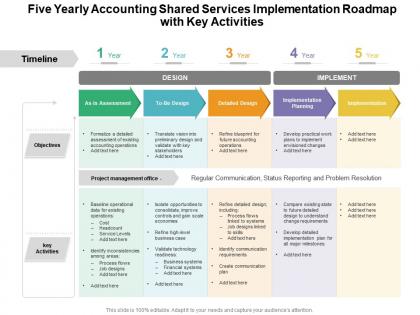
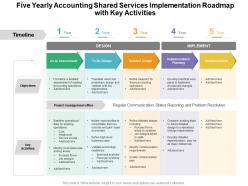
Five yearly accounting shared services implementation roadmap with key activities




Try Before you Buy Download Free Sample Product
 Impress Your
 Audience
 100%
100% Editable
 Save Hours
 of Time


Visualize your work plan and communicate your ideas impactfully with our pre designed Five Yearly Accounting Shared Services Implementation Roadmap With Key Activities. Showcase the detailed overview of the project, the key deliverables, and the milestones to be achieved with the help of our fully customizable PowerPoint layout. You can easily emphasize on the project goals and discuss all the activities involved in an easy to comprehend manner by utilizing our professionally designed PPT theme. This roadmap PowerPoint layout is a perfect strategic planning tool that can help in keeping the project on track. With our attractive PowerPoint theme, you can articulate the workflow, track the work progress, and have a clear vision of the goal to be achieved. Download this versatile Five Yearly Accounting Shared Services Implementation Roadmap With Key Activities and save your hours of work.
People who downloaded this PowerPoint presentation also viewed the following :
Five yearly accounting shared services implementation roadmap with key activities with all 2 slides:
Give your audience a fulfilling experience. They will find our Five Yearly Accounting Shared Services Implementation Roadmap With Key Activities elevating.
FAQs for Five yearly accounting shared services implementation roadmap
Honestly, you gotta start by figuring out where you're at right now, then map out exactly where you want to be - like what services you'll offer and how well they need to run. Technology roadmap is huge too (that stuff always drags on forever though). Change management can't be an afterthought either. Break everything into phases with real deadlines, and definitely set up some kind of governance to keep people accountable. Oh, and metrics - you need ways to actually measure if it's working. Just make sure whatever you build actually helps the business hit its goals. Otherwise you're just rearranging deck chairs. I'd test it on one process first before going crazy with a full rollout.
Honestly, just document everything first - every single step in your workflows and who's doing what. Time how long stuff actually takes too. I guarantee you'll find like 3 approval layers that don't need to exist. Look for where work gets stuck waiting around, or where you're still doing manual processes that could totally be automated. Track your team's time for a couple weeks because we're all terrible at guessing where hours actually go. The hardest part? You gotta stop defending the old way of doing things just because it's familiar.
Yeah, tech is pretty much everything for shared service centers. Without it, you're just doing the same manual stuff in a different building which is pointless. Automation handles the boring repetitive tasks - invoice processing, reconciliations, all that. Then you've got cloud ERP systems giving you visibility across business units. AI can spot problems early too. My advice? Start small though. Figure out what's eating up the most time manually and automate those pieces first. The whole model kinda falls apart without decent tech backing it up.
Start by mapping what you're doing now - AP, AR, monthly close stuff usually works best since they're high-volume and pretty standardized. Company size matters a lot here, plus how spread out you are geographically. Some places go crazy with this and honestly just make things worse for themselves. Most pick between centralized, decentralized, or hybrid depending on their specific headaches and what they can actually handle resource-wise. I'd definitely run a pilot first with just one function. Test it out, see what actually works instead of what looks good on paper, then expand from there.
Track your operational stuff first - cost per transaction, how fast things get processed, error rates. That's the meat and potatoes. Also watch employee satisfaction because cranky people tank everything. FTE reduction and compliance improvements are huge wins to measure too. Oh, and don't forget business partner satisfaction scores. The real trick though? Get your baseline numbers locked down before you even start, otherwise you'll be guessing at ROI later. Monthly dashboards work way better than scrambling when your boss randomly asks for updates. Trust me on that one.
Compliance totally runs the show when you're planning this stuff. Map out all your regs first - SOX, GDPR, whatever local tax nonsense you're dealing with. Some processes just can't be centralized because of data residency rules, which sucks but whatever. Build your compliance checks into each phase from the start. Don't wait until the end or you'll hate yourself when auditors tear it apart. Oh, and do a gap analysis early - I learned that one the hard way. It dictates how fast you can move and what controls you'll need everywhere.
Honestly, the worst part is always getting people on board with change - they'll fight you every step of the way. Plus trying to make different systems actually work together? Total pain, especially with older software that's basically held together with duct tape. Oh and you'll definitely need to handle the whole "am I losing my job?" conversation carefully. Moving all your data over without breaking everything is another headache I wouldn't wish on anyone. Start with getting your key people excited about it first though. Trust me, having them in your corner from day one will save you so much drama down the road.
Honestly, automation is a game changer for cutting down on mistakes. Start with your most repetitive stuff - invoice processing, bank reconciliations, that kind of thing. RPA tools handle these way better than doing it manually (we're talking like 70% fewer errors). Month-end close is usually where I tell people to begin since it's such a pain anyway. The repetitive tasks are honestly perfect for this - frees up your team to do actual analysis instead of data entry grunt work. Focus on high-volume processes first. You'll see results pretty quickly once you get going.
Cross-train everyone instead of keeping people stuck in one department - you'll need that flexibility later. Documentation is honestly such a drag to create, but remote training basically requires it. Do video tutorials too if you can. Regular knowledge sessions between your veterans and newbies work great. Give people actual transactions to practice on, not just boring theory stuff. Oh, and pair up new hires with mentors - someone they can bug with random questions without feeling weird about it. Trust me, it saves everyone headaches down the road.
Cloud stuff is game-changing for scaling your shared services. Way more flexible and cheaper than the old setup. You'll get real-time data everywhere, automated workflows, and disaster recovery that actually works - not like those on-premise nightmares. Honestly, implementation isn't the total headache it used to be compared to traditional ERP projects. The cool part? You can centralize everything without being stuck in one location. Opens up global talent, 24/7 processing capabilities. My advice - start with your most annoying manual processes first. Those are your easiest wins.
Honestly, getting stakeholders bought in is all about making them feel heard from day one. Pull key people into your planning sessions - they'll actually fight for something they helped create. Quick wins are your best friend here, so run some pilot programs that show real results fast. I've learned the hard way that going radio silent is basically relationship suicide, even when nothing major is happening. Address their biggest fears upfront - job security, crazy workload changes, whatever keeps them up at night. Monthly check-ins work great for catching problems before they blow up. Oh, and don't underestimate how much people just want to know what's going on.
Honestly, just break it into smaller pieces instead of trying to do everything at once. Start with something easy like payroll or AP - get that working first. Your team won't freak out as much, and you can actually figure out what's broken before it becomes a nightmare. Once people see it's not terrible (and maybe even helpful?), then you can add the trickier stuff like financial reporting. The quick wins really help too - keeps people from complaining as much when you roll out the next phase. Way better than going big and having everything fall apart simultaneously.
Look, continuous improvement is what keeps shared services from turning into a dumpster fire. Regular feedback loops and tracking metrics help you spot problems early. Quarterly reviews are clutch too - I swear teams get way too comfortable and then act shocked when their SLAs tank. Build this stuff into your normal routine instead of making it some big separate thing. Honestly, just pick one process this month and figure out where it's getting stuck. The friction points are probably more obvious than you think once you actually map it out.
So data analytics basically gives you superpowers for your accounting shared services - you'll see patterns and trends that would take forever to find manually. Want to catch which vendors are always late? Done. Cash flow problems brewing? You'll spot them early. The real game-changer is setting up dashboards that automatically highlight weird stuff so you're not buried in Excel hell (been there, not fun). My advice? Start with something simple like AP automation, get a few quick wins, then build from there. Pretty amazing what you can see when the data does the heavy lifting.
Most companies see 15-30% savings in the first 2-3 years, hitting positive ROI around year two. Consolidating staff gives you the biggest bang for your buck, plus standardizing processes and better tech. Oh, and you'll probably get some surprise wins too - like faster month-end closes and better compliance stuff. Your mileage will vary depending on how messy things are right now. I'd start with conservative estimates for your business case, then track both the obvious savings (headcount, systems) and the harder-to-measure benefits like speed and accuracy. That way you can show the complete story.
No Reviews