


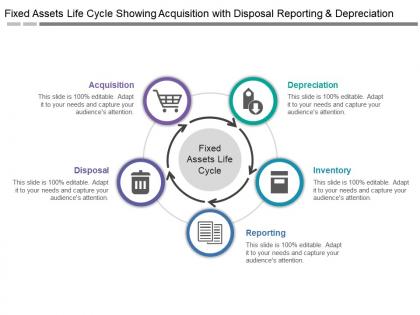
Fixed assets life cycle showing acquisition with disposal reporting and depreciation




Try Before you Buy Download Free Sample Product
 Impress Your
 Audience
 100%
100% Editable
 Save Hours
 of Time


Acquire global flexibility with our Fixed Assets Life Cycle Showing Acquisition With Disposal Reporting And Depreciation. Cut across geographical borders.
People who downloaded this PowerPoint presentation also viewed the following :
Fixed assets life cycle showing acquisition with disposal reporting and depreciation with all 5 slides:
The individual hues of our Fixed Assets Life Cycle Showing Acquisition With Disposal Reporting And Depreciation blend beautifully. It is attractively color coordinated.




FAQs for Fixed assets life cycle showing acquisition with disposal
The fixed assets lifecycle includes acquisition, deployment, utilization, maintenance, and disposal stages. These stages streamline asset management by optimizing procurement decisions, tracking operational performance, scheduling preventive maintenance, and maximizing disposal value, with many organizations finding that systematic lifecycle management reduces costs, enhances productivity, and ultimately delivers better return on investment.
Proper categorization of fixed assets streamlines management by enabling accurate depreciation calculations, optimal maintenance scheduling, and strategic replacement planning. Through systematic classification by type, location, and usage patterns, organizations enhance regulatory compliance, improve budget forecasting, and maximize asset utilization, with many companies finding that structured categorization reduces operational costs while delivering better investment decisions.
Organizations can evaluate fixed asset depreciation using straight-line method, declining balance method, units of production method, sum-of-years-digits method, and accelerated depreciation approaches. These methods enable companies to align depreciation strategies with operational patterns, optimize tax benefits, and improve financial reporting accuracy, with many manufacturing and technology firms finding that method selection significantly impacts cash flow management and strategic asset replacement planning.
Technological advancements significantly enhance fixed assets lifecycle management through automated tracking, predictive maintenance algorithms, IoT sensors, and AI-powered analytics. These innovations streamline asset monitoring, optimize maintenance schedules, and extend operational lifespans, with manufacturing and healthcare organizations finding that smart asset management reduces costs while improving reliability and strategic decision-making capabilities.
Asset tracking serves as the operational backbone of fixed asset lifecycle management by providing real-time visibility into asset location, condition, utilization rates, and maintenance schedules throughout each phase. Through RFID tags, barcode systems, and GPS technology, organizations streamline procurement decisions, optimize maintenance timing, and enhance disposal planning, with many manufacturing and healthcare facilities finding that comprehensive tracking reduces asset losses by 30% while maximizing operational efficiency.
Businesses optimize fixed asset acquisition through comprehensive needs assessment, strategic vendor evaluation, total cost of ownership analysis, and alignment with long-term operational goals. By implementing structured procurement processes, conducting thorough market research, and negotiating favorable terms, organizations streamline purchasing decisions while minimizing costs, ultimately delivering enhanced resource allocation and competitive advantage.
**INPUT**: What are the compliance implications during the disposal phase of fixed assets? **OUTPUT**: Disposal compliance implications include environmental regulations, data security requirements, tax documentation, asset transfer certifications, and regulatory reporting obligations. These requirements vary significantly across industries, with healthcare facilities managing medical equipment disposal, financial institutions ensuring data destruction protocols, and manufacturing companies adhering to environmental standards, ultimately requiring comprehensive documentation and strategic planning to avoid penalties while maximizing recovery value. [Word count: 60]
Organizations assess residual value through market analysis of comparable assets, consultation with certified appraisers, review of historical disposal data, evaluation of asset condition and remaining functionality, and consideration of scrap or salvage worth. These assessment methods streamline disposal planning and financial forecasting, with many companies finding that accurate residual valuations enhance budget accuracy, optimize replacement timing, and maximize recovery value, ultimately delivering better capital allocation decisions.
**INPUT**: What strategies can be employed to extend the useful life of fixed assets? **OUTPUT**: Effective asset lifecycle extension strategies include preventive maintenance scheduling, regular inspections, strategic upgrades, proper operator training, and environmental controls to minimize wear and tear. These approaches streamline operations by reducing unexpected breakdowns, optimizing performance levels, and maximizing return on investment, with many manufacturing and healthcare organizations finding that proactive asset management delivers significant cost savings while enhancing operational efficiency. **Word count: 60 words**
Businesses can effectively manage maintenance and repairs through predictive analytics, scheduled preventive maintenance, real-time monitoring systems, and strategic vendor partnerships. These approaches streamline operations by reducing unexpected downdowns, extending asset lifespan, and optimizing resource allocation, with many manufacturing and healthcare organizations finding that proactive maintenance strategies ultimately deliver significant cost savings and enhanced operational efficiency.
Automated fixed asset tracking systems deliver enhanced accuracy, real-time visibility, streamlined compliance reporting, reduced manual errors, and improved operational efficiency. These technologies revolutionize asset management by eliminating spreadsheet dependencies, accelerating audit processes, and enabling predictive maintenance scheduling, with many organizations finding that automation reduces tracking costs by up to 40% while significantly improving asset utilization.
Fixed asset lifecycle management contributes to organizational sustainability by optimizing resource utilization, extending asset lifespans through preventive maintenance, and minimizing environmental waste through strategic disposal and recycling. This comprehensive approach enables organizations to reduce operational costs, improve energy efficiency, and meet sustainability goals, while ultimately delivering enhanced competitive advantage and regulatory compliance in an increasingly environmentally-conscious business landscape.
Essential financial metrics for evaluating fixed asset performance include return on assets (ROA), asset turnover ratio, depreciation rates, maintenance cost ratios, and capacity utilization percentages. These metrics enable organizations to assess operational efficiency, optimize resource allocation, and make strategic replacement decisions, with many manufacturing and logistics companies finding that regular performance tracking ultimately delivers improved profitability and competitive advantage.
Organizations ensure compliance with accounting standards throughout the fixed asset lifecycle by implementing robust asset tracking systems, conducting regular physical audits, maintaining detailed depreciation schedules, and establishing clear disposal procedures. These practices enable accurate financial reporting, proper capitalization thresholds, and systematic impairment testing, with many enterprises finding that automated compliance monitoring ultimately delivers enhanced regulatory adherence and streamlined audit processes.
Businesses can prepare for asset end-of-life by implementing disposal planning, refurbishment assessments, resale market analysis, and salvage value optimization strategies. Through proactive lifecycle management, companies in manufacturing, healthcare, and retail sectors streamline asset transitions, recover maximum residual value, and minimize disposal costs, ultimately enhancing operational efficiency and reducing total ownership expenses.
-
Designs have enough space to add content.
-
Out of the box and creative design.