


Flow of funds through financial intermediaries and markets




Try Before you Buy Download Free Sample Product
 Impress Your
 Audience
 100%
100% Editable
 Save Hours
 of Time


Being forthright is your forte. Our Flow Of Funds Through Financial Intermediaries And Markets embody that attitude.
People who downloaded this PowerPoint presentation also viewed the following :
Content of this Powerpoint Presentation
Description:
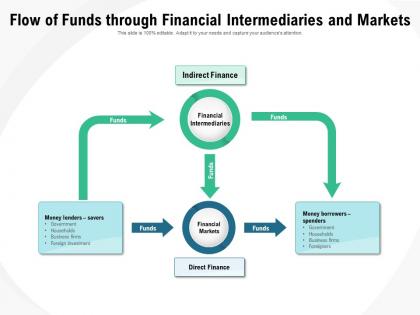
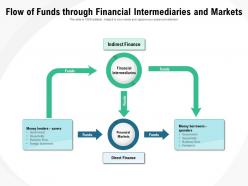
The image depicts a graphical representation of the flow of funds through financial intermediaries and markets. The main title, "Flow of Funds through Financial Intermediaries and Markets," sets the context for the information presented on the slide, which is about the movement of funds in the financial sector.
There are two main paths indicated: Indirect Finance and Direct Finance. In the Indirect Finance path, funds flow from savers to financial intermediaries marked in the diagram as a green circle with overlapping arrows. Savers, here termed "money lenders," include households, government, business firms, and foreign investment. Financial intermediaries then direct the funds to borrowers (spenders), which include the government, households, business firms, and foreigners depicted in a blue rectangle on the right.
The Direct Finance flow shows funds moving straight from savers to financial markets and then to borrowers, bypassing financial intermediaries. This signifies that in direct finance, financial markets play a key role in connecting savers and borrowers directly.
Use Cases:
Different industries can make use of the slide to explain their role in the financial ecosystem, the flow of capital, or the function of markets and intermediaries within their operations or to their stakeholders.
1. Banking:
Use: To explain the role of banks as financial intermediaries.
Presenter: Financial Analyst
Audience: Bank Employees
2. Education:
Use: Teaching the concept of finance and capital flow.
Presenter: Professor
Audience: Students majoring in Finance
3. Investment Services:
Use: Illustrating how investment funds channel investor capital.
Presenter: Investment Advisor
Audience: Potential Investors
4. Government Finance:
Use: Describing public financing operations.
Presenter: Treasury Official
Audience: Policymakers
5. Corporate Finance:
Use: Explaining how corporations access capital.
Presenter: CFO
Audience: Shareholders
6. Non-Profit Sector:
Use: Demonstrating fund allocation and investment strategy.
Presenter: Finance Director
Audience: Board Members
7. Financial Technology:
Use: Showcasing the impact of fintech on direct and indirect finance models.
Presenter: Fintech Product Manager
Audience: Industry Experts
Flow of funds through financial intermediaries and markets with all 2 slides:
Display fortitude with our Flow Of Funds Through Financial Intermediaries And Markets. They encourage a fearless disposition.

FAQs for Flow of funds through financial
Oh this is pretty straightforward actually! Banks, credit unions, insurance companies - they're all middlemen connecting people who have money with people who need it. So when you deposit cash, they lend it out to someone getting a mortgage or whatever. They also spread out risk by diversifying stuff and handle payments so you don't have to track down borrowers yourself (which would be a nightmare honestly). Plus they give you liquidity - fancy word for being able to grab your money when you need it. Without them, the whole financial system would be way messier.
So banks are middlemen, right? You deposit money, they don't just let it collect dust - that'd be pointless. They pool everyone's cash together and loan it out for mortgages, business stuff, whatever people need. Pretty smart actually. The difference between what they pay you (like 0.5% lol) and what they charge borrowers is their profit. Your money that would otherwise just sit there gets put to work in the economy. Plus you get a safe spot to keep it, so it's win-win I guess.
So non-bank financial institutions are basically all the players outside traditional banks - think insurance companies, pension funds, hedge funds, fintech lenders. They create different ways for money to flow from savers to borrowers. Banks can't do everything, right? These institutions fill those gaps with specialized lending and investment products. More competition usually means better innovation. But here's the thing - they're not as regulated as banks, which creates new risks. Oh, and they're not just adding to the financial system, they're actually changing how the whole intermediation thing works.
So basically fintech is just cutting out all the middlemen, right? Your phone becomes this mini-bank that can do peer-to-peer lending, give you automated investment advice, process payments instantly. It's honestly pretty crazy how fast this stuff is moving. These digital platforms match borrowers directly with lenders now. They use AI to make credit decisions too - way cheaper than the old way. Traditional banks are kinda scrambling because they either need to adapt fast or they'll get steamrolled. Can't really blame people for switching when everything's so much more convenient.
So the big ones are counterparty risk - basically your intermediary could go under. Liquidity's another headache since you might not get your money exactly when you need it. Fees and spreads will eat into your returns too, obviously. What really bugs me is the moral hazard thing - these guys might gamble more with your cash since it's not their necks on the line. You're also handing over control of your investments, which some people hate. Plus it just makes everything more complicated operationally. I'd spread across multiple intermediaries if you go this route and really dig into how they handle risk management first.
Dude, interest rates are like the master control for all financial stuff. Low rates? Banks start acting like they're at a casino - lending to anyone with a pulse because they need higher returns. Credit standards get pretty loose (and we know how that usually goes...). But when rates climb up, suddenly everyone gets picky. Banks tighten up lending, love those cheap deposits more, and basically become way more conservative. Honestly, just watch where rates are heading and you can pretty much predict if your bank's gonna be your best friend or start ghosting you.
Banks have to keep certain capital reserves - basically a safety cushion for when things go wrong. Regulators run stress tests too, simulating worst-case scenarios to see if they'd survive. There's also deposit insurance protecting your money if a bank goes under, which is honestly pretty reassuring. They do surprise inspections regularly to catch issues early. Risk limits prevent banks from getting too crazy with investments. Oh, and before you work with any financial company, definitely check they're properly regulated first - learned that one the hard way!
So basically, financial intermediaries are like the middlemen who keep markets moving. Banks and brokers are constantly trading, which means when you want to sell your stocks, there's usually someone ready to buy. They narrow the gap between buying and selling prices too. Without them, good luck trying to quickly cash out your investments - you'd be waiting forever. Market makers absorb those weird moments when everyone's buying or selling at once. Oh, and definitely check how liquid a market is before you invest, especially with smaller companies. Those can be sketchy to get out of fast.
Think of mutual funds like a potluck dinner but for investing. You throw your money in with thousands of other people, and a professional manager uses that giant pile to buy stocks, bonds, whatever. Way easier than trying to pick individual stocks yourself (I tried that once - disaster). You get instant diversification plus access to expensive investments you couldn't afford alone. Sure, they charge fees for managing everything, but honestly the expertise is worth it. Just compare expense ratios between funds before you pick one.
So insurance companies are basically giant investment machines. You pay your premiums every month, but most people don't file claims for years, right? All that money just sits there. Companies take those huge cash pools and dump them into stocks, bonds, real estate - whatever makes money. They're actually some of the biggest investors around, which is kinda wild when you think about it. Your car insurance payment? It's probably funding some corporate loan or government bond somewhere. Pretty crazy how they turned our "just in case" money into this massive economic engine.
So here's the deal - banks exist because nobody really knows if strangers will pay them back. Borrowers obviously know their own financial situation way better than you do, which creates this whole mess of risky people being the most eager to borrow (that's adverse selection). Plus once they have your money, they might just blow it on something stupid (moral hazard). Banks are actually good at this stuff though - they screen people, keep tabs on loans, and spread risk around. I mean, would you really want to research every random person asking for money? That's why peer-to-peer lending isn't everywhere.
So direct intermediation is basically cutting out the middleman - you're buying stocks straight from a company or doing person-to-person lending. With indirect, there's someone in between doing the heavy lifting. Banks are the perfect example - they take your deposits and lend that money out, but they're changing the terms completely (your savings account vs someone else's mortgage, totally different deals). Most stuff we use is actually indirect. Your checking account, that index fund you mentioned last week - all middlemen. The real difference? Indirect intermediation transforms the product somehow. Direct just matches people up.
So lenders basically want to know if you'll pay them back, right? They start with your credit score - that's like their first impression. After that, they dig into your job history and how much money's coming in versus going out. Debt-to-income ratio is huge here. If you've got collateral, that helps too. Some places use fancy computer programs to decide, others have actual humans review everything (honestly depends on how much you're borrowing). My advice? Get your paperwork organized beforehand because clean docs make this whole thing way faster.
Dude, financial stuff is getting wild right now. DeFi is basically trying to replace banks entirely, which is kinda scary but also cool? AI's making loan decisions in seconds now. You can literally get credit through Uber or Shopify - embedded finance is everywhere. Open banking finally forced everyone to share data (took forever). Digital banks are crushing it while old-school places panic and try to catch up. Regulators are completely lost with crypto and international rules. Honestly, any bank not going full digital and partnering with fintech startups is toast.
Look, financial intermediaries are just middlemen who make everything way easier. Banks handle all the boring stuff - credit checks, monitoring borrowers, dealing with collateral. You'd go broke trying to research every investment yourself, honestly. They pool everyone's money together so costs stay low and processes get standardized. Plus they're good at matching people who want to lend with people who need to borrow. My dad learned this the hard way when he tried direct lending once. Bottom line? Use them when doing it yourself would cost more than it's worth.
No Reviews