


Food And Beverage Startup Company Pitch Deck Potential Target Audience For Food Startup




Try Before you Buy Download Free Sample Product
 Impress Your
 Audience
 100%
100% Editable
 Save Hours
 of Time


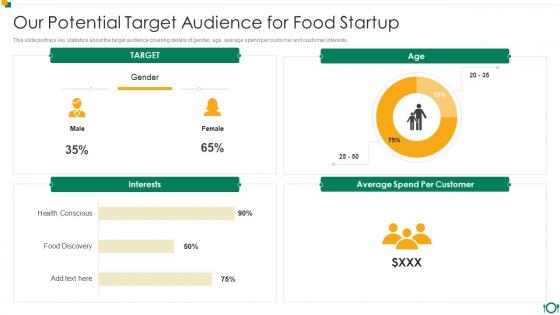
This slide portrays key statistics about the target audience covering details of gender, age, average spend per customer and customer interests.
People who downloaded this PowerPoint presentation also viewed the following :
Food And Beverage Startup Company Pitch Deck Potential Target Audience For Food Startup with all 7 slides:
Use our Food And Beverage Startup Company Pitch Deck Potential Target Audience For Food Startup to effectively help you save your valuable time. They are readymade to fit into any presentation structure.





FAQs for Food And Beverage Startup Company Pitch Deck Potential Target Audience
Food startup consumers typically include health-conscious millennials and Gen Z, busy urban professionals, sustainability-focused individuals, early technology adopters, and households with higher disposable incomes. These demographics increasingly seek convenient, nutritious, and ethically-sourced food options, with many finding that food startups deliver personalized experiences, innovative products, and transparent sourcing that traditional food companies struggle to match.
Health trends significantly shape food startup target audiences by driving demand for functional foods, plant-based alternatives, personalized nutrition, and clean-label products. These evolving preferences create distinct consumer segments, with millennials and Gen Z prioritizing wellness benefits, while health-conscious families seek transparent ingredients, ultimately enabling startups to build loyal communities around specific dietary lifestyles and nutritional values.
Consumer lifestyle significantly influences food business target audiences by determining dietary preferences, convenience needs, health priorities, purchasing behaviors, and meal preparation habits. Food startups leverage lifestyle insights to develop products that align with specific consumer segments, such as busy professionals seeking quick meals or health-conscious families prioritizing organic ingredients, ultimately delivering personalized experiences and competitive market positioning.
Food startups can identify their niche by analyzing consumer pain points, dietary trends, geographic gaps, and underserved demographics within specific food categories. Through market research, competitor analysis, and customer feedback, startups pinpoint opportunities in areas like plant-based alternatives, ethnic cuisines, or specialty diets, ultimately delivering targeted solutions that resonate with specific consumer segments.
Food startups should consider lifestyle preferences, values around sustainability and health, dietary motivations, convenience priorities, and social dining behaviors when defining psychographic segments. These factors enable startups to create targeted messaging and product positioning that resonates deeply with specific consumer mindsets, with many successful food brands finding that psychographic alignment drives stronger customer loyalty and premium pricing opportunities.
Local community engagement is crucial for food startups, as it builds trust, generates authentic word-of-mouth marketing, and creates loyal customer bases through direct relationships and cultural relevance. By participating in farmers' markets, partnering with local suppliers, and engaging in community events, food startups establish credibility and emotional connections, with many finding that these grassroots efforts deliver higher customer retention and organic growth than traditional advertising methods.
Food startup audiences frequent Instagram, TikTok, YouTube, food blogs, Reddit communities, and specialized platforms like Yelp and food delivery apps. These platforms enable startups to showcase products through visual content, engage food enthusiasts directly, and build brand awareness, with many food businesses finding that strategic social media presence drives customer acquisition and ultimately delivers enhanced market visibility and competitive advantage.
Food startups can leverage consumer feedback through surveys, social media analytics, taste testing sessions, and purchase behavior analysis to identify their most engaged customer segments. By analyzing demographic patterns, preferences, and purchasing habits from early adopters, startups can refine their messaging and product positioning, ultimately enabling more targeted marketing strategies and improved customer acquisition costs.
Millennials prioritize convenience, health consciousness, sustainability, and authentic brand storytelling when purchasing from food startups, often researching ingredients, sourcing practices, and company values before buying. They embrace subscription services, mobile ordering, and premium pricing for quality products, with many food startups finding that transparent communication and social media engagement significantly influence millennial purchasing decisions and brand loyalty.
Food startups create compelling value propositions by clearly defining their unique benefits, addressing specific consumer pain points, and aligning with target audience values like sustainability, health, or convenience. Through authentic storytelling, competitive differentiation, and consistent messaging across touchpoints, these startups build emotional connections while delivering tangible outcomes, ultimately establishing brand loyalty and market positioning in an increasingly competitive landscape.
Food startups can reach health-conscious consumers through targeted social media campaigns highlighting nutritional benefits, partnerships with fitness influencers and wellness brands, transparent ingredient sourcing communications, and strategic placement in health-focused retail locations. These approaches enable startups to build authentic connections by emphasizing clean labels, sustainability practices, and functional benefits, ultimately delivering trusted brand relationships and competitive advantage in the increasingly wellness-driven marketplace.
Food startups can capitalize on trends by monitoring consumer behavior, social media insights, and industry reports to identify emerging preferences like plant-based options, sustainable packaging, or functional foods. By aligning product development with these trends, startups create authentic connections with health-conscious millennials, eco-aware Gen Z consumers, and busy professionals seeking convenient nutrition, ultimately delivering market relevance and competitive differentiation.
Social media influencers significantly shape food startup target audiences by building brand awareness, establishing credibility through authentic reviews, and driving consumer behavior through engaging content. They enable startups to reach niche demographics more effectively than traditional marketing, with many food brands finding that influencer partnerships deliver higher engagement rates and faster customer acquisition, ultimately creating loyal communities around new products.
Food startups can utilize storytelling by sharing their origin story, highlighting sustainable sourcing practices, showcasing customer transformation journeys, and demonstrating their mission-driven values through authentic narratives. These storytelling approaches enhance brand connection by creating emotional resonance, building trust with health-conscious consumers, and differentiating products in increasingly competitive markets, ultimately delivering stronger customer loyalty and sustained business growth.
Climate change, plastic pollution, food waste, carbon footprints, and biodiversity loss significantly influence sustainable food startup demographics, particularly among environmentally conscious millennials and Gen Z consumers. These concerns drive purchasing decisions in urban markets, with many consumers increasingly prioritizing brands that demonstrate measurable environmental impact reduction, sustainable packaging, and transparent supply chain practices, ultimately creating competitive advantage through values-based loyalty.
-
Informative design.
-
Informative presentations that are easily editable.