

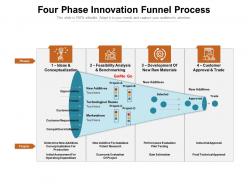
Four phase innovation funnel process





Try Before you Buy Download Free Sample Product
 Impress Your
 Audience
 100%
100% Editable
 Save Hours
 of Time


Our Four Phase Innovation Funnel Process are topically designed to provide an attractive backdrop to any subject. Use them to look like a presentation pro.
People who downloaded this PowerPoint presentation also viewed the following :
Four phase innovation funnel process with all 2 slides:
Use our Four Phase Innovation Funnel Process to effectively help you save your valuable time. They are readymade to fit into any presentation structure.
FAQs for Four phase
So the innovation funnel breaks down into three stages: ideation (brainstorming a bunch of ideas), development (testing the good ones), and implementation (actually launching them). You basically start with tons of possibilities and filter down based on what's realistic, what people want, and what you can afford. Most ideas won't make it - which is fine! Be brutal about cutting things that aren't working. But here's the thing - don't rush through that middle development phase. It feels chaotic and messy, but that's where you're constantly tweaking things and honestly, that's where average ideas turn into something people actually care about.
Set up scoring criteria first - market potential, feasibility, resources needed, how it fits your goals. Rate each idea 1-5 on these factors, then weight them by what matters most to your business. I swear, half the teams I know waste forever arguing about which ideas are "cooler" without any real system. Get different departments to review regularly so you're not stuck in a bubble. The hard part? You've got to kill the weak ideas fast, even if someone's attached to them. That's how you free up time and money for the ones that'll actually work.
Track different stuff at each stage - ideation needs volume and variety of ideas. Screening is about conversion rates and how fast you make decisions (trust me, ideas dying in limbo kills morale). Development should focus on hitting milestones, staying on budget, timeline stuff. Commercialization gets fun - adoption rates, revenue, customer feedback. Honestly, dashboards are your best friend for catching problems early. Don't go crazy measuring everything though. Pick like 2-3 key metrics per stage and actually use them.
Honestly, people need to feel safe throwing out weird ideas without getting shot down immediately. Try that "yes, and" approach instead of being the idea killer. Give your team actual time to mess around with stuff - maybe like that Google 20% thing where they can explore random projects. Mix up who's working together too, since different backgrounds usually spark better creativity. Here's the thing though - you've got to celebrate the smart failures just as much as wins, or people will play it too safe. I'd probably start with monthly brainstorming sessions where literally nothing's off the table. Creates that culture where taking creative risks won't tank someone's career.
Look, customer feedback is your best friend when developing new ideas - don't skip it. Start collecting input on rough concepts, then keep going through prototypes. I've watched so many teams get obsessed with their "brilliant" idea and ignore what customers actually want. Big mistake. Real feedback helps you figure out what to fix, what to scrap, or when to completely change direction before burning cash. Oh, and make sure you're talking to actual customers, not just your coworkers who'll tell you what you want to hear. Trust me on this one.
Dude, those department silos are innovation killers. Getting different teams talking early saves you so much headache later. Like when engineering and marketing actually chat before building something? Game changer. Finance folks can spot budget issues way before you're knee-deep in development costs. Honestly, I've seen some genius ideas come from the weirdest combinations - our accountant once had this random insight that totally changed how we approached user onboarding. Wild, right? You'll iterate faster and avoid those "cool but impossible" projects that waste everyone's time. Just start with monthly cross-team brainstorming sessions and see what happens.
Honestly, start with something simple like Trello - those Kanban boards work better than you'd think. If you want to get fancier later, Brightidea and IdeaScale are solid for collecting team ideas. Asana's pretty good for tracking stuff through your development stages too. UserVoice is clutch for getting customer feedback before you waste time building something nobody wants. But here's the thing - pick whatever your team will actually stick with. I've seen too many companies blow money on fancy tools that just sit there unused. You can always upgrade once you've got a real process going.
Honestly, visual presentations are a lifesaver for innovation funnels. People instantly get how ideas move from concept to launch when they can actually see it mapped out. Flowcharts work great, or even basic funnel graphics showing where each project sits. I've been in way too many meetings where everyone's confused about what "early stage" means - visuals fix that mess immediately. Your team will spot bottlenecks and resource gaps right away. We started using a simple dashboard that tracks all projects by stage and it completely changed how aligned everyone got. Seriously, try it.
So basically, external trends are like filters that totally reshape your innovation process. COVID's a perfect example - overnight everyone's priorities flipped to digital health and remote work stuff. Market changes, regulations, what competitors do, consumer behavior - all that creates pressure on your projects. Some get fast-tracked, others die. You've gotta build in feedback loops so you're actually responding to what's happening outside instead of just following some rigid internal process. Otherwise you end up working on irrelevant stuff while the world moves on without you.
Most companies just dump everything into their innovation pipeline - like, zero filtering whatsoever. Then they're shocked when nothing good comes out the other end. You've got teams working on five mediocre projects instead of one game-changer. Plus nobody knows what the actual success metrics are at each stage, so projects just zombie-walk forward forever. And here's what really gets me - they skip talking to actual users because they think their idea is obviously brilliant. Set clear criteria from day one and be ruthless about cutting things that don't measure up.
Here's the thing - start cheap and get pickier as you go. Do customer interviews, quick prototypes, tiny pilots first. Don't blow your budget on unproven stuff. Most ideas should die early when it's still cheap to kill them, not after you've spent months building something nobody wants. Each stage needs stricter criteria before ideas can move forward. I swear, half the startups I know would still be alive if they'd just tested their assumptions properly instead of falling in love with their first concept. Higher investments only make sense once you've actually validated the core idea works.
Honestly, just run way more experiments at once instead of doing them one by one. Set up clear "kill criteria" beforehand so you can dump the duds quickly. Those stage-gate meetings? Keep them short and decisive - nobody wants another endless committee thing. Test your riskiest stuff first with super basic prototypes. Don't make innovation someone's side hustle either - give it real resources. Oh, and tackle your scariest assumptions upfront rather than dancing around them. The whole point is bombing early and cheap so the good ideas can actually move.
Yeah totally! Small businesses can definitely use innovation funnels. Just brainstorm like crazy first - that part's free anyway. Then get super picky about what actually moves forward. Partner with local universities or freelancers for prototyping instead of building whole teams. Digital tools are your friend for testing before you blow money on physical stuff. Honestly, tight budgets sometimes force better decisions than having endless cash (learned that the hard way). Start with one tiny experiment, see what happens, then double down on whatever works. The constraint thing actually helps you focus.
Dude, prototyping and validation are like your safety net in the middle stages. You're basically testing if people actually want what you're building before you blow all your time and cash on development. I always think of it like - would you buy a car without test driving it first? Same logic here. When something's not clicking, you can pivot fast. When it is working, you know where to focus your energy. Way better to mess up early when it's cheap than realize months later that nobody cares about your product. Trust me on this one.
Honestly, most innovation stuff dies in the middle stages because people just forget about it. You've got to celebrate those small wins along the way - set up checkpoints so teams actually see they're moving forward. Don't just share the successes either, talk about what went wrong and what you learned. Monthly showcases work great for this - teams demo their progress and get fresh ideas. The key thing is showing stakeholders WHY projects are evolving, not just boring status updates. Quick feedback loops are clutch too. Never let stuff sit around for months collecting dust.
-
Excellent job
-
Excellent products for quick understanding.
-
Content of slide is easy to understand and edit.
-
Presentation Design is very nice, good work with the content as well.