


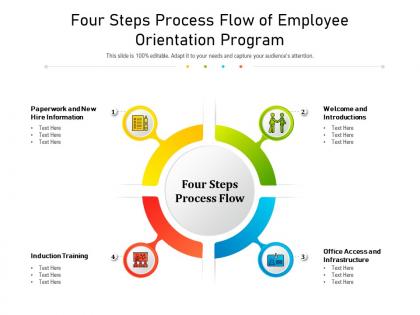
Four steps process flow of employee orientation program




Try Before you Buy Download Free Sample Product
 Impress Your
 Audience
 100%
100% Editable
 Save Hours
 of Time


Our Four Steps Process Flow Of Employee Orientation Program are topically designed to provide an attractive backdrop to any subject. Use them to look like a presentation pro.
People who downloaded this PowerPoint presentation also viewed the following :
Four steps process flow of employee orientation program with all 2 slides:
Use our Four Steps Process Flow Of Employee Orientation Program to effectively help you save your valuable time. They are readymade to fit into any presentation structure.

FAQs for Four steps process flow of
Effective employee orientation includes comprehensive company culture introduction, role-specific training modules, compliance and policy education, mentor assignment, and structured feedback mechanisms. These components work together by accelerating time-to-productivity, enhancing employee engagement, and reducing turnover rates, with many organizations finding that well-structured orientation programs ultimately deliver stronger retention and faster integration across departments.
Organizations can tailor orientation programs by incorporating visual presentations, interactive workshops, hands-on simulations, peer mentoring sessions, and self-paced digital modules to accommodate different learning preferences. Through strategic combinations of multimedia content, collaborative activities, and personalized learning paths, companies streamline knowledge transfer while enhancing employee engagement, ultimately delivering faster integration and improved retention rates.
Company culture serves as the foundation of employee orientation, shaping how new hires understand workplace values, communication styles, expected behaviors, and organizational priorities from day one. Through structured culture integration activities, mentorship programs, and immersive experiences, organizations help employees align with company mission and values, ultimately delivering faster team integration, higher retention rates, and stronger employee engagement across all departments.
Technology enhances employee orientation through digital onboarding platforms, virtual reality training modules, mobile learning apps, automated workflow systems, and interactive presentation tools. These solutions streamline administrative tasks, deliver consistent training experiences, and enable personalized learning paths, with many organizations finding that technology-enhanced orientation reduces time-to-productivity while improving new hire engagement and retention rates.
Common pitfalls include information overload, lack of personalization, insufficient manager involvement, missing feedback mechanisms, and poor scheduling coordination. These challenges can overwhelm new hires and reduce engagement, with many organizations finding that streamlined, interactive approaches deliver better retention rates, faster productivity, and enhanced employee satisfaction while avoiding costly early turnover.
Feedback from new hires improves orientation by identifying knowledge gaps, highlighting confusing processes, and revealing timing issues that experienced staff might overlook. This input enables organizations to streamline content delivery, enhance role-specific training modules, and adjust pacing, with many companies finding that incorporating regular feedback reduces time-to-productivity and increases early retention rates.
Key orientation metrics include time-to-productivity, employee retention rates, job satisfaction scores, completion rates, and knowledge assessment results. These measurements help organizations streamline their onboarding processes by identifying program gaps, enhancing new hire experiences, and reducing turnover costs, with many companies finding that data-driven orientation improvements deliver faster integration and stronger long-term performance.
A well-structured orientation program significantly improves employee retention by establishing clear expectations, accelerating integration, and building early engagement through comprehensive onboarding experiences. Organizations with strategic orientation processes report 25% higher retention rates, as new hires feel more connected, confident, and prepared for success, ultimately reducing turnover costs while enhancing long-term employee satisfaction and productivity.
New employees should receive comprehensive orientation resources including employee handbooks, organizational charts, role-specific training materials, technology access credentials, and mentorship assignments. These resources streamline the onboarding experience by providing clear expectations, facilitating faster integration, and establishing support networks, with many organizations finding that well-equipped new hires demonstrate higher engagement and productivity from day one.
Organizations can integrate diversity and inclusion training through interactive workshops, mandatory modules covering unconscious bias and cultural competency, mentorship programs pairing diverse team members, and leadership-led discussions on company values. These approaches enhance workplace culture, improve employee retention, and foster innovation by creating inclusive environments, with many companies finding that early D&I exposure significantly improves long-term engagement and collaboration across diverse teams.
Mentors and buddy systems serve as crucial support networks during orientation, providing new employees with personalized guidance, cultural integration, practical workplace navigation, and ongoing feedback throughout their initial weeks. These relationships enhance employee confidence, accelerate productivity, and improve retention rates, with many organizations finding that structured mentorship programs reduce onboarding time while fostering stronger team connections.
Orientation programs should be reviewed quarterly and updated annually, with immediate revisions following major organizational changes, policy updates, or feedback indicating knowledge gaps. Many companies find that regular reviews ensure content remains current with evolving workplace practices, compliance requirements, and company culture, ultimately delivering more effective onboarding experiences and stronger employee retention rates.
**INPUT**: What strategies can be employed to engage remote employees during orientation? **OUTPUT**: Engaging remote employees during orientation involves interactive virtual sessions, digital mentorship programs, gamified learning modules, personalized welcome packages, and structured check-ins with managers and team members. These strategies streamline onboarding by fostering connection, accelerating cultural integration, and ensuring consistent knowledge transfer, with many organizations finding that comprehensive digital orientation ultimately delivers higher retention rates and faster productivity ramp-up. [Word count: 60 words]
Onboarding encompasses the comprehensive months-long integration process including paperwork, training, cultural assimilation, and performance tracking, while orientation focuses specifically on the initial welcome activities and basic introductions during an employee's first days. This distinction matters because effective onboarding significantly enhances retention rates, accelerates productivity, and builds stronger organizational commitment, with many companies finding that structured programs reduce turnover costs while delivering superior employee experiences.
Legal compliance issues during employee orientation include anti-discrimination policies, workplace safety regulations, data privacy requirements, wage and hour laws, and harassment prevention protocols. These comprehensive briefings ensure regulatory adherence while protecting both employees and organizations, with many companies finding that thorough compliance orientation significantly reduces legal risks and creates safer, more inclusive workplace environments.
-
Excellent template with unique design.
-
The Designed Graphic are very professional and classic.
-
Visually stunning presentation, love the content.
-
Really like the color and design of the presentation.