

Global Financial Crisis Powerpoint Presentation Slides





Try Before you Buy Download Free Sample Product
 Impress Your
Audience
 100%
Editable
 Save Hours
of Time


Grab this visually appealing Financial Crisis PowerPoint Presentation Slides to showcase the economic slump of the 20th century. This economic crisis PPT slides deck contains graphical layouts which will help you elucidate vital facts with ease. This economic recession PPT slideshow provides you appropriate graphics to showcase key statistics of past financial crunches. Our financial depression PowerPoint theme gives you impeccable layouts from infographics and flowcharts to pie charts and timeline diagrams. Our content-driven economic decline PowerPoint theme gives you a tabular format to represent the impact of the great depression on investment banks. Use professionally designed fiscal crisis PowerPoint presentation to discuss the spread and the events that ensued. So, download our financial turmoil PPT to obtain professional layouts such as the subprime effect, fed tapering, and current situation.
People who downloaded this PowerPoint presentation also viewed the following :
Content of this Powerpoint Presentation
Slide 1: This slide introduces Global Financial Crisis. State your Company name and begin.
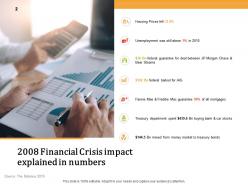
Slide 2: In this slide, 2008 Financial Crisis Impact Explained in Numbers.
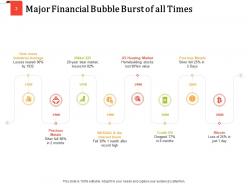
Slide 3: This slide showcases Major Financial Bubble Burst of all times
Slide 4: This slide displays Impact of The Great Recession on Investment Banks
Slide 5: This slide shows 2008 Financial Crisis Cost.
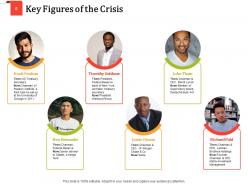
Slide 6: This slide presents Key Figures of the Crisis
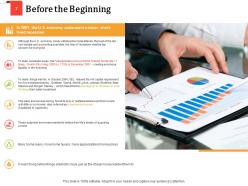
Slide 7: This slide shows Before the Beginning. In 2001, the U.S. economy underwent a minor, short-lived recession.
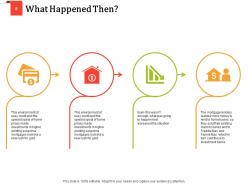
Slide 8: This slide explains What Happened after crisis.
Slide 9: This slide explains How did it Spread?
Slide 10: This slide explains How did those who bought CDOs protect themselves?
Slide 11: This slide displays Beginning of the End.
Slide 12: This slide showcases Subprime Effect
Slide 13: This slide displays Major Bailout Packages
Slide 14: This slide shows Recipients of Penalties
Slide 15: This slide showcases After a Decade- Current Scenario
Slide 16: This slide describes Fed Tapering
Slide 17: This slide shows Quantitative Easing
Slide 18: This is Global Financial Crisis Icons Slide.
Slide 19: This slide is titled as Additional Slides for moving forward.
Slide 20: This slide displays Our Mission, Vision and Goals.
Slide 21: This is 30 60 90 Days plan slide.
Slide 22: This is Our team slide with names and designations.
Slide 23: This slide displays Comparison.
Slide 24: This is Financial slide.
Slide 25: This slide displays Targets.
Slide 26: This slide shows Timeline
Slide 27: This is Thank you slide with Contact details.
Global Financial Crisis Powerpoint Presentation Slides with all 27 slides:
Use our Global Financial Crisis Powerpoint Presentation Slides to effectively help you save your valuable time. They are readymade to fit into any presentation structure.




FAQs for Global Financial Crisis
So basically banks were giving out mortgages to anyone with a pulse back then - people who obviously couldn't pay them back. Then they'd package all these garbage loans together and sell them as "safe" investments (yeah right). Housing prices tanked and everything fell apart like dominoes. The whole mess got way worse because of deregulation in the 90s and 2000s. Banks could basically gamble however they wanted. Honestly, just watch how loose lending gets and how much debt these institutions are carrying - that's your red flag for when things might go sideways again.
So basically the housing mess kicked off everything. Banks were literally giving mortgages to anyone - zero income checks, no money down, totally insane. Home prices tanked and millions just said "screw it" and walked away from underwater houses. All those sketchy mortgages got bundled into "safe" investments and sold worldwide. The whole system was way more connected than anyone realized. Oh and that friend who works in finance? Yeah, he lost like 40% of his portfolio because he trusted his advisor blindly. Always research what's actually in those securities they're pushing.
So basically, banks went crazy giving mortgages to people who had zero business getting them - bad credit, sketchy income, you name it. Everyone thought house prices would just keep climbing forever (lol). By 2006-2007, people started defaulting like crazy. Here's where it gets messy: banks had already chopped up these garbage loans and sold them as "investments" worldwide. Total disaster. Honestly, the whole thing could've been avoided if people just stuck to the old rule - if a deal sounds way too good, it probably is.
So basically banks used to have these rules keeping them from gambling with regular people's money. Then in '99 they killed Glass-Steagall and suddenly your local bank could also be playing the stock market with your deposits. Wild, right? With way less oversight, they started packaging up sketchy mortgages and selling them around. Think of it like - you remove all the safety barriers on a racetrack and yeah, cars go faster but the crashes are absolutely brutal. When one bank went down, they all started falling because everything was so connected. Just keep an eye on how rule changes might mess with your own investments.
Dude, it was absolutely insane. Markets everywhere just tanked - like 40-50% drops in just a few months. Banks literally stopped lending to each other because nobody trusted anyone anymore. Can't say I blame them honestly. Currencies were all over the place, everyone was dumping everything for Treasury bonds and gold. Commodities got destroyed too since nobody expected people to buy anything. I remember looking at investment accounts from that time - pure carnage. Government bonds were basically the only thing that didn't get completely wrecked.
Look, the bailouts were messy but they stopped everything from going to hell. Banks would've failed left and right otherwise, and good luck getting a loan when that happens. Yeah, it sucked watching taxpayers save the same idiots who created the problem - honestly still pisses people off. But credit markets started working again, which is what mattered. Sure, maybe it taught banks they can be reckless and get rescued later. That's a fair criticism. Still, without those bailouts we probably would've seen something way worse than what actually happened.
So basically the whole crisis taught everyone that you can't just trust your fancy models and assume past trends will continue - that's exactly what screwed everyone over. Banks had to learn the hard way about diversification instead of going all-in on housing. Crazy how many supposed experts totally missed the red flags, right? Now they stress test everything under worst-case scenarios, not just when markets are chill. Oh and they can't let just one team handle all the risk anymore - you need multiple people watching. Main takeaway: always plan for your core assumptions being dead wrong.
Dude, the 2008 crisis was brutal for jobs everywhere. Unemployment doubled in the US from like 5% to 10%. Spain got absolutely wrecked - hit 20%! Most developed countries saw similar jumps between 2007-2009. Germany somehow dodged the worst of it thanks to their safety nets, but places like Ireland got hammered. Youth unemployment in Europe was just devastating to watch. Recovery was all over the place though - really depended on each country's policies and how their economy was set up. Oh, and when you're looking at current job numbers, it's helpful to compare them against those crazy 2008-2010 figures for perspective.
So after 2008 went to hell, regulators freaked out and changed everything. Dodd-Frank hit in the US - stricter capital rules, new consumer protection bureau, the works. Basel III made global banks hold way more cash reserves. Now they stress-test constantly to prove they won't collapse again. Derivatives got way more oversight too. The whole "too big to fail" problem supposedly got fixed with resolution plans, but honestly? These banks are still enormous. Oh and if you're thinking finance career - compliance became a nightmare but hey, maybe we won't have another meltdown.
Honestly, that whole mess made everyone paranoid about money. People got obsessed with emergency funds and started comparing prices on literally everything. Generic brands became the norm, restaurants took a hit because everyone was cooking at home. The "do I actually need this?" question became real - and weirdly, a lot of folks never stopped asking it. Trust in banks? Pretty much shot. Now people research the hell out of big purchases instead of just trusting their financial advisor. Even today, most consumers still pick value and security over flashy stuff or convenience. Wild how lasting those changes were.
Honestly, the whole thing just made countries way more paranoid about depending on each other for trade. Everyone started scrambling for their own bilateral deals instead of trusting the big multilateral stuff. Regional blocs like the TPP got huge. China weirdly ended up gaining power from it all - pretty crazy since they didn't even cause the mess. Companies totally rethought their supply chains too. No more just-in-time everything; now it's all about not getting screwed when things go sideways. Oh, and if you're digging into data, look at 2009-2012. That's where you'll see the real changes happening.
Yeah, emerging markets got wrecked when investors panicked and yanked their money back to "safer" places. Brazil, Russia, Eastern Europe - their currencies and markets just tanked. Capital flight was insane. But here's what's crazy: they bounced back way faster than the US and Europe did. Their banks weren't loaded up with all that toxic garbage, so once the dust settled they recovered quicker. Now if you're thinking about investing there - and I mean, who knows with markets these days - just look for countries with solid foreign reserves and economies that aren't totally dependent on one thing.
Honestly, you've gotta prep for the worst before it happens. Keep solid cash reserves and don't put all your eggs in one basket revenue-wise. 2008 was brutal - even "safe" stuff like real estate got destroyed. Debt should stay reasonable, and get those credit lines sorted now while banks actually like you. Your suppliers and customers? Those relationships will save your ass when things get rough. Oh, and do this exercise - figure out how many months you'd last with zero income coming in. That number will either make you sleep better or scare you into action real quick.
Dude, those credit agencies totally screwed everyone over. They gave AAA ratings to these super sketchy mortgage products - basically said they were as safe as government bonds. But here's the kicker: the banks creating this garbage were literally paying the agencies to rate them. So yeah, major conflict of interest there. Pension funds saw those ratings and thought "oh sweet, safe investment!" Wrong. When housing crashed, all those "super safe" securities went to zero overnight. Honestly makes me not trust any of these rating systems. Always do your own research before putting money anywhere.
So 2008 totally flipped how central banks work. Interest rates stay super low now - like, for years instead of months. The Fed started doing all this quantitative easing stuff, basically creating money to buy bonds when regular rate cuts weren't working anymore. They're obsessed with financial stability now, not just keeping inflation in check. I mean, makes sense after watching everything almost collapse. Oh and those "emergency" low rates? They're pretty much normal now, so plan around that continuing. Wild how temporary fixes become permanent, right?
-
Wonderful templates design to use in business meetings.
-
Excellent products for quick understanding.
-
Awesomely designed templates, Easy to understand.
-
Much better than the original! Thanks for the quick turnaround.
-
Attractive design and informative presentation.