


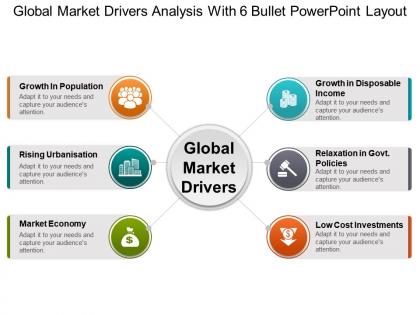
Global market drivers analysis with 6 bullet powerpoint layout




Try Before you Buy Download Free Sample Product
 Impress Your
 Audience
 100%
100% Editable
 Save Hours
 of Time


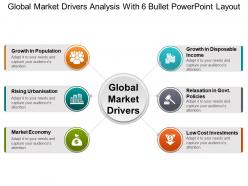
We are glad to offer our fully professional, modern, business oriented global market Drivers Analysis with 6 Bullet PowerPoint layout presentation template to let you provide a detailed analysis of the global market along with market size by growth, value, segments etc. You can display various market globalization drivers such as growth in population, rising urbanization, economy, income, investments, change in government policies with this amazing PPT template. Design template can also be used to display globalization in international business management, different drivers and restraints of globalization in advance, so that necessary actions can be taken on time and business goals can be achieved without any hassle. The design template is extremely useful as analyzing market growth drivers and hurdles of globalization in advance will provide you an extra advantage over your competitors. So, keeping all these aspects in mind, download this wonderful market drivers and new business models PPT template and use in your future presentations to impress your audience. Establish eligibility with our Global Market Drivers Analysis With 6 Bullet Powerpoint Layout. Convince folks you have the acumen.
People who downloaded this PowerPoint presentation also viewed the following :
Global market drivers analysis with 6 bullet powerpoint layout with all 5 slides:
Help is here! Our Global Market Drivers Analysis With 6 Bullet Powerpoint Layout are ready to bail you out of all your presentation presentation worries.

FAQs for Global market drivers analysis with 6
Honestly, focus on GDP growth, inflation (CPI data), and unemployment numbers first - those are your bread and butter. Interest rate decisions from central banks will move markets fast. Consumer confidence and manufacturing PMIs are gold because they show if people actually want to spend money. Oil prices? Yeah, they mess with everything sometimes so don't ignore them. Currency rates matter big time for international stuff. Set up alerts for your region plus US, EU, and China since they pretty much control global trends. Monthly releases are perfect to start with - you'll spot the patterns quick.
Markets absolutely hate uncertainty, so whenever geopolitical stuff happens you get crazy volatility in currencies, stocks, commodities - the whole mess. Look at Ukraine - energy and grain prices went nuts because they're huge exporters. Investors always run to safe stuff like gold or the dollar when things get scary. But here's what's wild - it's not just short-term chaos. These events actually force companies to completely rebuild their supply chains and find new trading partners. Even election trade policies can mess with markets for months. Honestly, sanctions alone can flip entire industries upside down.
Tech basically flips the whole game - early adopters get cheaper costs and better products while everyone else scrambles to keep up. Look at Netflix vs Blockbuster, or how Africa just skipped straight to mobile banking instead of building traditional banks everywhere. Pretty wild when you think about it. Companies that drag their feet? They're toast. I've seen it happen so many times - you blink and suddenly your competition is doing things you didn't even know were possible. Best move is just staying curious about what's coming next and trying stuff out before you're forced to.
Honestly, consumer behavior is what makes or breaks entire markets. When people start buying differently - like this whole sustainability craze - companies scramble to redesign everything from supply chains to products. It's wild how fast these changes spread now thanks to social media. A trend in one country hits everywhere else within months instead of years. I'd definitely watch what consumers in your industry are doing differently. Those shifts usually signal where the whole market's headed next. Plus it gives you a heads up before everyone else catches on.
Ugh, currency swings are such a pain for multinationals. Your overseas revenue becomes worth way more or less when converted back home - total profit roller coaster. Material costs from international suppliers shift constantly too. Products that were competitive yesterday might be overpriced tomorrow in certain markets. It's honestly exhausting trying to plan anything! Smart companies usually hedge with forward contracts to lock in exchange rates. Removes some of that crazy volatility. Though my cousin's company tried that once and... well, that's another story.
Climate and geography totally change your game plan for different markets. Clothing brands switch up their inventory for hot vs cold places, right? Tech companies have to tweak hardware for dusty or humid environments too. Everyone's super focused on being eco-friendly now - honestly it's kind of exhausting but customers care. You'll need to research local environmental rules and energy costs early on. Supply chains get tricky with shipping routes and seasonal material shortages. Geography basically dictates everything from what you sell to how you get it there.
Demographic changes completely flip consumer spending patterns. Aging populations in Europe and Japan? They're boosting healthcare and luxury markets big time. Meanwhile, younger crowds in Africa and Southeast Asia are driving tech adoption and buying more basic goods. Birth rates can literally predict market opportunities 30+ years out - kinda wild when you think about it. A product crushing it in Germany could totally bomb in Nigeria just because of age differences. Population pyramids are actually super useful when you're scoping out new markets.
So trade deals are basically the opposite of tariffs, right? Deals open up markets by cutting barriers and making regulations easier to deal with. Tariffs just make your stuff more expensive abroad - nobody wants that. It's honestly like the rules change every week depending on what politicians are up to. Your pricing gets hit, supply chains cost more, and some markets become totally pointless to enter. I'd definitely watch what's happening with trade talks in places you want to expand. These things can flip your whole strategy pretty fast.
Oh man, you really can't just translate stuff and hope it works. I found out the hard way when this "be yourself" campaign totally bombed in South Korea - turns out that message doesn't hit the same there. Colors, images, even your whole vibe needs to match what people actually value. Like in Japan, group harmony trumps individual success every time. The US loves that "stand out from the crowd" energy, but it'll fall flat in collectivist cultures. Honestly? Get local consultants before you do anything. Market research first, campaigns second.
Supply chain mess-ups totally wreck market stability. Prices go crazy, investors freak out, everything gets unpredictable. Blocked shipping routes or factories shutting down? Boom - commodity prices spike immediately. Then it spreads everywhere since everything's connected now. Markets hate uncertainty, so traders get all twitchy when they can't figure out what stuff will cost next month. My buddy works in logistics and says it's gotten way worse lately. You should probably watch supply chain indicators in your industry. Maybe diversify suppliers or look into hedging - anything to cushion the blow when this stuff inevitably happens again.
So basically, digital transformation flips customer engagement from you just shouting at people to having actual conversations in real time. Now you can personalize stuff for tons of customers at once and track how they move between your website, app, whatever. The best part? No more guessing games - the data shows you exactly what people want. You're meeting customers where they already hang out, like on their phones or social. Oh, and make sure all your different platforms actually connect to each other first. That's honestly where most companies mess up. Creates way better relationships when everything works together smoothly.
India's where I'd put my money first - that middle class boom is insane. Vietnam's crushing it too as the new manufacturing hotspot since everyone's moving away from China. Nigeria might surprise you, it's Africa's biggest economy and the young people there are super tech-forward. Honestly Southeast Asia in general is on fire right now. Bangladesh and Indonesia are worth watching too, though I feel like everyone sleeps on Bangladesh. You should probably start thinking about these markets before your competition beats you to it.
Honestly, sustainability stuff is pushing companies to get way more creative than they used to be. You've got to cut waste and emissions somehow, right? So they end up inventing new tech and materials that actually give them an edge over competitors. Millennials will pay extra for eco-friendly products too - like 70% of them according to research I've seen. The government regulations are getting stricter every year, which means early movers grab market share while everyone else plays catch-up. My advice? Figure out what green trends are gonna hit your industry first and beat them to it.
Honestly, data analytics is like having a crystal ball for consumer trends. You can track what people are buying, their social media vibes, search patterns across different countries - way faster than waiting around for traditional market research. I love how you get real-time insights instead of guessing. Set up some dashboards for your target regions and you'll start seeing which products are about to explode, when seasonal stuff shifts, how culture affects purchases. The patterns that pop up will blow your mind. It's basically spotting opportunities before everyone else catches on.
Regulatory changes hit companies way harder than most people realize. Your supply chains get turned upside down. Pricing has to shift. Sometimes you're literally redesigning products to stay compliant - it's wild how fast this stuff moves. Look at what happened with EU privacy laws, total chaos for companies that weren't ready. The smart ones? They're already watching for what's coming next and building operations that can pivot quickly. Honestly, the companies doing this right are making their competitors look like they're standing still. Make sure your legal team isn't working in a silo from ops.
-
The content is very helpful from business point of view.
-
Very unique, user-friendly presentation interface.