


Handling Emergency Situations At Hotel Training Ppt




Try Before you Buy Download Free Sample Product
 Impress Your
 Audience
 100%
100% Editable
 Save Hours
 of Time


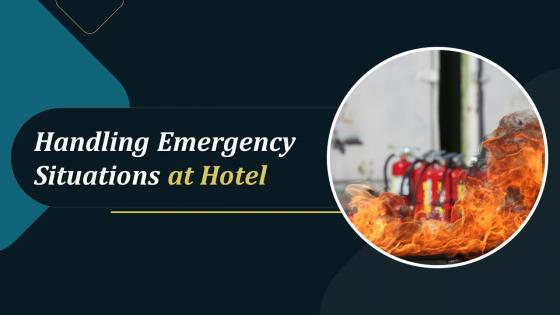
This set of slides contains information about possible emergencies at hotel premises and preventive measures to avoid them. The emergencies covered are fire incidents, bomb threat situations, accidents, medical emergencies, death of a guest, and drunk guests.
People who downloaded this PowerPoint presentation also viewed the following :
Content of this Powerpoint Presentation
Slide 2
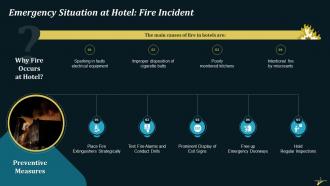
This slide contains information about main sources of fire at hotel which are: sparking in faulty electrical equipment, improper disposal of cigarette butts etc. It also lists preventive measures to avoid fire accidents such as placing fire extinguishers strategically, testing fire alarms and conducting drills etc.
Instructor’s Notes:
Preventive measures to avoid fire incidents at a hotel are:
- Place Fire Extinguishers Strategically: Ensure that the fire extinguishers in hotels have a proper weight and gauge limit, and replace them if they do not have one. Extinguishers rated Classes A, B, and C, which are capable of extinguishing fires involving paper, wood, oils, and gases, respectively should be placed at strategic locations in a hotel
- Prominent Display of Exit Signs: At the time of the fire, conditions can be chaotic and confusing, which is why exit signs should be illuminated and prominently displayed to guide people even if their vision is obscured
- Test Fire Alarms and Conduct Drills: Fire alarms quickly warn everyone that a potential danger exists. Testing of fire alarms will help locate faults (if any) that can be corrected before any disaster strikes. Also, fire drills for the employees should be conducted as part of the emergency action plan
- Free up Emergency Doorways: Employees must be made aware that places where bulletin boards are covered in paper are high-risk fire areas; here a little spark would turn into a big fire. Moreover, emergency doorways should not be blocked by other things. Any sort of boxes or equipment should be moved aside so they don't slow down the process of moving out of the hotel
- Hold Regular Inspections: Not keeping up-to-date with fire safety system and neglecting their annual services results in faulty equipment. Proper inspection of alarms, lights, and extinguishers should be carried out
Slide 3
This slide represents the checklist to be used for fire incidents preparedness at hotel. It contains details about the arrangements made related to exteriors, exit features, hazardous materials, fire alarm systems, and waste disposal.
Slide 4
This slide contains information about the emergency situation of bomb threat at hotel and the standard operating procedures (SOPs) to follow if a bomb threat is received by a call.
Slide 5
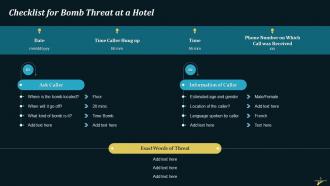
This slide represents the checklist to be used for a bomb threat call. It contains details about the threat, questions to be asked from the caller, the wording of the threat, and information about the caller.
Slide 6
This slide contains information about the Standard Operating Procedures (SOPs) to be followed at the time of accident in a hotel.
Slide 7
This slide represents an accident reporting form to be used by the hotel. It contains details about the guest’s information, person who reported the accident, description of the accident, its cause and the follow-up recommendation for the same.
Slide 8
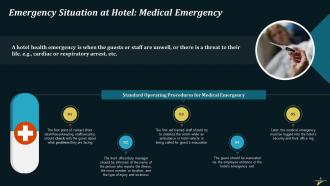
This slide contains information about the Standard Operating Procedures (SOPs) to be followed at the time of illness or epidemics at the hotel.
Slide 9
This slide showcases the SOPs to follow in case of guest’s death at hotel.
Instructor’s Notes:
Following are the steps which hotel staff should follow in case of guest’s death:
- Inform General Manager: If a death occurs in hotel premises, the general manager should be informed immediately, who will then calls the doctor and the police
- Confirm Cause of Death from Doctor: Once the doctor confirms the death of the guest, the address of the guest should be identified and their family members informed
- Handover Body to Kin: Once all formalities are completed, the body, fully covered should be put on a stretcher. The luggage of the deceased shall be handed over to the kin of the deceased upon their signatures
- Disinfect the Area: Later on, after permission from the police, the area should be thoroughly cleaned and disinfected
Slide 10
This slide contains information about the handling procedure of a drunk guest at a hotel. The guest has to be handled with patience, must be shifted to other areas, and security staff must be called in.
Handling Emergency Situations At Hotel Training Ppt with all 28 slides:
Use our Handling Emergency Situations At Hotel Training Ppt to effectively help you save your valuable time. They are readymade to fit into any presentation structure.




















FAQs for Handling Emergency Situations At
You'll want to start with hazard identification and clear evacuation routes. Designate emergency wardens and make sure everyone knows who's doing what for fires, medical stuff, severe weather - the whole deal. Honestly, regular drills are everything because people's brains just shut off when they're scared. Practice quarterly at minimum. Communication protocols matter too, plus updated contact lists and a way to account for everyone after. Oh, and map out where your exits, first aid kits, and emergency supplies are. Sounds boring but it's worth it. When's your last drill been?
Start with checking all your current emergency plans - are they actually current or from like 2019? Run through those tabletop exercises with your team because honestly, they always expose more problems than you think they will. Survey people about whether they'd know what to do in a real emergency. Most won't, but that's fine - that's why you're doing this! Look back at any incidents you've had for lessons. Oh, and definitely schedule a practice drill soon. Real-time tests show you exactly where things fall apart way better than paperwork ever will.
Dude, scenario training is a game changer. Reading procedures vs actually doing them under pressure? Totally different animals. When your heart's pounding in a real emergency, you'll fall back on whatever you've practiced - not what you memorized. I learned this the hard way at my old job. These drills expose weak spots in your plans and get your team working like they actually know each other. Plus there's something about going through the motions that builds real confidence. Just make sure you're practicing stuff that could actually happen in your specific building, not some generic fire drill nonsense.
VR simulations are honestly game-changers for emergency training - you can practice fire drills or medical scenarios without anyone getting hurt. Mobile apps are clutch too since your team can pull up protocols right during an actual emergency. Online modules work great for people with crazy schedules. Gaming elements actually keep folks awake instead of scrolling their phones (trust me, I've sat through those boring safety presentations). Analytics show you who's slacking on training and what gaps you've got. I'd start simple though - maybe just a basic app with emergency contacts and key procedures first.
You definitely want them feeling realistic but safe - no point putting anyone in actual danger. Run them quarterly minimum, but mix up the scenarios so people don't just sleepwalk through it. Some should be surprise ones too since real emergencies don't exactly send calendar invites, you know? After each drill, spend time debriefing - that's honestly where you learn the most. Test your comm systems and evacuation routes under actual conditions, not perfect ones. Oh and don't forget to collect feedback from everyone who participated. Schedule your next one soon while you're thinking about it!
So basically every industry trains for their own nightmare scenarios, you know? Hospitals drill infection control and moving patients fast. Manufacturing plants? They're all about chemical spills and equipment going haywire. Oil companies practice for those crazy wellhead blowouts (honestly terrifying if you think about it). Restaurants focus on kitchen fires, schools do lockdown drills. You get the idea. Figure out your top 3-5 risks at work and train around those. Don't waste time on generic stuff that'll never happen to you - make it real and specific to what you'd actually face.
Your mindset matters way more than people think. I've watched guys with solid skills completely choke during drills because they weren't ready mentally. Stress literally hijacks your brain if you haven't trained for it. Clear thinking goes out the window fast when you're panicking. That's the whole point of repetitive scenario training - builds muscle memory AND toughens you up psychologically. You can't just practice the technical stuff and expect to perform under pressure. Honestly, most people skip the mental prep and wonder why they freeze up. Start adding stress inoculation exercises to whatever you're already doing.
Honestly, most places just tick the training box and call it done - huge mistake. Run surprise drills and time everything: evacuation speeds, how people actually use equipment, communication during chaos. Quiz folks after sessions to see what stuck. I always throw in some post-drill surveys too because people will tell you straight up what sucked. The real test isn't whether they showed up to training. Can they actually perform when stuff hits the fan? Decision-making under pressure is where you really see if your training worked or if it was just another boring PowerPoint session.
Start with FEMA's free templates - they're actually pretty good and cover most scenarios. Red Cross has solid downloadable stuff too. OSHA gives you the regulatory backbone you need. Mix those official resources with real case studies though, makes it way less boring for people. Oh and definitely check your local emergency management office, they sometimes have region-specific materials that are super helpful. I'd grab FEMA's basics first since they're comprehensive, then tweak everything for your specific workplace hazards. The evacuation procedures part is usually what needs the most customization anyway.
Definitely do it once a year minimum - though if you're in something risky like construction, maybe bump it to every 6 months. CPR's got those strict deadlines you can't mess around with. Honestly though, I'd throw in quick refreshers whenever new people join your team too. The muscle memory thing is real - you don't want to be fumbling around trying to remember steps during an actual emergency. Oh, and after any incident happens, that's prime time for a refresher while it's fresh. Just block those dates in your calendar now like they're doctor appointments you can't skip.
Honestly, getting people to actually care is the hardest part - everyone just sees it as another box to tick. Budget's always tight too since good training costs real money. Then there's the nightmare of finding time slots that work for everyone's crazy schedules. Plus you've gotta keep updating everything because workplace harassment stuff changes constantly (which is exhausting). My advice? Skip the generic scenarios and make it super specific to your actual workplace situations. Rolling it out department by department works way better than doing everyone at once - learned that the hard way at my last job.
So you know how it sucks when your one emergency person calls out sick? Cross-training fixes that mess. Get 2-3 people trained on each critical thing - equipment, evacuations, talking to first responders, whatever. Way faster response times when everyone actually knows their stuff. People work better together when they're not totally clueless about what others are doing, especially when everything's chaos. I learned this the hard way at my old job honestly. Start with your most important roles first and build from there.
Look, the legal exposure is no joke here. OSHA will absolutely hammer you with fines if your emergency training sucks and someone gets hurt. Workers' comp claims pile up fast too. The real nightmare though? Negligence lawsuits where they prove your people weren't trained right. Your insurance might even bail on you if they think the training was garbage. I'd honestly do a full audit of what you've got now and make sure everything's documented properly - like, obsessively documented. Way better to overdo it than have some lawyer picking apart your program later.
Getting your community involved is honestly a game-changer for emergency prep. You'll have way more trained people and resources to work with when things go sideways. Local folks know stuff you'd never think of - like which roads flood first or where the elderly neighbors live. My cousin's company learned this the hard way during that ice storm last year. Instead of your team scrambling alone, you're part of something bigger. Check with your local emergency management office first. They usually have training programs already running that you can jump into.
Your leaders basically make or break the whole thing. If they're actually showing up to training and talking openly about safety stuff, people pay attention. But when managers just dump it on someone else? Total disaster - nobody cares. The best ones I've worked with celebrate when teams do safety stuff right and make people feel comfortable asking dumb questions or reporting weird things they notice. Honestly, it's pretty simple psychology. Your team's only gonna take emergency prep seriously if they see leadership visibly giving a damn about it first. Actions speak way louder than memos.
-
Understandable and informative presentation.
-
Their designing team is so expert in making tailored templates. They craft the exact thing I have in my mind…..really happy.