

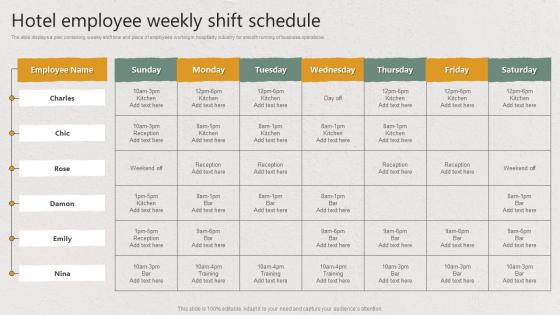
Hotel Employee Weekly Shift Schedule




Try Before you Buy Download Free Sample Product
 Impress Your
 Audience
 100%
100% Editable
 Save Hours
 of Time


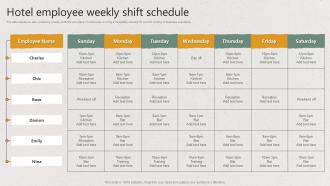
The slide displays a plan containing weekly shift time and place of employees working in hospitality industry for smooth running of business operations.
People who downloaded this PowerPoint presentation also viewed the following :
Hotel Employee Weekly Shift Schedule with all 6 slides:
Use our Hotel Employee Weekly Shift Schedule to effectively help you save your valuable time. They are readymade to fit into any presentation structure.





FAQs for Hotel Employee
Honestly, start by figuring out when you actually need bodies there vs. when it's just nice to have coverage - saves you from overstaffing slow days. Map out everyone's availability and skill levels first. Don't be that manager who always schedules the same person for weekend shifts, you know? Build in buffer time because someone's always gonna call out last minute. Check the legal stuff too - max hours, breaks, all that. I'd sketch a rough draft then run it by the team before you lock it in. They'll catch things you missed and probably appreciate being asked.
Dude, employee preferences are literally everything for scheduling. Ask your team what they actually want first - days off, morning vs night shifts, whatever. You'll get way fewer people calling in "sick" or begging to switch last minute. Trust me on this one. Sure, you still need to cover all your shifts and keep operations running, but happy employees show up. It's not rocket science, though managers act like it is sometimes. Just survey everyone about their real preferences, then build around those patterns when you can. People want some control over their lives.
Schedule 15-30 minute overlaps so outgoing staff can actually brief the next shift. Seriously, places that skip this turn into a total mess! Have them use some kind of checklist or form - doesn't need to be fancy, just consistent so important stuff doesn't fall through the cracks. Your team should know exactly when to show up for handoffs. Maybe set up a simple log both shifts can check during transitions? The overlap time costs you a bit upfront but saves so much headache later when things don't get missed or duplicated.
Dude, get some scheduling software - it'll change your life. Apps like When I Work or Deputy let your staff swap shifts and request time off right from their phones. No more texting chains about who can cover what. The smart ones now actually factor in labor laws and busy periods automatically, which honestly blows my mind. When someone calls out sick, you get instant alerts so you can scramble for coverage way faster. I'd say try one for a couple weeks and see how it goes. Way better than those hellish spreadsheets you're probably using now!
So labor laws are basically what stop your boss from making you work 24/7 lol. They cover the big stuff - max hours per day, when you get breaks, overtime kicks in after 40 hours, rest time between shifts. Your state probably has specific rules about meal breaks after like 5-6 hours too. Honestly, some managers act like these laws don't exist until they get hit with fines. Before you agree to any weird schedule, I'd definitely check your state's labor department website. It's boring reading but worth it. Companies can still run their business, they just can't treat people like robots.
Healthcare does 12-hour shifts to cut down on handoffs - pretty smart for any 24/7 place. Manufacturing rotates forward (days to evenings to nights) since it's way easier on your body than going backward. Retail now uses data to predict rush times and staff up accordingly. Airlines though? They've nailed this stuff. Their rotation systems balance what employees want with what actually needs to get done. Honestly, just look at industries dealing with similar headaches as yours. Why start from scratch when someone's already figured it out?
Oh man, the worst part is definitely understaffing and people calling out sick at the worst possible times. Everyone wants weekends off too - I swear it's like they think the business closes or something lol. Cross-training helps a ton so people can jump between roles. Get some decent scheduling software that flags gaps before they bite you. Build in extra coverage because someone's always gonna be sick on a Saturday. Give people their schedules way ahead of time and rotate the crappy shifts fairly. Honestly, just pick your biggest headache first and fix that before trying to solve everything. You'll go crazy otherwise.
Honestly, most managers mess this up by never actually asking what their people want. Start there first. Then figure out your core hours when you absolutely need bodies, and build flexibility around that - maybe shift swaps, compressed weeks, whatever works. Get some basic scheduling software to see where you're wasting coverage vs where you're stretched thin. The weekend rotation thing is huge though - nobody wants to feel like they always get stuck with Saturdays. Be upfront about when you genuinely need certain shifts covered, but give people choices when you can. Oh, and don't change schedules last minute unless it's an emergency. Pick one flexible option to test first.
Honestly, just start with your old data - that's gonna be your goldmine. Look at past patterns and when you get busy during different seasons. Then figure out how many tasks each shift actually needs and work backwards to staffing numbers. There's fancy statistical stuff like regression analysis if you're feeling ambitious, but honestly? Simple methods work just fine most of the time. Track things like call volume or how many people walk through your doors. Seasonal adjustments are key too. Mix historical data with those seasonal tweaks and you'll get pretty close to what you actually need.
Honestly, flexible scheduling is a game-changer for employee happiness. People get way less stressed when they can work around their actual lives instead of fighting some arbitrary 9-to-5. Your retention will improve because workers feel trusted. Burnout drops. Sick days decrease too. I'd start by just asking your team what kind of flexibility they actually want - maybe some want different start times, others need remote days. Then try a few things out and see what sticks. It's wild how much this one change can transform workplace morale.
Deputy, When I Work, and Humanity are your best bets. They all handle the basic stuff like conflict detection pretty well. Deputy's super user-friendly - great if your managers aren't tech wizards. When I Work won't break the bank but still gets the job done. Humanity's got solid forecasting if you're dealing with complicated operations. Honestly though, interfaces matter way more than you'd think since your managers will be staring at these things every day. Grab free trials for a couple and see what feels right - that's how I picked mine.
Honestly, chaos theory explains this perfectly - when one person calls out sick, everything falls apart. You get coverage gaps that force overtime. Staff burns out from the extra hours. Then more people call out because they're exhausted. It's wild how fast it spirals. The trick is spotting where you're most vulnerable and building in some breathing room. One callout shouldn't tank your whole operation, you know? I'd map out which shifts depend on each other most heavily. Always have backup plans... and then backups for those backups too.
Honestly, shift timing makes a huge difference for your team's performance. The wrong schedule absolutely kills productivity, but get it right and you'll see way better focus and fewer mistakes. Night shifts are the worst - they typically drop performance by like 10-15% compared to day shifts. Consistent schedules beat rotating ones every time because people can actually get into a rhythm. I'd say track your main metrics for a few weeks across different patterns. You'll figure out pretty quickly what works for your situation. It's kind of obvious once you see the data side by side.
Oh man, shift work is brutal for your head - anxiety and depression go through the roof when your body clock doesn't know what's happening. Sleep gets totally screwed, which makes the mood stuff even worse. Here's what actually works though: rotate forward through shifts (day to evening to night), give people 48+ hours between changes, and don't pile on too many nights in a row. Also predictable schedules posted two weeks ahead make a huge difference. I swear some managers think they can just wing it with scheduling but consistency is everything. Your brain needs to know what's coming next.
Start with the basics - turnover rates, missed shifts, and how much you're bleeding on overtime costs. Those numbers don't lie. Check if productivity drops during certain shifts too. If you've got customers, their satisfaction scores will tell you a lot. But here's the thing - just ask your people how they're feeling about it. I know that sounds too simple, but their feedback is gold. Survey them about work-life balance and whether they're exhausted all the time. Then see how all this lines up with what you're trying to achieve business-wise. Pull last quarter's data first though, that's where you'll spot the real problems.
-
The slides come with appealing color schemes and relevant content that helped me deliver a stunning presentation without any hassle!
-
The ease of modifying templates is just superb! Also, the vast collection offers plenty of options to choose from.