


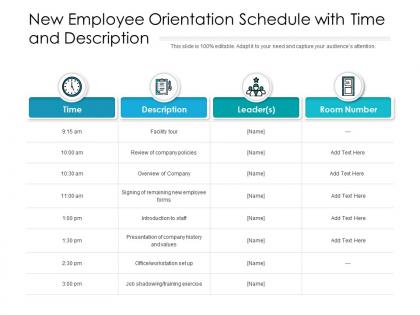
New employee orientation schedule with time and description




Try Before you Buy Download Free Sample Product
 Impress Your
 Audience
 100%
100% Editable
 Save Hours
 of Time


Our New Employee Orientation Schedule With Time And Description are topically designed to provide an attractive backdrop to any subject. Use them to look like a presentation pro.
People who downloaded this PowerPoint presentation also viewed the following :
New employee orientation schedule with time and description with all 2 slides:
Use our New Employee Orientation Schedule With Time And Description to effectively help you save your valuable time. They are readymade to fit into any presentation structure.
FAQs for New employee orientation schedule with
Don't dump everything on them day one - that's just cruel and nobody remembers it anyway. Spread the important stuff over their first week or two instead. Cover the basics: company culture, their specific role training, boring admin like benefits, and introduce them to the team. Oh, and definitely set up those 30-60-90 day expectations early. I'd prioritize what they absolutely need to know right away versus what can wait. Build in shadowing time with experienced people - that's usually way more valuable than another PowerPoint. The whole point is making them feel ready and welcomed, not like their head's spinning.
Honestly, digital onboarding platforms are a game-changer - you can build interactive modules and virtual tours instead of death-by-PowerPoint sessions. Set up automated welcome emails and get team members to record quick video intros. That personal touch goes surprisingly far. Online resource hubs work great too since people can reference stuff later without bugging HR constantly. Oh, and VR training exists now which is wild, but probably overkill unless you're Google or something. Even just digitizing paperwork and making a few welcome videos will transform how new hires feel that first week.
Honestly, your company's vibe totally shapes how you set up orientation. Collaborative places spend way more time on team intros and group stuff instead of just parking people at computers all day. Results-focused companies? They hit you with performance goals right off the bat. Some lucky companies keep it super chill, others have these intense multi-week boot camps that reflect how formal everything is. The main thing is don't make orientation feel completely different from actual work life - nobody wants that jarring "wait, this isn't what I signed up for" moment after week one.
Just swap the in-person stuff for virtual versions - office tours become screen-shared workspace walkthroughs, meetings go to video calls, physical handouts become PDFs. Actually, recorded virtual tours are kinda genius because new hires can rewatch them later. Build in extra time for tech setup and VPN nonsense. Remote people need way more check-ins their first week since they can't just wander over with questions. Oh, and definitely set up a digital buddy system - that's clutch for making them feel less isolated.
Honestly, the worst thing you can do is dump everything on them day one. Information overload is real and they'll forget half of it anyway. Mix things up - skip the endless PowerPoint parade and throw in some hands-on stuff. Get them working on actual tasks between the boring orientation bits. Oh, and make sure they meet with their manager super early, like day two max. That relationship sets the tone for everything. Don't pack sessions back-to-back either. People need bathroom breaks and a chance to process stuff. Include some casual hang time with the team too - maybe lunch or coffee. Stretch the whole thing over a week or two instead of cramming it all in. Way more effective.
Set up feedback touchpoints after orientation and at the 90-day mark. Anonymous surveys work way better than face-to-face - people actually tell you what sucked instead of being polite. The goldmine is those "what I wish someone told me day one" responses. Look for patterns around timing issues or info overload. Then here's the crucial part (that most companies blow) - actually change things based on what you hear. Swap boring modules, fix gaps, adjust pacing. Oh and tell the next batch of hires what you updated. They love knowing their feedback mattered and won't happen to them.
Look at retention first - are people leaving within 30-90 days? That's your biggest red flag. Time-to-productivity matters too, like when they actually hit their stride or stop asking a million questions. Manager feedback scores help, but honestly? Just straight up asking "did orientation actually prepare you?" works better than fancy surveys sometimes. New hire satisfaction surveys are solid data points. Oh, and track this stuff month over month - you'll see trends emerge fast. If your numbers suck consistently, that's when you know something's broken in the process.
Honestly, I'd check it every 2-3 months if possible. Quarterly at minimum though. New compliance stuff pops up, processes change, and you'll get feedback from recent hires about things that totally confused them. Your company's evolving too, so what made sense six months ago might feel ancient now. I always forget unless I set a calendar reminder - probably should've done that sooner at my last job. Ask your newest people what they wish they'd known on day one. Their feedback is usually spot-on since everything's still fresh.
Honestly, ditch the all-day lecture approach - nobody retains that anyway. Mix in hands-on stuff with short presentations. Get them actually meeting team members, not just hearing about org charts. I know it sounds super cheesy, but office scavenger hunts genuinely work for breaking the ice. Give them small real tasks so they feel useful immediately. Check in throughout the day to see how they're doing. The game-changer though? Assign a buddy for their first week. Someone who'll answer all those "stupid" questions they won't ask you directly. You want them excited, not drowning in information overload.
Honestly, getting different departments involved in orientation is such a game changer. New hires get to hear from actual team leads instead of just HR reading policies at them. Way better than the boring handbook stuff, you know? Each department sees things HR might totally miss about what newbies actually need to know. I'd do like 15-minute "day in the life" sessions from each team during that first week. People remember stories way more than bullet points anyway. It's just more real when you hear what the job's actually like from someone who's doing it every day.
Oh man, definitely include the basic stuff - employee handbook, org chart, job description with their main duties. IT setup guides are crucial too. Building maps and parking info might seem silly but trust me, people get lost on day one. Also cafeteria hours, key contacts list (new people forget names constantly), and any required training materials. Benefits enrollment forms obviously. Maybe toss in something about company culture? Honestly the trick is giving them what they actually need without drowning them in paperwork. Prioritize the stuff they'll use immediately.
Honestly, the best approach is pairing them up right on day one. Have mentors actually sit in on some orientation stuff - makes their follow-up conversations so much better instead of just generic small talk. Weekly 30-minute check-ins work great for the first month, then you can space them out more. Oh, and ditch some of those boring company culture presentations for casual coffee chats instead. Way more effective. The whole thing shouldn't feel like another box they're checking off. After a month or so, you'll naturally need fewer touchpoints as people get comfortable.
Honestly, 3-5 days works for most jobs, but it really depends on how complex the role is. Some places do a full week deep-dive, others spread it out over two weeks with shorter sessions. I've seen those one-day orientations and they're just stressful for everyone - way too rushed. You don't want to drown people in paperwork on day one, but you also can't skip the important stuff like culture, policies, and basic system training. Oh, and introductions obviously. My advice? Figure out what you absolutely can't skip first, then work backwards to see how much time you'll actually need. The goal is they feel ready to actually do their job, not overwhelmed.
Mix up your orientation activities to hit different learning styles. Throw in some videos and infographics for visual people. Role-playing and hands-on stuff works great for kinesthetic learners. Don't forget discussion groups for the auditory folks - they'll eat that up. Honestly, I've seen companies overcomplicate this and create these insane schedules that nobody can follow. Just switch formats every 30-45 minutes and you're golden. Oh, and reading materials too for people like me who actually prefer that. Survey your new hires first about what they like, then rotate between different approaches instead of death by PowerPoint all day.
Okay so the must-haves are harassment training, safety stuff, and data privacy agreements. Sexual harassment training is legally required within 90 days in most states - seriously don't forget that one. Basic safety protocols and emergency procedures are obvious. Then whatever's specific to your industry, like HIPAA for healthcare or financial regs if you deal with money. Code of conduct too obviously. The whole legal training block usually takes 2-3 hours which honestly feels long but whatever. Oh and document when everyone completes it because auditors are obsessed with that stuff.
-
Graphics are very appealing to eyes.
-
Innovative and Colorful designs.
-
Wonderful templates design to use in business meetings.
-
Topic best represented with attractive design.
-
Qualitative and comprehensive slides.