


How Does 3d Printing Work AI In Manufacturing Ppt Powerpoint Presentation File Aids




Try Before you Buy Download Free Sample Product
 Impress Your
 Audience
 100%
100% Editable
 Save Hours
 of Time


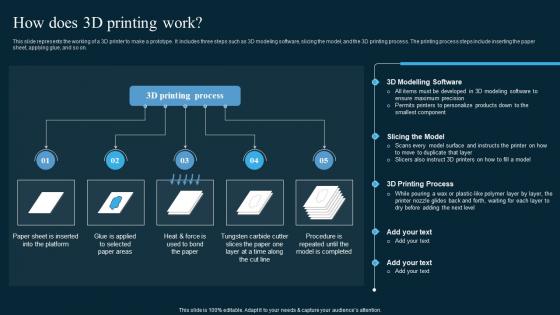
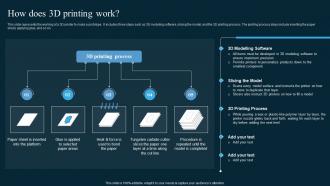
This slide represents the working of a 3D printer to make a prototype. It includes three steps such as 3D modeling software, slicing the model, and the 3D printing process. The printing process steps include inserting the paper sheet, applying glue, and so on.
People who downloaded this PowerPoint presentation also viewed the following :
How Does 3d Printing Work AI In Manufacturing Ppt Powerpoint Presentation File Aids with all 9 slides:
Use our How Does 3d Printing Work AI In Manufacturing Ppt Powerpoint Presentation File Aids to effectively help you save your valuable time. They are readymade to fit into any presentation structure.








FAQs for How Does 3d Printing Work AI In Manufacturing Ppt Powerpoint
Key advantages include rapid prototyping, customized production, reduced material waste, shorter lead times, and enhanced design flexibility. These technologies streamline manufacturing by eliminating traditional tooling requirements, enabling on-demand production, and facilitating complex geometries, with many automotive and aerospace companies finding that integration ultimately delivers significant cost reductions and faster time-to-market.
3D printing revolutionizes supply chain dynamics by enabling localized production, reducing inventory requirements, and minimizing transportation costs across manufacturing networks. Through additive manufacturing technologies, companies streamline operations by producing components on-demand, eliminating lengthy lead times, and reducing dependency on traditional suppliers, ultimately delivering greater flexibility and responsiveness in increasingly complex global markets.
Industrial 3D printing commonly utilizes thermoplastics like ABS and PLA, metal powders including titanium and aluminum, photopolymers, ceramics, and composite materials. These materials present both cost and performance trade-offs, with metals delivering superior strength for aerospace and automotive applications while thermoplastics offer cost-effective solutions for prototyping, ultimately enabling manufacturers to balance budget constraints with operational requirements.
3D printing revolutionizes prototyping by enabling rapid iterations, reducing development timelines from months to days, minimizing material waste, and allowing complex geometries impossible with traditional manufacturing. Automotive and aerospace companies leverage these capabilities to test multiple design variations simultaneously, accelerate time-to-market, and reduce prototyping costs by up to 70%, ultimately delivering faster innovation cycles.
Additive manufacturing enhances sustainability by reducing material waste through precise layer-by-layer construction, minimizing energy consumption compared to traditional subtractive methods, and enabling local production that cuts transportation emissions. Automotive and aerospace companies increasingly leverage these technologies to create lightweight components, optimize supply chains, and achieve circular economy goals, ultimately delivering cost savings while meeting environmental regulations.
Aerospace, automotive, healthcare, and consumer goods industries are experiencing the most dramatic transformations through 3D printing, with aerospace companies creating lightweight components, automotive manufacturers producing custom parts, and medical device producers developing patient-specific implants. These sectors leverage additive manufacturing to reduce production costs, accelerate prototyping cycles, and enable mass customization, ultimately delivering enhanced operational efficiency and competitive advantages in increasingly demanding markets.
Manufacturers face challenges including high initial equipment costs, limited material options, slower production speeds for large volumes, skilled workforce requirements, and quality consistency concerns. While these obstacles present adoption barriers, many manufacturing organizations find that strategic implementation in prototyping, custom parts, and low-volume production ultimately delivers competitive advantages and operational flexibility.
Manufacturers ensure 3D printing quality through rigorous material testing, automated monitoring systems, standardized printing parameters, post-production inspection protocols, and calibrated equipment maintenance. Industries like aerospace and automotive leverage real-time sensors, dimensional scanning, and statistical process controls to minimize defects, reduce waste, and maintain consistent specifications, ultimately delivering reliable products while streamlining production workflows.
Software serves as the critical backbone of manufacturing 3D printing, managing design optimization, material flow control, quality assurance protocols, production scheduling, and real-time monitoring systems. These integrated platforms enable manufacturers to streamline workflows, reduce material waste, and maintain consistent quality standards, with automotive and aerospace companies finding that advanced software solutions deliver faster production cycles and significantly lower operational costs.
3D printing enables mass customization by eliminating traditional tooling constraints, allowing manufacturers to produce unique variants without retooling costs, design modifications in real-time, and small-batch personalized products economically. Industries like automotive, aerospace, and medical devices leverage this flexibility to deliver tailored solutions, reduced inventory costs, and enhanced customer experiences, ultimately providing significant competitive advantage in increasingly demanding markets.
Regulatory hurdles for 3D printed products include quality control standards, material certification requirements, intellectual property compliance, safety validation protocols, and traceability documentation across manufacturing processes. These challenges present both obstacles and opportunities, with industries like aerospace, medical devices, and automotive developing comprehensive frameworks that streamline approval processes while ensuring product integrity, ultimately delivering faster market entry and enhanced competitive advantage.
Manufacturers leverage 3D printing to reduce waste through on-demand production, precise material usage, rapid prototyping, localized manufacturing, and customized part creation. This additive approach enables companies to minimize excess inventory, reduce transportation costs, and accelerate product development cycles, with automotive and aerospace industries finding significantly improved resource efficiency and competitive advantage.
Emerging 3D printing trends include multi-material printing, metal additive manufacturing, large-scale industrial printers, AI-integrated design optimization, and sustainable bio-based materials. These technologies streamline production workflows, reduce material waste, and enable mass customization across automotive, aerospace, and medical device sectors, ultimately delivering faster prototyping and competitive manufacturing advantages.
3D printing innovation creates new market opportunities through mass customization, rapid prototyping, on-demand manufacturing, localized production, and complex geometries previously impossible with traditional methods. These capabilities enable manufacturers to serve niche markets, reduce inventory costs, and accelerate product development cycles, with industries like aerospace, medical devices, and automotive finding significant competitive advantages in personalized products and faster time-to-market.
Case studies demonstrate 3D printing's manufacturing success through reduced production costs, faster prototyping cycles, and enhanced customization capabilities across automotive, aerospace, and medical device sectors. Companies like BMW and Boeing have leveraged additive manufacturing to streamline supply chains, minimize waste, and accelerate product development, ultimately delivering competitive advantages and operational efficiency.
-
SlideTeam’s pool of 2Million+ PPTs has really benefited my team, everyone from the IT department to HR. We are lucky to have crossed ways with them.
-
Easily Editable.