


Introduction To 3d Printing Or Additive Manufacturing AI In Manufacturing




Try Before you Buy Download Free Sample Product
 Impress Your
 Audience
 100%
100% Editable
 Save Hours
 of Time


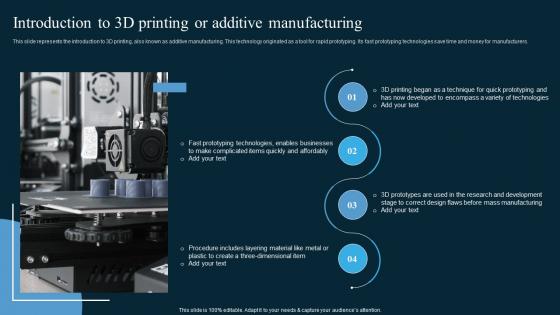
This slide represents the introduction to 3D printing, also known as additive manufacturing. This technology originated as a tool for rapid prototyping. Its fast prototyping technologies save time and money for manufacturers.
People who downloaded this PowerPoint presentation also viewed the following :
Introduction To 3d Printing Or Additive Manufacturing AI In Manufacturing with all 9 slides:
Use our Introduction To 3d Printing Or Additive Manufacturing AI In Manufacturing to effectively help you save your valuable time. They are readymade to fit into any presentation structure.








FAQs for Introduction To 3d Printing Or Additive Manufacturing
So you've got PLA which is perfect when you're starting out - super forgiving and biodegradable. ABS is way stronger but honestly kind of a pain because it smells and needs good ventilation. PETG sits nicely between those two. Then there's weird stuff like TPU if you want bendy prints. I totally ruined a phone mount once because PLA warps in hot cars, whoops. Your material basically determines how strong, flexible, and heat-resistant your print will be. Just start with PLA until you get the hang of things, then branch out depending on what you're making.
So basically, 3D printing builds stuff layer by layer from computer files. Traditional manufacturing usually cuts away material from big blocks or uses molds for mass production. The cool thing about 3D printing? You can make crazy internal shapes that you'd never be able to machine normally. But honestly, if you need thousands of something, traditional methods crush 3D printing on speed. For you though, 3D printing's perfect for quick prototypes - no expensive tooling needed. Each part can be different without switching anything up. Oh, and definitely go 3D first if you're only making a few pieces.
Dude, 3D printing in medicine is honestly insane right now. Doctors are making custom prosthetics that actually fit people properly - no more one-size-fits-all nightmare situations. But here's the crazy part: surgeons can print exact replicas of your organs before cutting you open. They literally practice on a model of YOUR brain first. Wild, right? Dental stuff, hearing aids, even printing living tissue for lab experiments - it's all happening. My cousin works at a hospital and says the costs are dropping so fast that smaller clinics will probably have this tech soon. Pretty cool time to need medical help, honestly.
Honestly, 3D printing is a game-changer for waste. You're only using exactly what you need instead of cutting away tons of excess material. Local production means way less shipping - which is huge for emissions. My buddy's been experimenting with recycled ocean plastic as filament, pretty wild stuff. On-demand manufacturing kills the need for warehouses full of inventory sitting around. You can also design parts to be lighter and more efficient, saving materials down the line. I'd start small - find some parts you're ordering from overseas that you could just print locally instead.
Honestly, the money thing hits first - equipment and training costs add up fast. Your whole production line might need tweaking too, which is a headache. 3D printing's way slower than regular manufacturing when you need tons of units. Quality control becomes this whole new beast since your old testing methods probably won't work. Material costs are brutal, and finding good suppliers? Good luck with that. Your team's gonna struggle if they're stuck in old-school manufacturing mode. I'd totally start with just one small project first - test the waters before you dive in headfirst.
So basically, resolution controls how smooth your prints look. It's like pixel density but for 3D layers, you know? 0.3mm layers = fast prints but you'll see those lines. 0.1mm = takes forever but looks incredible. Honestly, I just stick with 0.2mm for most things - decent quality without the insane wait times. You can always go finer for detailed stuff or chunkier when you're just prototyping. Oh, and pro tip: higher res absolutely destroys your print time, so plan accordingly if you're doing anything big.
Honestly, software runs the whole show with 3D printing. First you'll design stuff in CAD programs like Fusion 360 or Tinkercad. Then comes the slicer - that's where things get interesting. Cura and PrusaSlicer are popular ones that turn your model into actual printer instructions. They handle layer height, infill patterns, supports, all that technical stuff. Some printers need extra software for monitoring too, which can be kinda annoying. My take? Just pick one CAD program and one slicer, then get really good at them. Don't hop around between different tools or you'll never master any of them.
So the big thing is you're thinking in layers now instead of machining operations. Complex internal stuff and overhangs that would be totally impossible to mill or cast? Easy. Traditional manufacturing wants everything uniform and simple, but 3D printing actually likes complexity - doesn't cost extra to make weird shapes. You'll worry about supports, print orientation, and layer adhesion instead of tool access. Oh and forget mold release angles, that's not a thing anymore. It really does flip everything upside down. I'd say just design your next prototype however you want first, then figure out supports after.
Honestly, 3D printing could totally change how you handle your supply chain. You can just print stuff when you need it instead of stockpiling inventory or waiting forever for shipments from China. Game changer for spare parts especially - no more sitting around for weeks waiting on some random bracket that costs $2 but somehow takes a month to arrive. The catch? You'll have to get good at managing digital files instead of physical stock, plus invest in decent printers. I'd start by looking at those low-volume parts you always struggle to keep in stock.
Honestly, 3D printing's about to get insane in the next few years. Way faster and cheaper, plus you'll be able to print with metals, ceramics, even living tissue - which is wild if you think about it. The machines won't be such a pain anymore either. No more needing an engineering background just to change materials! Multi-material jobs will be totally normal, and companies will actually use them for real production instead of just making prototypes. I'd figure out what materials you care about now because the options are gonna explode soon.
Definitely grab some safety glasses and crack a window - those plastic fumes are nasty. The hot end will absolutely burn you (learned that lesson quick). Never leave long prints running overnight or when you're out - honestly, the fire risk isn't worth it. Keep flammable stuff away from your setup and make sure it's on something sturdy where kids can't mess with it. Oh, and figure out how to hit the emergency stop before you even start your first print. Sounds paranoid but you'll thank me later!
So post-processing is basically where the magic happens - it takes your raw print and makes it actually look finished. I usually start with sanding to get rid of those layer lines (though I probably spend way too much time on this step lol). You can paint it, drill holes where you need them, or combine multiple pieces. Chemical smoothing works great too if you're into that. Oh, and here's something I learned the hard way - plan out what you're gonna do BEFORE you print. Trust me, it'll save you from having to redo stuff later when you realize you should've oriented it differently.
For small runs, 3D printing is way cheaper - like $5-50 per part instead of thousands for tooling. Once you're making 1000+ pieces though, injection molding becomes the better deal per unit. Timeline matters too. Need prototypes fast? 3D printing saves you weeks compared to waiting for tooling (which honestly feels like forever). I'd go with 3D printing for prototypes and small batches, then make the jump to traditional manufacturing when you're scaling up. Really depends on where you are in the process.
Dude, 3D printing will totally change how you approach product development. You can whip up prototypes in days instead of waiting weeks. Testing multiple versions won't drain your budget like traditional manufacturing would. Get something physical in users' hands to validate your concept before dropping serious cash on tooling. Small production runs? Totally doable for early customers or crowdfunding. I know companies that went from concept to market in just a few months this way. Grab a basic desktop printer for simple stuff, or hit up Shapeways for the fancy complex parts. Just get prototyping already!
Yeah, you can definitely get in trouble printing stuff that's trademarked or copyrighted - logos, characters, that kind of thing. Patents are honestly the trickier issue though. So many functional parts have patent protection and it's really hard to tell what's covered. I learned this the hard way once! Copyright mostly hits decorative items and figurines. Best approach? Stick to original designs or open-source files. There's tons of free stuff out there. If you're unsure about something, just make your own version instead of copying it exactly.
-
Great product with effective design. Helped a lot in our corporate presentations. Easy to edit and stunning visuals.
-
Excellent Designs.