

Hr roles and responsibilities example of ppt




Try Before you Buy Download Free Sample Product
 Impress Your
 Audience
 100%
100% Editable
 Save Hours
 of Time


Assess a variety of factors that aid in hiring processes using our Hr roles and responsibilities example of PPT. Form new strategies that impact your organization from human resources management perspective. Help visualize key information to manage the workforce the best way possible using our human resources management PPT template. Evaluate the effectiveness of your recruitment process easily and effectively by using our Hr job description PPT slide. Help your audience read and understand data patterns in a comprehensive manner. You can use Hr PPT template to analyze your organizations’ people problems using the data. You can evaluate a variety of factors that will aid you in improving employee performance. Create strategies to bring about the desired business outcomes using our Human resource management PPT. Carry out the important functions of acquisition, optimization, paying and developing the workforce of the organization effortlessly. With high quality content and graphics, provide a visual aid for your presentation. Use this Hr functions and strategy PPT layout to design an attractive yet easy to comprehend business PowerPoint presentation. Harness your thoughts with our Hr Roles And Responsibilities Example Of Ppt. You will get a good grip on them.
People who downloaded this PowerPoint presentation also viewed the following :
Content of this Powerpoint Presentation
The role of the human resources department in any business is immense. Without these trained and experienced individuals who know how to handle and channelize the energies of your people, there can be a lot of leakage of the staff's energies. Hence, we have designated roles and responsibilities forfor HR professionals. These include staffing, training and development, and most importantly, engagement with the staff on where they see fit into the company and the grand vision the business may have for the employees.
Drawing up an employees benefit plan is essential to businesses; get it here.
On paper, all of this seems elementary and rudimentary, but to do proper justice to it, businesses need to communicate the roles and responsibilities to the HR and the HR to their audience using a presentation.
At SlideTeam, we are aware of the need for this kind of ready-to-use product and have created one just for you. The idea is to save the companycompany’s time and effort and spare it the tedium of designing such presentations.
Here’s a great PPT Template depicting HR focus in the form of a matrix.
Each of the templates is 100% editable and customizable, meaning you can change it at your convenience.
Let’s explore these templates now!
Template 1 HR Roles and Responsibilities Example PPT Template for Businesses
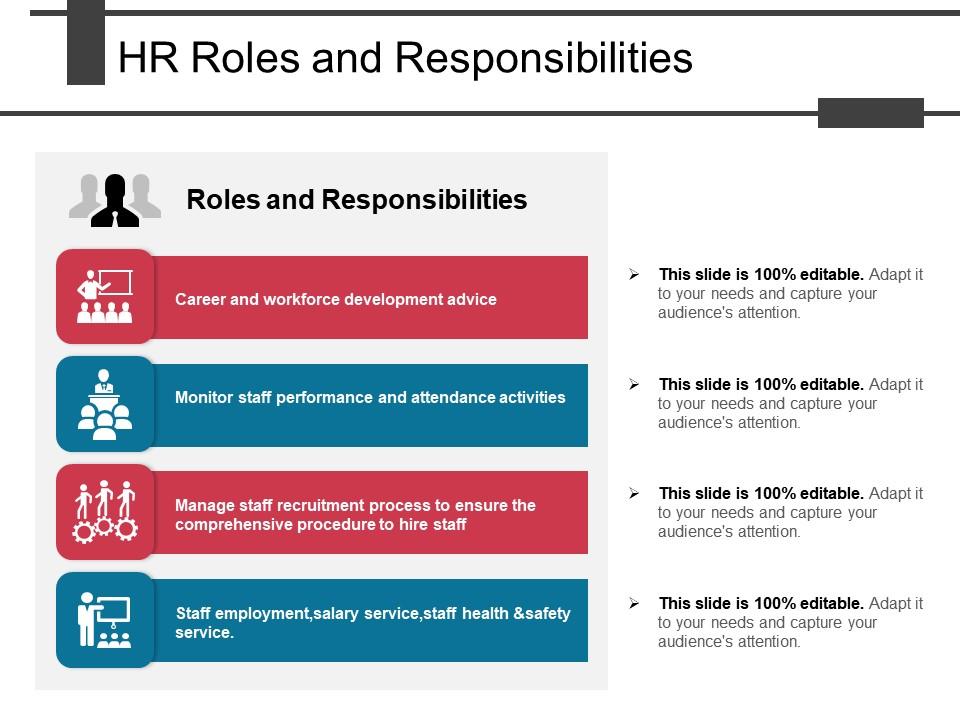
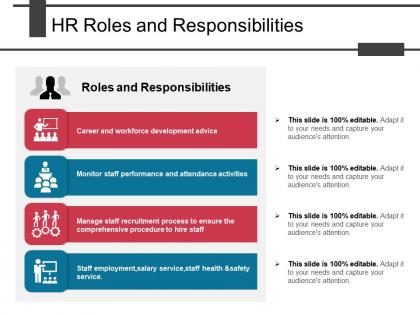
Use this PPT Template to understand the way HR roles and responsibilities contribute to the management of the workforce in the best way possible. Evaluate the effectiveness of your recruitment process efficiently and effectively by using this HR roles and responsibilities slide. The four major roles and responsibilities that must be on the agenda are career and workforce development advice, monitoring staff performance and attendance activities, manage the staff recruitment process to ensure the comprehensive procedure for hiring staff. Other critical role related to this is staff employment, salary service, and health &safety service. The slide also includes another segment alongside each of the significant HR roles and responsibilities. Here, you can list all the actionable tasks that contribute to the smooth performance of the duties related to the assigned roles in HR.
HR PROCESSES CRITICAL TO SUCCESS
In any business organization, HR processes are critical to success, as these create space and discipline for talent and creativity to emerge from a structured framework. For this, the department and the company must understand HR roles and responsibilities that ensure a smooth people-to-people and team environment to be built up. This PPT Template provides the appropriate framework.
PS Understand three primary roles of HR personnel with this product from SlideTeam.
Hr roles and responsibilities example of ppt with all 5 slides:
Achievements become a habit with our Hr Roles And Responsibilities Example Of Ppt. Be able to deliver consistently.


FAQs for Hr roles and responsibilities
So HR basically does five big things: they recruit people, manage how employees are doing, handle paychecks and benefits, make sure the company follows laws, and run training programs. Oh, and now they're getting more into planning out the whole workforce strategy too. Honestly, they're way more strategic than people give them credit for. They keep everything from falling apart by getting the right people hired, making sure pay is fair, and preventing legal disasters. When you're dealing with them, just tie whatever you need back to how it helps employees or the business.
Oh man, HR is literally everything people-related! Job postings, screening candidates, coordinating interviews, making offers - that's just getting them in the door. Once they're hired? Performance reviews, training, career planning, succession stuff. Honestly the hardest part is figuring out what hiring managers actually need vs what they say they need (spoiler: usually different lol). You'll want some standard processes but don't make them too rigid. Different roles need different approaches. It's a lot but super rewarding when you get the right person in the right spot!
Send them stuff beforehand - schedule, paperwork, maybe some company swag. People actually get excited about welcome packages, it's weird but it works! First day should be structured but not overwhelming. Map out their week with intros, training, role stuff, but don't info-dump everything at once. Here's what really matters though: get them a buddy who's NOT their manager. Someone they can ask stupid questions to without feeling judged. Then do check-ins at 30, 60, 90 days. Those touchpoints catch problems before people quit.
Look, bad managers will kill engagement faster than anything else - I've seen it happen so many times. But HR can actually fix this stuff by being the go-between for what people need and what companies can give. Think competitive pay, growth paths, making sure bosses don't completely suck at their jobs. Recognition programs help too. The trick? Don't wait for people to quit before you act. Do regular check-ins with your teams about what's broken. Sometimes it's tiny fixes that prevent the big walkouts. Surveys work, but honestly just talking to people tells you more.
So basically you're building the whole performance review framework and keeping it running smoothly. Create the evaluation forms, train managers on feedback (trust me, they desperately need this), set up review schedules. Track who's due for reviews and jump in when things get messy between managers and employees. Document everything for legal reasons - super important. Connect performance results to pay decisions too. Oh, and watch for trends across different teams. Honestly? Start by looking at what you're doing now because there's probably broken stuff you haven't noticed yet.
So when workplace drama hits, HR usually jumps in to play referee. They'll chat with everyone involved and dig through emails or whatever to figure out what actually happened. Half the time it's just people talking past each other - which honestly drives me crazy but whatever. If it's more serious stuff, they have formal complaint processes they follow. Sometimes lawyers get involved too. My advice? Don't wait around hoping it'll fix itself. Get HR involved early and write everything down when you report it. Trust me on that last part.
So honestly, HR is like the backbone of company culture. You're hiring people who vibe with what you want to build, creating policies that actually matter, and dealing with drama when things go sideways (and trust me, they will). The engagement surveys and culture metrics? That's your reality check - shows you what's really happening vs. what the C-suite thinks is happening. Here's the thing though - don't just write down your values on some poster. Actually live them in every meeting, every hiring decision, every random Tuesday conversation. Culture isn't a document, it's what people feel walking through your doors.
So your HR team basically needs to stay current on all the labor laws - federal, state, local, the whole mess. They do regular training and work with employment lawyers when things get tricky. Most of the day-to-day stuff involves updating handbooks, running audits on wages and safety protocols, that kind of thing. Training managers is huge too since they're usually the ones who accidentally mess up first. Honestly, the smart move is catching violations before they blow up into lawsuits. I'd suggest setting up monthly check-ins with HR - way better than scrambling when something goes wrong.
Honestly, training and development can make or break your retention rates. People bail when they feel stuck, so investing in their growth keeps them around way longer. Plus you're not constantly bleeding money on recruiting replacements. Skills gap analyses are your friend here - figure out where people actually need help instead of guessing. It also helps spot your future leaders early. I've seen companies completely transform their culture just by showing employees they actually care about their development. Performance goes up, people feel valued, and your bottom line benefits too.
Dude, start with an ATS system - it'll automatically screen resumes for keywords so you're not drowning in applications. Video interviews are clutch now (honestly saved my sanity during COVID). AI tools help spot good candidates quicker and cut down on unconscious bias, which is pretty cool. Chatbots handle those repetitive candidate questions 24/7. Oh, and don't just stick to job boards - social media recruiting opens up way more talent. Just roll out one thing at a time though. Your team will hate you if you dump everything on them at once.
Honestly, start with your hiring - post on diverse job boards and get different people on interview panels. Employee resource groups help a ton for making people feel included. Skip the one-time diversity workshops though, they're pretty useless. Ongoing bias training actually works better. Oh, and track your numbers! Sounds boring but you need data to see what's working. The biggest thing is getting leadership on board - if your executives don't genuinely care, everything else is just performative nonsense. Mentorship programs and listening sessions are solid too for building that psychological safety everyone talks about.
Most HR teams do employee surveys - usually quarterly or annual pulse checks about management, workload, that kind of stuff. One-on-ones catch problems before they explode. Exit interviews are honestly where you get the real tea since people have nothing to lose at that point. The annoying thing? Half these companies run surveys then completely ignore the results. Track your turnover rates too - that tells the whole story. Oh, and if you don't have regular pulse surveys yet, that's probably your best starting point.
So you're basically running the whole succession planning show. First thing - audit your current leadership bench because that'll show you where you're screwed if someone leaves tomorrow. Then you're spotting high-potential people, building development programs, and mapping out who could step into critical roles. Working with managers on individual development plans is huge too. Honestly, this is probably the most strategic stuff you'll do in HR since you're literally deciding who runs the company next. Just don't overthink the process initially - start simple and build from there.
Honestly, your HR team needs to get serious about real connection, not just Zoom fatigue. Set up actual one-on-ones that matter - not those awkward "how are things?" calls. Build in some decent virtual team stuff, and for the love of god, stop measuring success by hours logged. That's so outdated it hurts. Train your managers on remote leadership because most of them are winging it. Get good collaboration tools, create feedback loops that actually work, and ask your people what's helpful versus total waste of time. Oh, and audit whatever policies you have now - bet half of them don't make sense anymore.
Honestly, AI recruitment tools are everywhere now - they're making hiring way faster and helping predict what employees actually need. Remote work stuff is still figuring itself out, but companies are finally taking mental health seriously. Skills-based hiring is replacing those ridiculous degree requirements (thank god). There's also this whole "employee experience design" thing that's basically UX for workplaces. My advice? Follow some HR tech newsletters to separate the real innovations from total BS. I've been burned by hyped-up tools before, so it's worth being picky about what you actually invest time in.
-
Unique design & color.
-
Best Representation of topics, really appreciable.
-
Enough space for editing and adding your own content.
-
Excellent template with unique design.