


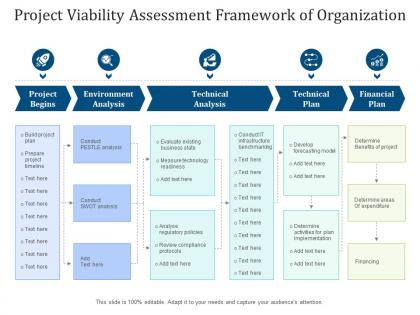
Project viability assessment framework of organization




Try Before you Buy Download Free Sample Product
 Impress Your
 Audience
 100%
100% Editable
 Save Hours
 of Time


Our Project Viability Assessment Framework Of Organization are topically designed to provide an attractive backdrop to any subject. Use them to look like a presentation pro.
People who downloaded this PowerPoint presentation also viewed the following :
Project viability assessment framework of organization with all 2 slides:
Use our Project Viability Assessment Framework Of Organization to effectively help you save your valuable time. They are readymade to fit into any presentation structure.

FAQs for Project viability assessment
Honestly, I'd break it down into three main things. First - will this actually make you money and how fast? Check your projected ROI and when you'll break even. Market stuff comes next - is there real demand, who's your competition, how big is your audience? The execution part is huge though (and where most people mess up). Do you actually have the right team and resources to make this happen? I've watched so many good ideas fail because nobody asked "can we realistically pull this off?" Maybe create a quick scorecard, rate each area 1-10. Sounds boring but it works.
Honestly, market conditions can totally make or break your project. Strong demand + weak competition? You're set. But saturated markets or shaky economics will crush even brilliant ideas - I've watched it happen so many times. Timing is everything, which sounds cliché but it's true. Check out customer spending power, what competitors are doing, any regulatory stuff coming down the pipeline. Oh, and broader economic trends in your space obviously. Quick reality check before you start planning saves you from banging your head against the wall later. Trust me on this one.
Look, stakeholder analysis is huge for figuring out if your project will actually work. Map out everyone early - sponsors, users, even the people who might fight you on it. The neutral ones will catch you off guard, trust me. Rate their power and interest levels because these folks literally determine if you succeed or crash and burn. Their expectations and support matter way more than whatever looks good in your project plan. I'd start with a simple list and really think through how each person might react. It's the difference between launching something people want vs. something that dies on arrival.
Honestly, risk assessment saves you from those brutal project failures that could've been avoided. You systematically figure out what might go wrong instead of just hoping for the best. I've watched so many promising projects completely tank because people didn't think through the obvious pitfalls. Monte Carlo analysis or basic risk matrices help turn your hunches into real numbers. Map out your biggest 5-10 risks first and assign actual probabilities to each one. It sounds nerdy but it'll completely change how you look at whether something's actually doable or just wishful thinking.
Honestly, just start with NPV - if those numbers suck, nothing else matters. IRR's solid too for getting the full picture. DCF works well when you've got projects with cash flows all over the place, especially long-term stuff. Payback period is super basic (like, almost too simple) but executives eat it up since it's easy to grasp. Oh, and if you're dealing with anything remotely risky, throw in some sensitivity analysis or Monte Carlo sims to see how badly things could go sideways. But yeah, NPV first - that's your reality check.
Dude, you HAVE to nail down your project scope first - it's literally everything. Skip this and you're just throwing darts at cost estimates and timelines. I learned this the hard way watching projects crash because people thought they'd "figure it out as we go." Once you know exactly what's in scope (and what isn't), then you can actually estimate your budget, spot the real risks, figure out if it's even technically doable. Trust me on this one - spend way more time here than you think you need before you even look at spreadsheets.
Look, the math is just part of it. Can your team actually handle this thing or are you gonna be figuring it out as you go? I've watched solid projects totally bomb because nobody really bought in from the start. The political stuff matters more than people think. Also check if the timing makes sense - are you jumping into a crowded market or is this actually where your company wants to head? Sometimes the spreadsheet looks amazing but you're missing all the messy human factors. Trust your gut on this one too.
Dude, the right tech makes project assessment so much easier. Predictive analytics lets you run different scenarios, AI catches risks you'd totally miss otherwise. Automation beats the hell out of spreadsheets for number crunching. Real-time project management tools show you exactly where your timeline and resources stand - honestly game-changing stuff. Don't just grab whatever's trending though. Pick something that actually matches your project size and team. I learned this the hard way after overcomplicating things with fancy tools we didn't need. Start simple, then add more as you figure out what clicks.
Honestly, the worst thing you can do is be way too optimistic about timing and budget - I've watched so many projects crash because of this. Also, don't use market data that's ancient history at this point. Getting the wrong people involved (or forgetting key stakeholders) will bite you later when they're like "wait, did anyone think about XYZ?" Run some nightmare scenarios on your numbers too. Oh, and definitely get someone else to review everything before you present. Buffer time is your friend here - trust me on that one.
Dude, if your project doesn't fit with what the company actually wants to achieve, you're basically screwed. Leadership won't give you money or resources. When budget cuts happen - which, let's be real, they always do - your project gets chopped first. Even brilliant ideas get killed if they're not supporting the big strategic stuff everyone cares about. Honestly, I've seen this happen so many times. Before you get too deep into all the feasibility research, figure out exactly how your project helps the organization's main goals. Then practice explaining that connection super clearly.
Honestly just start with Excel - it's still the best for financial stuff if you know what you're doing. Microsoft Project or Smartsheet work great for timelines and resources. For the heavy financial modeling, Excel with NPV templates is solid, or @RISK if you want to get fancy with Monte Carlo sims. Stakeholder feedback gets tricky though. Miro or Lucidchart are clutch for visual mapping sessions. Monday.com or Asana help track everything as you go. But real talk - most teams can pull off decent viability assessments with just Excel and a solid template. Don't overthink the tools part.
Dude, regulatory stuff will totally derail your project if you're not careful. Permits, safety standards, environmental checks - whatever applies to your industry needs to be sorted early. I learned this the hard way on a previous project, honestly. These requirements can bump your costs up 20-40% and add months to your timeline. The worst part? Discovering new regulations halfway through development. Map everything out during your feasibility study. Don't be that person scrambling for permits at the last minute. Build compliance costs right into your budget from the start.
Honestly, start with real customer interviews - not surveys, actual conversations. Test prototypes with your target users early. Most people mess up the financial modeling part because they're way too optimistic about numbers (I've seen this kill so many good ideas). Do competitive analysis but use actual data, not just assumptions. Maybe run a small pilot or MVP to test your biggest assumptions in the real world? Pick your three riskiest assumptions and design specific tests for each one. The whole point is getting objective feedback instead of just guessing based on what you and your team think.
Definitely dig into your old project data - there's gold in there. Most teams do this "lessons learned" thing and then never actually look at the notes again, which drives me crazy. Check what killed similar projects before: budget disasters, timeline explosions, stakeholders losing their minds. Those same red flags will probably pop up again. I'd track stuff like how much scope creep you typically see, burn rates, approval times. Make yourself a quick checklist of your team's usual pain points and run new proposals through it. Sounds boring but it'll save your butt later.
Dude, your team's skills can totally make or break these big projects. I've watched so many crash because people thought they could wing it with whatever talent they had on hand. You really need folks who've been in the trenches before, not just read about it in some manual. When shit hits the fan (and it always does), experienced people solve problems way faster. Timeline estimates? Way more accurate when your team actually knows what they're doing. Before you dive in, be super honest about where your team's weak - maybe budget for some training or bring in outside help. Trust me on this one.
-
Very unique and reliable designs.
-
Use of different colors is good. It's simple and attractive.