


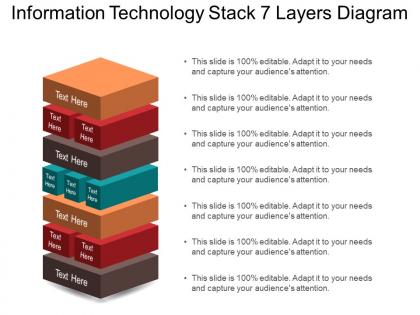
Information technology stack 7 layers diagram





Try Before you Buy Download Free Sample Product
 Impress Your
 Audience
 100%
100% Editable
 Save Hours
 of Time


Be an instant hit with our Information Technology Stack 7 Layers Diagram. Get folks on their feet clapping away.
People who downloaded this PowerPoint presentation also viewed the following :
Information technology stack 7 layers diagram with all 5 slides:
Put forth your views in any forum. Our Information Technology Stack 7 Layers Diagram are applicable everywhere.




FAQs for Information technology stack
So basically there are four layers to think about. Infrastructure is your foundation - servers, cloud stuff, networking. Platform layer comes next with your OS, databases, all that middleware. Your actual applications sit on top of that. Then users see the presentation layer. It gets messy fast though, especially in bigger companies. I'd just map out what you currently have in each section - makes it way easier to see where things are doubled up or missing. Trust me, you'll probably find some weird gaps you didn't know existed.
Honestly, your tech stack makes or breaks how fast you can ship stuff. Compatible tools that work together? You'll fly through development and deployment. Pick the wrong combo and you're stuck debugging integration issues for weeks. I learned this the hard way on my last project - spent more time fighting tools than building features. Modern stacks with solid CI/CD can turn month-long cycles into days. Team onboarding gets way easier too. My take: go for developer experience over whatever's trendy right now. Trust me on this one.
Dude, cloud computing totally changed everything. You don't have to build your own servers anymore - just use AWS, Azure, whatever. Your team can actually focus on coding instead of fixing broken hardware at 2am (been there, it sucks). Scaling happens automatically, you get backups built in, and deployments are way faster. Most new apps are cloud-native now with containers and serverless stuff. I'd start by figuring out what parts of your current setup you could move to managed services first.
First thing - figure out what you're actually building and what your team knows well. Budget matters too, obviously. Think about whether you need to scale fast or if security's a big deal. Honestly, everyone just copies the same React/Node setup these days without thinking. Your team's skills matter way more than what's trendy right now. How steep is the learning curve? What about maintenance costs down the road? Community support's huge too - you don't want to get stuck with some obscure framework. Build a tiny prototype first. The "best" stack is whatever your developers can actually ship and keep running without losing their minds.
So front-end is basically what users see - HTML, CSS, JavaScript, React, Vue, all that visual stuff. Back-end handles the server side: databases, APIs, Python, Node.js, the logic that actually makes things work. Picture a restaurant (yeah I know, overused comparison but whatever) - front-end is the dining room, back-end is the kitchen chaos. They talk to each other through APIs, which is crucial or nothing connects properly. Honestly? Pick one side first. Trying to learn both at once just scrambles your brain. You'll get there faster focusing on frontend OR backend initially.
So microservices is where you chop up that massive monolithic app into tons of smaller, independent services. Each one can use different tech stacks and databases - pretty cool actually. They all talk through APIs instead of being one giant thing. Fair warning though, it gets messy fast with all the moving parts! You'll need container stuff, service discovery, monitoring out the wazoo. The infrastructure becomes way more distributed than what you're probably used to. Honestly I'd test it out with just a couple services first before diving headfirst into the chaos.
Open-source stuff can save you tons of money - no licensing fees to worry about. You can customize everything however you want, which is pretty sweet. The communities around these tools are usually solid too, so chances are someone's already figured out your exact problem. But honestly? You're basically signing up to be your own IT support. Security patches, updates, all that maintenance work - it's on you now. I've seen teams get burned because they picked open-source tools thinking they'd save money, then didn't have anyone with time to actually maintain them. Just make sure you've got the bandwidth for it.
So DevOps basically flips your whole approach to building IT systems. You're gonna want automation and monitoring baked in from the start. Microservices work way better than those huge monolithic apps - trust me on this one. Everything becomes code, even your infrastructure, which sounds weird but actually makes deployments so much smoother. I know it feels like a lot if you're used to traditional ops work. The trick is picking tools that work well with CI/CD pipelines. Start by looking at your current setup and figure out what's slowing down your deployments.
First thing - dig into each component's security history. How fast do they patch stuff? Any major vulnerabilities lately? Authentication and encryption matter too, obviously. I'd focus on the database and web framework since those are your biggest risks. Third-party services can be sketchy so research those carefully. The whole compliance thing depends on your industry but don't skip it. Honestly, I always make a basic checklist first - sounds boring but it saves time later when you're comparing options. This stuff gets messy quick if you don't stay organized.
So data management tools are like the middleman in your tech setup. Raw data sits in databases and data lakes at the bottom. Then you've got ETL pipelines and data warehouses that grab all that messy info, clean it up, and feed it to your apps above. Short version - they're traffic cops for data flow. I learned this the hard way when our analytics went to hell because nobody was managing the data properly. Your apps will either starve for info or choke on bad data without decent management tools. Pretty much makes everything else pointless.
So cross-platform stuff like Flutter and React Native are everywhere right now - companies don't want to build separate apps anymore. Firebase and serverless backends are pretty much the norm too, which honestly makes life way easier. Micro-frontends are the new shiny thing, though I think it's kinda overrated tbh. AI features aren't optional anymore either. Even low-code platforms actually work decent now, which surprised me. If you're starting something new, definitely check out Flutter. The dev experience is really smooth and you won't hate yourself dealing with platform differences later.
Honestly, this stuff can make or break your whole setup. Bad integration is like trying to use amazing apps that just... don't talk to each other. Super frustrating. Your team ends up doing tons of manual work and workarounds that waste time. But when everything connects smoothly? Data flows between systems, workflows actually work, and people don't want to throw their laptops out the window. I always tell people to check APIs first - sounds boring but it matters. Make sure new tools play nice with what you've already got before you commit.
Honestly, start by figuring out what's actually broken with your current setup - don't just migrate because it's trendy. Break it into smaller chunks instead of trying to rebuild everything at once. I learned that the hard way on a project last year. Get your stakeholders on board early and budget time for the team to actually learn the new tech properly. Document your integrations and dependencies like crazy. If you can run both systems side by side during the switch, do it. Always have a backup plan ready. Don't rush the timeline - seriously, it's better to go slow than crash and burn.
First thing - load test everything to see what breaks. I know it sounds obvious but you'd be shocked how many teams just wing it and pray nothing explodes. Run those benchmarks during your busiest hours and hunt down the bottlenecks in your databases and APIs. Can your setup actually scale horizontally when things get crazy? Like, can you just spin up more servers without everything falling apart? Your database needs to handle way more transactions too. Write down what you find (seriously, document it) and build out a roadmap with clear triggers for when to upgrade stuff.
Don't over-engineer right off the bat - that's the big one. Also skip the shiny new frameworks just because they look cool. Your team will hate you when they can't figure out how to fix bugs later. I'd say avoid getting locked into expensive vendors too early. Build simple first, then get fancy. Most problems already have good solutions anyway, so don't reinvent everything from scratch. Pick tools your people can actually handle long-term. Oh and make sure whatever you choose won't bankrupt you when you need to scale up.
-
Great designs, really helpful.
-
Great designs, really helpful.