


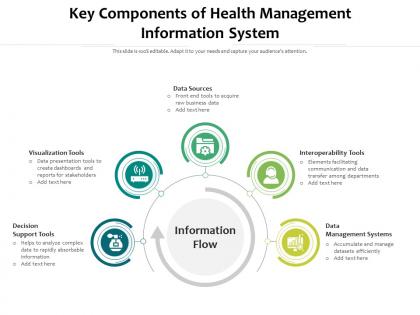
Key components of health management information system




Try Before you Buy Download Free Sample Product
 Impress Your
 Audience
 100%
100% Editable
 Save Hours
 of Time


Our Key Components Of Health Management Information System are topically designed to provide an attractive backdrop to any subject. Use them to look like a presentation pro.
People who downloaded this PowerPoint presentation also viewed the following :
Key components of health management information system with all 2 slides:
Use our Key Components Of Health Management Information System to effectively help you save your valuable time. They are readymade to fit into any presentation structure.
FAQs for Key components of health
Honestly, the biggest thing is how much cleaner your data gets - no more duplicate entries or digging through paper files forever. Different departments actually talk to each other now, so lab results just show up in patient charts automatically. Pretty nice not having to guess anymore since you get real analytics on outcomes and operations. Your billing gets way smoother too, codes generate from clinical notes which saves tons of time. I'd probably figure out what's driving you most crazy right now and tackle that first - that's where you'll see money come back fastest.
HMIS basically connects all your patient data so docs can actually see the full picture fast. Game changer for diagnoses. Urban areas especially benefit since patients bounce between specialists constantly - now everyone's on the same page. Rural places get even more out of it though, being able to pull up patient histories when you're hours from the nearest specialist. Medical errors drop big time when providers aren't working blind. Plus your treatment plans get way more targeted since everything's in one spot instead of scattered across different systems. I'd start by figuring out where your data gaps are worst - that's honestly where you'll see results quickest.
Honestly, data analytics transforms your HMIS from just storing stuff to actually helping you make smart decisions. You'll catch disease outbreaks early and predict when you're gonna need more resources. The pattern recognition is insane - it spots weird medication combos and tracks outcomes across thousands of patients way better than we ever could manually. Plus it shows you care gaps you'd totally miss otherwise. Instead of drowning in data, you're using it to improve patient care and streamline workflows. My advice? Figure out which metrics actually impact your day-to-day work first, then expand from there.
So HMIS basically stops hospitals from doing the same tests twice, which is surprisingly common. Workflows get way smoother too. The real money saver though? Catching problems before they blow up into expensive disasters. Doctors spend way less time on paperwork - and trust me, they're drowning in that stuff normally. Patients don't get stuck with redundant procedures or stay in beds longer than needed. Better preventive care keeps people from ending up in the ER constantly. The system shows which treatments actually work without breaking the bank. I'd start by figuring out what's currently eating your budget and time.
So basically an HMIS handles all your compliance stuff automatically by putting the regulatory requirements right into your daily workflows. You don't have to worry about missing mandatory data fields or forgetting reports - it does that for you. Way better than those nightmare spreadsheets everyone tries to use! It'll even catch compliance problems as they happen and update when regulations change. The best part is your whole team follows the same process instead of hoping Sarah remembers that one weird rule from 2019. Definitely set up those compliance dashboards early - you'll thank me later during audit season.
Ugh, honestly the money will hit you first - these systems cost way more than anyone expects. Staff will complain constantly about learning new software (fair though, change sucks). Your current tech setup probably can't handle it, and training takes forever. Oh, and migrating old data? Total headache. Then you've got security rules since it's patient info, plus endless updates and maintenance fees. I'd say pick one department to test it out first. Get people on board early or they'll sabotage it. Budget like triple what you think you need.
So interoperability is basically whether your patient data can actually move between different systems or just gets trapped. Good interoperability means complete records that follow patients everywhere - different doctors, specialists, hospitals. Without it? Total nightmare. You're stuck with fragmented data and constantly asking people to fax records (ugh, fax machines in 2024). Clinicians miss crucial info, patients get duplicate tests, coordination falls apart. When you're shopping for HMIS systems, definitely look for ones using HL7 FHIR standards. Trust me, it'll save you so much frustration later.
Honestly, hands-on practice is everything - let people mess around in the actual system with real examples. Different roles need different training though, so don't lump nurses and admin staff together (learned that one the hard way). Quick reference sheets are lifesavers when they're panicking at 2am. I'd definitely pair your tech people with the ones who still call IT about their mouse. Sometimes peer help clicks better than formal sessions anyway. Oh, and schedule follow-ups after launch because that's when the real questions start rolling in.
Dude, COVID totally changed everything with HMIS systems. Healthcare places that were super slow to go digital suddenly had to set up telehealth and remote monitoring in like weeks, not years. Pretty crazy to see honestly. All these different systems also had to start talking to each other for contact tracing stuff - which was a nightmare before. The upside? HMIS vendors now have way better products since they got stress-tested during the worst possible conditions. If you're shopping around for systems now, you'll actually find some solid options that weren't there in 2019.
Data breaches are the big one with HMIS - plus unauthorized access and ransomware hits. Encryption and multi-factor auth are must-haves. Role-based access is huge too, so people only see what they actually need. Your staff will probably be your biggest risk though - I swear, someone always clicks the sketchy email. Training on phishing helps a lot. Security audits should happen regularly. Oh, and definitely do a risk assessment first to figure out where you're most exposed. It's wild how many places skip that step and just throw money at random security tools.
Patient portals are huge for this - people can check their records, book appointments, message doctors directly. It's pretty amazing how much control that gives them. Automated reminders help too, plus the system can send educational stuff based on whatever condition they have. Mobile access changes everything since they can jump on anytime. Also worth tracking satisfaction through built-in surveys and feedback tools (though honestly, getting people to actually fill those out is another story). I'd say roll out the portal feature first, then add other stuff gradually.
HMIS is basically your outbreak early warning system - it catches weird disease patterns and case spikes way before you'd spot them manually. Real-time dashboards show you what's happening across different areas, plus you get automatic alerts when things go above normal thresholds. Pretty handy for stuff like COVID surges or food poisoning clusters. It also tracks how well your response is working and where resources are going. Honestly, the speed is what impressed me most when I first saw it in action. Just make sure you set up those alert parameters ahead of time so you're not caught off guard.
So a bunch of tech is about to shake up HMIS big time. AI and machine learning will handle data analysis automatically and predict health trends - which honestly feels long overdue. Cloud systems are finally making everything more scalable. Real-time patient data will flow in through IoT devices, and blockchain might actually fix those annoying interoperability issues we're stuck with. Voice recognition will make data entry way less painful for doctors. Oh, and natural language processing too. You should probably figure out which ones matter most for your setup sooner rather than later.
Ugh, infrastructure differences are such a pain when you're trying to implement HMIS anywhere. Like, if the electricity cuts out half the time and internet's sketchy, you're gonna need offline systems and mobile apps that actually work. Meanwhile places with solid connectivity can do the fancy cloud stuff with real-time data. Rural vs urban is a whole other thing too - totally different needs. I learned this the hard way, but you really gotta assess what's actually there before building anything. What works great in one spot will probably crash and burn somewhere else, so don't even try to copy-paste your approach.
Hey! So basically you'll want to look at four main things. System performance stuff - uptime, how fast it loads, whether people actually use it (slow systems are the worst). Data quality is huge too - are docs filling everything out properly and on time? Then check if it's actually making work easier - less time documenting, faster billing, smoother processes. Oh and obviously patient outcomes that tie back to your system. I'd honestly just pick a few metrics from each area, get your baseline numbers, then review quarterly. Makes it way easier to show your boss why you need that budget increase later.
-
Very unique and reliable designs.
-
Great designs, really helpful.
-
Qualitative and comprehensive slides.
-
Great product with highly impressive and engaging designs.
-
Easily Editable.