

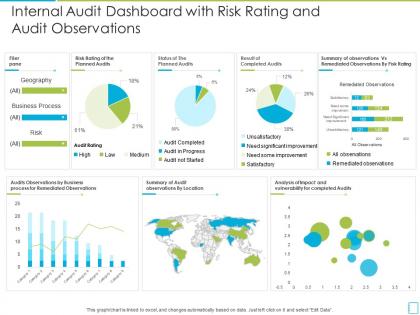
Internal audit dashboard observations international standards in internal audit practices




Try Before you Buy Download Free Sample Product
 Impress Your
 Audience
 100%
100% Editable
 Save Hours
 of Time


Our Internal Audit Dashboard Observations International Standards In Internal Audit Practices are topically designed to provide an attractive backdrop to any subject. Use them to look like a presentation pro.
People who downloaded this PowerPoint presentation also viewed the following :
Internal audit dashboard observations international standards in internal audit practices with all 2 slides:
Use our Internal Audit Dashboard Observations International Standards In Internal Audit Practices to effectively help you save your valuable time. They are readymade to fit into any presentation structure.

FAQs for Internal audit dashboard observations international standards in
So there's basically three parts: Attribute Standards handle the setup stuff - your audit function's purpose, authority, independence. Performance Standards cover the actual doing - risk assessment, planning, fieldwork, reporting. Then Implementation Standards give you specific guidance for different engagement types. Performance Standards are honestly where you'll live day-to-day. That's your bread and butter work. Attribute Standards are more like... getting your house in order upfront, if that makes sense. I'd jump into Performance Standards first since they'll actually help with whatever you're working on right now. Way more practical.
Yeah, so most countries just use the IIA standards as their base - though honestly some places get way more specific than others. Europe has extra rules for banks and insurance companies, while Japan and Singapore created their own versions that mix international stuff with local requirements. The US sticks pretty close to IIA but then throws Sarbanes-Oxley on top for public companies (fun times). I'd definitely look up both the IIA standards and whatever country-specific rules apply before you start planning anything. Saves headaches later.
So the IIA writes the rulebook for our whole profession - they created those International Standards that pretty much everyone follows. Their Red Book is like our bible, honestly. You'll find guidance on risk assessment, control testing, all that stuff. Most companies claim they follow IIA standards but then do whatever they want anyway, which is... typical. Definitely bookmark their site though. Their practice guides are actually useful for figuring out proper methodology. Without knowing their standards, you're basically flying blind in this field.
Stop treating compliance like a yearly chore you check off. Build clear policies that actually connect to your standards, then train everyone properly - I mean really train them, not just send an email. Most failures happen because people think they're good without actually verifying anything. Document stuff as you go and do internal reviews to catch problems early. Honestly, quarterly team check-ins work great for staying on track. The whole point is making it feel normal, not like this huge burden hanging over everyone's head.
Honestly, the worst part is dealing with resource constraints and office politics. Time's always tight, staff's stretched thin, and you're still expected to deliver quality work. Management constantly pressures you to rush or skip certain areas - which obviously messes with your independence. Good luck getting the data you need too, people act like you're asking for state secrets. Oh and don't get me started on keeping up with new standards while navigating their ancient IT systems. My take? Start building relationships day one, document absolutely everything, and stand your ground when it matters.
So internal audit standards are basically your roadmap for how governance should actually function day-to-day. They push companies toward better risk management and cleaner reporting, which ends up influencing how boards and executives make their calls. You're constantly doing health checks on your governance processes - finding weak spots and patching them up. Honestly, most companies don't realize how much these standards can tighten up their oversight until they start using them properly. Think of it as your early warning system that keeps leadership from making dumb mistakes.
Look, audit management software will save you so much headache - it handles documentation automatically and tracks your findings. Data analytics tools are honestly where it's at though, they catch risks and weird patterns way faster than doing everything manually. Plus workflow automation means you won't miss steps or mess things up. Cloud platforms make collaborating with everyone way smoother too. Oh, and they keep proper audit trails which auditors love. I'd start by figuring out what's driving you crazy compliance-wise, then find tech that fixes those specific problems first. Don't try to solve everything at once.
So risk assessment is like the backbone of internal auditing - you can't really do your job well without it. It helps you figure out which parts of the business are most likely to blow up or have fraud issues. I always think of it like being a paramedic deciding who needs help first. The IIA standards actually make it mandatory to use risk-based planning, so you don't have a choice anyway. Without it, you're just randomly picking what to audit and probably missing the areas that could actually hurt the company. It's way more efficient than the old "audit everything equally" approach.
Start with the IIA's Quality Assessment and Improvement Program (QAIP) - it's the gold standard for measuring audit effectiveness. You'll need both internal self-assessments and external reviews every five years. Track KPIs like audit cycle completion rates, stakeholder satisfaction, and recommendation implementation rates. Honestly, the metrics can feel overwhelming at first, so focus on what actually matters for your org's risk profile. I'd set up quarterly reviews against the International Standards and adjust from there. The external reviews are kind of a pain but worth it.
Honestly, you need someone on your team who's actually responsible for tracking these changes - otherwise stuff just falls through the cracks. Subscribe to IIA updates and other regulatory bodies, but don't stop there. I'd build standard reviews right into your annual planning so it becomes routine. Your audit procedures need updating whenever standards shift, which happens more than you'd think. The trick is creating some kind of system where your team can spot gaps between what you're doing now and new requirements fast. Oh, and start by checking your current setup against the latest standards first - might as well know where you stand.
Look, you've gotta build fraud risk assessment right into your audit planning from the start. Don't take everything management tells you at face value - that's just basic professional skepticism. The standards want you designing procedures that'll actually catch material fraud if it's happening. You're not becoming some forensic investigator or anything, but you do need to stay sharp during fieldwork. Honestly, the communication piece is huge too - flag any red flags or control weaknesses to management and the audit committee. It's really about staying alert throughout the whole process.
So here's the deal - internal audit standards make your financial reporting way more transparent because they force you to follow consistent processes when checking controls and risks. Following something like IIA standards builds trust with stakeholders since they know your reports actually got proper review. It's basically quality control for your financials, catches problems before they blow up publicly (which honestly saves so much headache). The standards make you document everything clearly and test systematically. This means your findings hold more weight and people actually believe your recommendations. Trust me, using recognized standards makes your whole audit process look legit.
So internal audit standards are basically your roadmap for checking if change management is actually working. They help you figure out if changes are rolling out right, risks aren't getting ignored, and your controls still do what they're supposed to do. Plus they keep you neutral when everyone's freaking out about changes - which honestly happens way more than it should. Leadership also takes your reports more seriously when you can back up your findings with actual standards instead of just gut feelings. Oh, and definitely map your changes against the standards from day one. Trust me, catching gaps early beats scrambling to fix disasters later.
You're gonna need the basics down first - accounting, finance, risk management stuff. Most places want certifications like CIA or CPA, plus you gotta keep up with those annual training hours. Critical thinking is massive though. I've literally watched people who knew all the technical stuff completely bomb because they couldn't actually analyze what was in front of them. Communication matters too since you'll present findings to management and deal with different departments constantly. Oh, and standards change all the time so staying current is key. Start with IIA's competency framework - it'll show you exactly where you're at and what gaps need filling.
So audit standards basically make you constantly evaluate your processes through regular check-ups and recommendations. Not just finding what's broken - you've got to benchmark against best practices and suggest real fixes. The follow-up part is honestly where it gets interesting (and where most places mess up). It creates these accountability loops so stuff doesn't just disappear into the void. Your audit team becomes this feedback loop pushing departments to actually improve. Key thing is tracking if recommendations get implemented and measuring real impact. Otherwise you're just doing paperwork for paperwork's sake.
-
Very unique and reliable designs.
-
Best Representation of topics, really appreciable.
-
Great designs, Easily Editable.
-
Visually stunning presentation, love the content.