


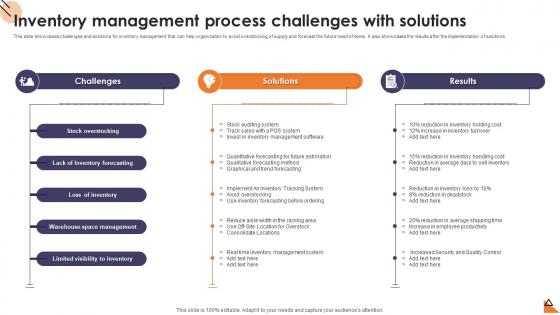
Inventory Management Process Challenges With Solutions




Try Before you Buy Download Free Sample Product
 Impress Your
 Audience
 100%
100% Editable
 Save Hours
 of Time


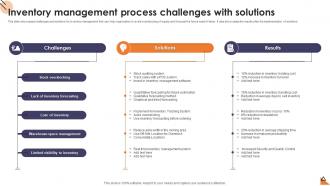
This slide showcases challenges and solutions for inventory management that can help organization to avoid overstocking of supply and forecast the future need of items. It also showcases the results after the implementation of solutions.
People who downloaded this PowerPoint presentation also viewed the following :
Inventory Management Process Challenges With Solutions with all 6 slides:
Use our Inventory Management Process Challenges With Solutions to effectively help you save your valuable time. They are readymade to fit into any presentation structure.





FAQs for Inventory Management Process
Ugh, demand forecasting is the worst - it's basically guessing what people want next month. Supply chain issues mess everything up too. You're constantly stuck between having too much inventory (bye bye cash flow) or running out of stuff and making customers mad. Oh and your different systems probably hate each other, which makes tracking everything a nightmare. Multi-channel selling just adds more chaos since each platform wants different stock levels. Honestly though? Figure out your demand patterns first. Once you've got that down, the rest becomes way more manageable.
Dude, get some barcode scanners ASAP if you're still counting by hand - that's your biggest quick win right there. RFID systems are even better but more expensive upfront. The whole point is getting real-time updates when stuff moves around, so you're not stuck with those nightmare spreadsheet situations. Inventory software will actually alert you before you run out of things or when numbers don't add up. I swear, warehouses I've worked with went from constant headaches to like 90% fewer mistakes just by automating the counting process. Manual tracking is honestly just asking for trouble these days.
Honestly, data analytics is a game-changer for inventory stuff. Instead of just guessing what you'll need, you can actually see patterns in your sales and predict when demand's gonna spike. Historical data gets processed way faster than Excel - and I've spent way too many hours fighting with spreadsheets, so trust me on that. You'll catch supply chain issues before they hit and figure out the sweet spot for reordering. The whole point is avoiding that nightmare of either running out of stock or having your cash tied up in products just sitting there. If you're just starting out, basic demand forecasting is probably your best bet.
Yeah, JIT is super fragile when supply chains get wonky. The whole point is having almost zero inventory, which backfires hard when deliveries are delayed or suppliers shut down. I learned this the hard way during COVID - companies were scrambling everywhere. You'll want some backup stock for your must-have items, plus multiple suppliers so you're not stuck with just one. Short sentences work. Having contingency plans ready makes a huge difference too. JIT's great for cutting costs, but honestly? It's risky as hell without those safety nets in place.
Look, start with demand forecasting - use your sales data to actually predict what you need instead of guessing. ABC analysis is a game changer too. Focus on your high-value stuff and don't waste energy overstocking the cheap items nobody cares about. Just-in-time ordering is solid if your suppliers don't flake on you. Set up those automated reorder points for anything that moves fast. Oh, and do cycle counting throughout the year - way better than those brutal annual inventory days where everyone wants to die. Don't try implementing everything at once though. Pick two things max.
Yeah, seasonal swings are brutal for inventory - you're either drowning in leftover stock or completely caught off guard by demand spikes. Look at your historical data from past seasons to spot patterns. Build up some buffer stock before peak times hit, and try to get flexible deals with suppliers so you can adjust orders fast. Safety stock helps a lot, but honestly don't overdo it or you'll just burn through cash. Oh, and start tracking these trends ASAP if you haven't already. Even messy data beats guessing what'll happen next season.
Ugh, both are terrible but for different reasons. Overstocking ties up your money in stuff just collecting dust, plus storage costs add up fast. Then there's the risk of things going bad or becoming outdated - learned that one the hard way with seasonal items once. But honestly? Running out of stock is probably worse. You're literally turning away sales and pissing off customers who'll just go to your competitors instead. Some won't come back even after you restock. Get good at predicting demand and set up alerts before you hit zero. That sweet spot exists, just takes practice to find it.
So inventory shrinkage is basically money down the drain - you're buying stuff that never makes it to actual sales. Could be theft, damage, paperwork screwups, whatever. Your cash flow gets wonky because you can't predict it properly. Here's what actually works: ditch the once-a-year inventory thing and do regular cycle counts instead. Tighten up how you receive shipments. Security cameras help, obviously. I'd track shrinkage by category though - that's where you'll spot the real patterns. Honestly, random spot checks are your best friend here. They catch problems while they're still small and cheap to fix.
Look, start with your historical sales data and throw in seasonal trends - that's your foundation. Don't rely on just one forecasting method though, mix it up because predicting stuff is already tricky enough. Economic conditions matter too, plus whatever your competitors are doing or if you've got big promotions coming up. Honestly, the biggest mistake I see people make? They set their forecast once and never touch it again. You need to check how accurate you were each month and adjust from there. Oh, and track where you're consistently wrong - there's usually a pattern hiding in those misses that'll help you get better.
Look, you gotta hit that balance where customers get what they want but you're not drowning in inventory costs. Focus your bigger stock on stuff that actually sells fast and makes good money. Slower items? Drop-ship those or do just-in-time orders - most people don't mind waiting if you tell them upfront. Sales patterns are your best friend here for forecasting. I'd honestly track your stockout costs against carrying costs every month so you can tweak things based on real numbers, not just guessing. Oh and be straight with customers about what's available - they appreciate the honesty way more than you'd think.
Start with a solid inventory system - TradeGecko, Fishbowl, or QuickBooks for smaller ops. Barcode scanners will save your sanity (trust me on this one, manual entry is a nightmare). Get a mobile app so your warehouse crew can update stock in real-time. Multiple locations? Go cloud-based so everyone's looking at the same data. Excel's fine when you're tiny but you'll hit its limits pretty quick. My buddy tried running everything through spreadsheets for way too long - don't be that guy. Focus on one system that actually talks to your other tools instead of having a bunch of random platforms that don't connect.
Honestly, training makes a huge difference with inventory mistakes. Your team learns proper counting methods and how to actually use the software right. When everyone's doing things the same way, you get way fewer mismatches between what's on the shelf and what's in the system. Trained people catch problems quicker too - damaged stuff, low stock warnings they'd normally miss. It helps with cycle counts and receiving procedures. I'd probably do some hands-on sessions with your actual software first. Then maybe quarterly refreshers? People forget this stuff faster than you'd think.
Dude, your suppliers are like your inventory lifeline. Good relationships mean they'll actually tell you when lead times are getting wonky or if there's gonna be a shortage. Trust me on this - when supply gets tight (and it always does), they'll bump your orders up the priority list if you've been cool to work with. I always share my forecasts with mine and actually give them feedback instead of just complaining. Honestly, most companies treat suppliers like garbage then wonder why their inventory planning falls apart. Work with them like actual partners. You'll dodge so many headaches down the road, plus they become your early warning system for potential disasters.
Here's what I'd do - first figure out all your carrying costs like storage, insurance, taxes, that whole mess. Companies always lowball these and it's honestly wild how fast it adds up. Usually hits around 20-30% of your inventory value per year. Do an ABC analysis on your priciest stuff first, then check your turnover ratios monthly to catch the dead weight. I'd probably just pick one product category this week and audit the hell out of it for a starting point. Monthly reports are clutch for spotting patterns you'd otherwise miss.
Look, globalization turns inventory management into a nightmare honestly. Your supply chains get stretched across different time zones and countries, so lead times drag on forever. Currency keeps bouncing around, regulations change between places, and don't even get me started on customs delays - they'll mess up your whole timeline. Quality standards are different everywhere too. But here's the upside: you can spread out your suppliers and find cheaper options if you're smart about it. Stock up more than usual and get some decent tracking tools so you know what's actually happening. When stuff goes wrong (and it will), you'll be ready.
-
The slides come with appealing color schemes and relevant content that helped me deliver a stunning presentation without any hassle!
-
“I required a slide for a board meeting and was so satisfied with the final result !! So much went into designing the slide and the communication was amazing! Can’t wait to have my next slide!”