


Iso 9001 iso 9001 and qms dashboards




Try Before you Buy Download Free Sample Product
 Impress Your
 Audience
 100%
100% Editable
 Save Hours
 of Time


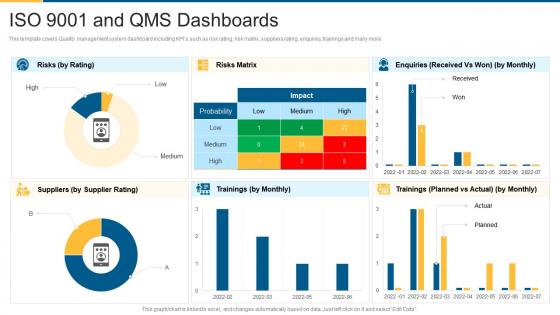
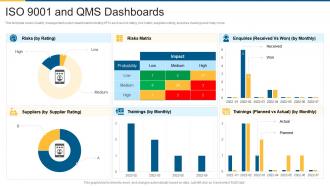
This template covers Quality management system dashboard including KPIs such as risk rating, risk matrix, suppliers rating, enquires, trainings and many more.
People who downloaded this PowerPoint presentation also viewed the following :
Iso 9001 iso 9001 and qms dashboards with all 7 slides:
Use our Iso 9001 Iso 9001 And Qms Dashboards to effectively help you save your valuable time. They are readymade to fit into any presentation structure.





FAQs for Iso 9001 iso 9001
So ISO 9001 has seven main principles you gotta know. Customer focus is the obvious one, but leadership buy-in is huge too - without that you're screwed. Getting your whole team involved matters way more than people think. You'll want to map out your processes instead of winging it, and actually use data to make decisions (novel concept, right?). Continuous improvement is key, plus don't ignore your supplier relationships. Honestly, the hardest part is figuring out which principle your company sucks at most. Quality can't just be the QA department's problem anymore.
Honestly, ISO 9001 just makes you do what you should already be doing - actually listen to customers and fix stuff when they complain. You'd think that's common sense, but apparently not! It forces you to track complaints, measure satisfaction, and document everything so your quality stays consistent. The best part? When problems come up (and they will), you've got actual systems to handle them instead of just crossing your fingers. Oh, and definitely map out how you deal with feedback right now - I bet you'll find some weird gaps you never noticed before.
So documentation is literally your proof that you're doing what ISO 9001 wants. Auditors need to see you've got your quality management system mapped out and that you're actually following your own procedures consistently. It's like showing your work in math class but for grown-ups with actual consequences lol. Having everything written down also keeps your whole team on the same page about quality standards. Honestly, start by just documenting what you're already doing - you'll be surprised how much ISO stuff you're probably doing without realizing it.
Dude, don't overthink ISO 9001 - that's where most small businesses mess up. Just document what you're already doing well instead of inventing crazy new processes. Map your main workflows first, then figure out where quality checks make sense. Free templates online are your friend for basic docs. Getting your team bought in early is huge though - nobody wants to deal with new procedures they don't understand. Oh, and start with just one department. Perfect that first, then roll it out everywhere else. Way less overwhelming that approach.
So the big shift in 2015 was moving to risk-based thinking instead of just prevention stuff. Leadership engagement became way more important - finally, because before it was just lip service honestly. They also streamlined documentation requirements, which is nice because you get more flexibility now. The high-level structure matches other ISO standards too. Context of organization is huge now, so you need to really understand your stakeholders. Oh and the process approach got emphasized more. If you're updating from 2008, start with risk assessment - that's where everyone gets stuck at first.
So first thing - map out your audit schedule and actually cover everything over time. Don't use auditors who work directly in those areas, that's just asking for bias. Train them properly too, obviously. Here's the thing though - compliance checking is boring. The real gold is spotting ways to improve stuff. Document your findings well and actually follow through on fixes. I've seen too many companies just file reports away and forget about them. Oh, and review your current schedule first - bet it's missing some critical processes.
Honestly, documentation is your worst enemy at first - everyone goes overboard and creates a mountain of procedures nobody actually uses. Your team's gonna hate it initially because it feels like pointless red tape. Getting people to actually follow consistent processes across different departments? Good luck with that, especially if your current setup is a mess. Employee buy-in is probably the hardest part though. Oh, and don't even get me started on trying to keep accurate records when half your staff thinks it's optional. My advice? Start ridiculously small with documentation and spend time explaining why you're doing this whole ISO thing in the first place.
So ISO 9001 is all about continuous improvement - it's literally built into the whole thing. You're constantly running that Plan-Do-Check-Act cycle, looking at data, getting customer feedback, then actually doing something with it. Honestly, it can feel like a lot at first because it never really stops. But that's kind of the point, right? Your quality system has to keep evolving. My advice? Just pick one process that's driving you nuts and try PDCA on it. You'll get the hang of it fast, and then you can tackle the bigger stuff.
Don't dump the whole ISO standard on everyone at once - that's a recipe for glazed eyes. Your quality team needs the deep stuff, but front-line people just need to know how their job fits the bigger picture. Skip those soul-crushing PowerPoint sessions (seriously, who enjoys those?). Real examples work way better than generic slides. Make it interactive with actual case studies from your processes. You'll need regular refreshers since things change. Document who learned what. Here's the key though - managers have to explain WHY we do things, not just rattle off procedures. That's what makes people actually care.
Oh yeah, ISO 9001 works great with other systems! They all use the same basic structure now (Annex SL), so you can stack them together pretty easily. Your quality stuff from 9001, environmental from 14001, safety from 45001 - honestly, the documentation overlaps so much it saves you tons of work. Risk management and audit processes are basically identical across all three. I'd map out what you already have first though - you might be way closer to multiple certifications than you realize. Way less scary than it sounds.
Focus on customer satisfaction scores, defect rates, and cycle times first - those are your bread and butter. Internal audit findings matter too, plus how fast you close corrective actions. Employee training completion and supplier performance are solid additions. Here's the thing though: pick metrics that actually move the needle for your business, not just what looks good on paper. I'd start with maybe 5-6 that leadership reviews monthly. You can always add more later. Oh, and measure real outcomes instead of just busy work - that's how you'll show actual ROI to the bosses.
ISO 9001's process approach is perfect for tightening up supply chains. Map out your supplier relationships first, then set clear vendor selection criteria. The risk-based thinking part (honestly took me forever to get this right) makes you spot supply chain weak spots early. Document your supplier evaluation - yeah, I know, more paperwork - and track their performance against your quality goals. Regular monitoring is key too. Oh, and definitely audit your current onboarding process first to see what's missing. Trust me, you'll find gaps you didn't even know existed.
Honestly, your leadership team can make or break the whole ISO thing. I've watched companies where executives just threw money at it and walked away - total disaster. You need them setting clear quality goals and actually showing up to management reviews, not treating it like busy work. The tricky part is getting them to communicate the quality policy so people actually understand it (and care). But here's the thing - when your leaders act like ISO matters, everyone else follows suit. Get them involved early or you'll be fighting an uphill battle when audit season hits.
Honestly, tech makes ISO 9001 so much less painful. Quality management software lets you track everything digitally instead of drowning in paperwork - trust me, that alone is worth it. Set up automated reminders for audits so you don't forget anything important. Real-time dashboards show your KPIs without digging through files. Cloud systems mean your team can access procedures from anywhere, which is clutch. My advice? Start by digitizing your most critical stuff first. You'll notice better consistency right away, and compliance tracking becomes way less of a headache.
So you're looking at around $5K-$15K upfront for the whole certification thing - gap analysis, documentation help, the actual audit. Then surveillance audits hit you for $2K-$5K every year, plus recertification every three years. Staff time's where it gets sneaky though - training, updating docs, all that prep work adds up. I'd honestly budget like $10K-$20K for your first year, then maybe $5K-$8K annually after. Oh and definitely shop around different certification bodies because their prices are all over the place. Some are way cheaper than others for basically the same service.
-
Use of icon with content is very relateable, informative and appealing.
-
Commendable slides with attractive designs. Extremely pleased with the fact that they are easy to modify. Great work!