


IT Companys Business Introduction Powerpoint Presentation Slides




Try Before you Buy Download Free Sample Product
 Impress Your
 Audience
 100%
100% Editable
 Save Hours
 of Time


A company profile is a professional introduction of a company to provide operational and financial information. Check out our professionally designed template for IT company's Business Introduction that wants to give its business details to its stakeholders employees, investors, clients, partners, shareholders, etc. It covers the operation information such as a brief overview of the company and its products and services, history, geographic presence, mission and vision statement, latest technologies, research and development activities, distribution network, etc. In addition to this, it covers the competitor details such as the name of top competitors by their operations, competitive landscape, financial comparison with competitors, etc. The template has also covered the financial overview of the company that includes the company's financials from its income statement revenue, EBIT, and Net income, balance sheet total assets, total liabilities, goodwill, and cash flow statement cash flows from operating, investing, and financing activities. In the end, it covers strategic details long-term growth goals and strategies, acquisition details, SWOT analysis, and risk management strategies of the company. The module also covers the primary corporate social responsibilities of the company. Download 100 percent editable IT company profile templates, allowing you to tailor the content to your specific requirements.
People who downloaded this PowerPoint presentation also viewed the following :
Content of this Powerpoint Presentation
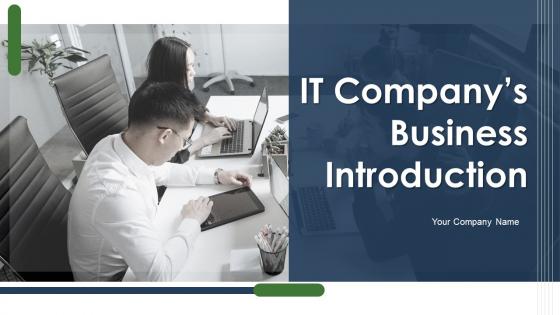
Slide 1: This slide introduces IT Company’s Business Introduction. State Your Company Name and begin.
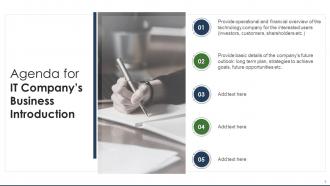
Slide 2: This slide states Agenda of the presentation.
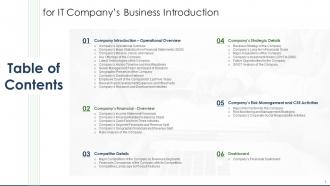
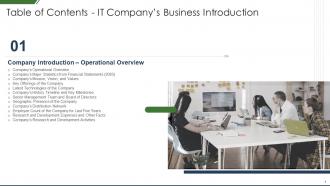
Slide 3: This slide presents Table of Content for the presentation.
Slide 4: This slide highlights title for topics that are to be covered next in the template.
Slide 5: The slide displays an introduction including brief overview, headquarter, founding year, business segment details etc.
Slide 6: This slide represents Company’s Major Statistics from Financial Statements.
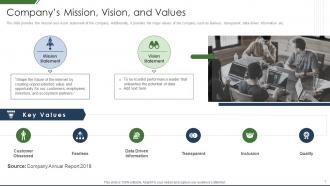
Slide 7: The slide provides the mission and vision statement of the company.
Slide 8: The slide presents key products & service of the company including its application software, hardware products and entertainment solutions.
Slide 9: The slide displays the details about latest technologies that the company uses in its products.
Slide 10: The slide represents the key milestones (founding, acquisitions, expansion etc.) of the company, from the years 2000 to 2020.
Slide 11: The slide provides the name and designation of senior management team (along with the Board of Directors) of the company.
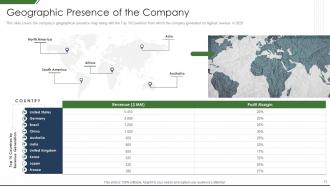
Slide 12: This slide covers the company’s geographical presence map along with the Top 10 Countries from which the company generated its highest revenue.
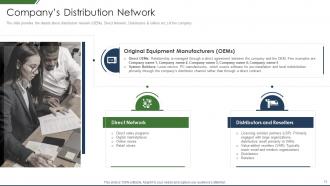
Slide 13: The slide represents the details about distribution network (OEMs, Direct Network, Distributors & sellers etc.) of the company
Slide 14: The slide shows the employee count of the company from the year 2017-2021 and their split (by geography and functions).
Slide 15: This slide presents Research and Development Expenses and Other Facts.
Slide 16: The slide provides the brief overview about the latest research and development activities.
Slide 17: This slide highlights title for topics that are to be covered next in the template.
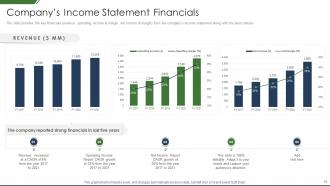
Slide 18: The slide represents the key financials (revenue, operating income & margin, net income & margin) from the company’s income statement.
Slide 19: The slide provides the key financials (total assets, total liabilities, goodwill) from the company’s balance sheet along with the basic details
Slide 20: The slide presents the cash flows from the operating, investing and financing activities of the company.
Slide 21: The slide provides the company’s revenue for last three years from three operating segments.
Slide 22: The slide displays the company’s revenue for last three years from its geographical segments.
Slide 23: This slide represents a table of key ratios (Current ratio, interest coverage ratio, Return on Equity, Return on Assets, Asset Turnover Ratio etc.) of the company.
Slide 24: This slide highlights title for topics that are to be covered next in the template.
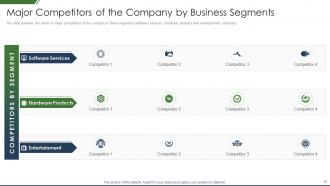
Slide 25: The slide presents the name of major competitors of the company in three segments (software services, hardware products and entertainment solutions).
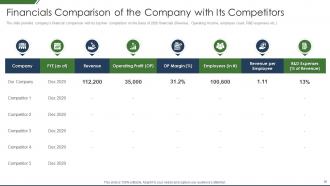
Slide 26: This slide shows Financials Comparison of the Company with Its Competitors.
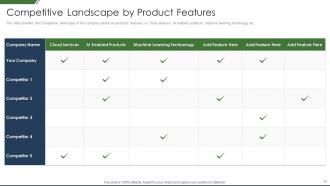
Slide 27: The slide displays the Competitive landscape of the company based on products’ features i.e. cloud services, AI enabled products, machine learning technology etc.
Slide 28: This slide highlights title for topics that are to be covered next in the template.
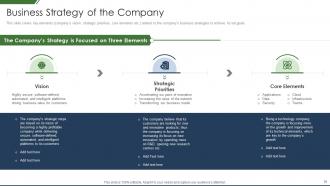
Slide 29: This slide covers key elements (company’s vision, strategic priorities, core elements etc.) related to the company’s business strategies to achieve its set goals.
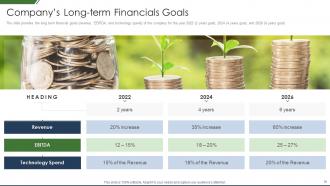
Slide 30: The slide presents the long term financial goals (revenue, EBITDA, and technology spend) of the company.
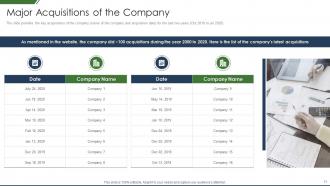
Slide 31: The slide provides the key acquisitions of the company (name of the company and acquisition date) for the last two years.
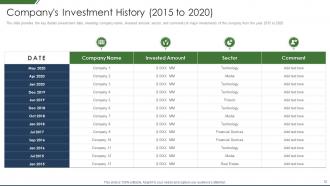
Slide 32: The slide displays the key details (investment date, investing company name, invested amount, sector, and comment) of major investments of the company.
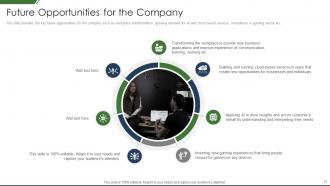
Slide 33: The slide represents the key future opportunities for the company such as workplace transformation, growing demand for AI and cloud based services.
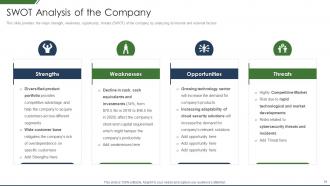
Slide 34: This slide provides the major strength, weakness, opportunity, threats (SWOT) of the company by analyzing its internal and external factors.
Slide 35: This slide highlights title for topics that are to be covered next in the template.
Slide 36: This slide provides key risk factors that might affect company’s operational and financials performance.
Slide 37: This slide displays key risk factors (foreign currency risk, interest rate fluctuations, equity risk, credit risk) along with the risk management strategies.
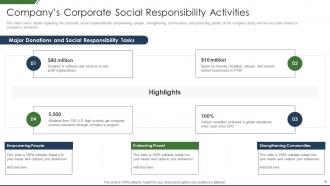
Slide 38: This slide represents Company’s Corporate Social Responsibility Activities.
Slide 39: This slide highlights title for topics that are to be covered next in the template.
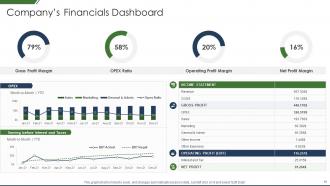
Slide 40: This slide presents Company’s Financials Dashboard with- Gross Profit Margin, Operating Profit Margin, Net Profit Margin, etc.
Slide 41: This slide displays Icons for IT Company’s Business Introduction.
Slide 42: This slide is titled as Additional Slides for moving forward.
Slide 43: This is About Us slide to show company specifications etc.
Slide 44: This is Our Team slide with names and designation.
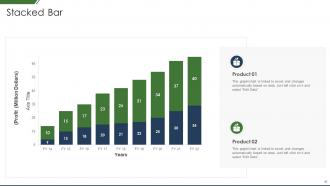
Slide 45: This slide represents Stacked Bar chart with two products comparison.
Slide 46: This slide shows Post It Notes. Post your important notes here.
Slide 47: This is an Idea Generation slide to state a new idea or highlight information, specifications etc.
Slide 48: This slide depicts Venn diagram with text boxes.
Slide 49: This is a Thank You slide with address, contact numbers and email address.
IT Companys Business Introduction Powerpoint Presentation Slides with all 54 slides:
Use our IT Companys Business Introduction Powerpoint Presentation Slides to effectively help you save your valuable time. They are readymade to fit into any presentation structure.



















FAQs for IT Companys Business Introduction
So we do three things mainly: cloud migration, cybersecurity, and custom software development. Healthcare clients need HIPAA-compliant stuff, retail wants e-commerce and payment security, financial services... well, they're paranoid about everything security-wise (can't blame them). The industry-specific thing is honestly what makes us different - most companies just throw generic solutions at everyone. Oh, and if you want to see how we'd handle your specific industry, I've got case studies that show real examples. Way more helpful than just talking about it.
Honestly, three things set us apart. First - we're laser-focused on mid-market manufacturing, not trying to be everything to everyone. Second thing is our support team is actually here in the US and available 24/7. But here's what really matters: we'll pick up the damn phone when something breaks. Most of our competitors either cast too wide a net or outsource support overseas, which just creates headaches. Manufacturing has weird legacy system issues that generic IT guys don't get. Oh, and definitely lead with the manufacturing angle when you're pitching - that's your hook.
We're pretty solid across the board! JavaScript is our bread and butter - React, Node.js, the usual suspects. Python too for backend stuff and data crunching. Most of us live in AWS and Azure these days, which honestly beats dealing with physical servers any day. SQL and Docker are pretty standard for everyone here. Docker especially - I swear it's saved us from so many "but it works on my machine" disasters. Oh, and we've got a couple mobile people doing React Native and Swift. What kind of project are you thinking about? I can point you toward whoever knows that stuff best.
Oh totally! So we just finished this massive project for MegaRetail Corp - completely rebuilt their e-commerce platform and somehow managed to speed up checkout by 300%. Crazy right? We've also got this AI chatbot running for HealthTech Solutions that cut their support tickets by 60%. The mobile app for LocalBank is doing really well too - like 2 million transactions a month now, which honestly blew our minds. I think I've got the detailed breakdowns saved somewhere if you want me to dig those up later.
Look, we bake security right into everything from the start - none of this "we'll add it later" nonsense that always backfires. Data gets encrypted whether it's moving around or sitting in storage. Regular pen testing, zero-trust architecture, the whole deal. Your team will need training too since honestly, people clicking weird links is still how most breaches happen. Oh, and we handle all the compliance stuff upfront so you're not panicking when audit season rolls around. Way less stressful that way.
Look, we do this hybrid thing with Scrum and Kanban - sounds fancy but it's pretty straightforward. Most projects run 2-week sprints with daily check-ins and the typical planning meetings. Thing is, we're not gonna die on that hill if it's not clicking for your team. Sometimes you gotta throw the playbook out the window, you know? Jira handles all the tracking stuff, Slack keeps everyone talking during sprints. Honestly, getting working software matters way more than following some textbook process. Need to switch directions halfway through a sprint? Yeah, we can roll with that.
So we do a bunch of stuff for professional development - internal workshops, outside certifications, conferences, the usual. Everyone gets dedicated learning hours monthly plus course reimbursement. The tech talks are actually pretty cool though - team members present new technologies they've found and honestly those sessions get way more engagement than I expected. Cross-functional work helps too since you're always picking up different approaches. Oh, and definitely set up a learning plan with your manager for this quarter. Makes it feel less random, you know?
Honestly, we just bake feedback collection right into everything we do. Regular check-ins, surveys after projects wrap up - the usual stuff. Then our product teams actually look at what comes in and figure out which features to build next. The annoying part? Balancing what one client screams about versus what actually helps everyone. We run these beta programs too where certain clients test stuff early - they love feeling special. But here's the thing: you've gotta close the loop. Tell people what happened with their suggestions, even if you couldn't do exactly what they wanted. Otherwise they'll stop caring.
Man, the speed of change is just insane right now. We'll finally get comfortable with our setup and then some new thing completely flips everything upside down. Finding good developers? Forget about it - everyone's fighting over the same pool of talent. Plus clients somehow expect us to be wizards at AI, cloud stuff, cybersecurity, literally everything. It's exhausting tbh. What's actually worked for us is just picking our battles - we invest hard in training our team but we're picky about which shiny new tools we actually adopt versus just watching from the sidelines.
Remote work there is pretty good actually. You'll get the usual stuff - Slack, Zoom, cloud storage - plus they use project management tools to keep everyone on track. Time zones can be annoying but most teams overlap for important meetings. The async communication is honestly what saves you though, so you won't be sitting around waiting for replies all day. Teams get budgets for whatever collaboration tools they want too. Oh, and definitely ask your manager which platforms your specific team likes since apparently some have pretty different setups.
Look, innovation pretty much runs everything we do here - from client solutions to picking our tech. We're always trying to guess what companies will actually need in 2-3 years. Honestly feels like being a psychic sometimes, but with better coffee. That's how we build stuff that won't be obsolete next month though. Your work feeds right into this whole process too. Every weird problem you crack could become our next big thing, so definitely keep notes on those random fixes you come up with.
So we basically look at both the tech stuff and business results. Tech side is your usual - did we hit deadlines, stay on budget, how many bugs popped up, system running smooth. Business metrics are trickier but more important honestly - are people actually using this thing, what's our ROI looking like, stakeholder surveys (good luck getting those back lol). The trick is nailing down what "success" means before you even start. Otherwise you're just guessing later. Don't go crazy with metrics though - 3 to 5 max or you'll be drowning in spreadsheets instead of actually improving anything.
So we're doing three big things for sustainability - energy-efficient cloud stuff, keeping our hardware longer (which honestly saves us money too), and staying remote to cut commuting. You've probably noticed we're not buying new equipment constantly anymore. Remote work has been a game-changer for our carbon footprint. We also check that our vendors actually care about environmental stuff and do quarterly carbon tracking. Oh, and if you're starting any new projects, just run it by facilities first with that sustainability checklist - takes like two minutes and keeps us compliant.
So we've got some really good partnerships going. AWS and Microsoft Azure handle our cloud stuff, plus there's a certified Salesforce partnership for CRM work. The ServiceNow collaboration has been huge though - honestly our enterprise clients love it. Next quarter we're expanding into cybersecurity partnerships which should be interesting. Oh, and definitely bring up these partnerships in proposals since we get preferred pricing and priority support from them. Want me to grab those partner benefit sheets for you? They've got all the specifics if you need them for anything.
Hey! So I've been tracking three big trends that are really shaking things up - AI automation, edge computing, and cybersecurity mesh. AI is obviously the buzzword everyone's obsessed with (seriously, every meeting), but honestly? Edge computing is where I see the real money. Your data gets processed right where you need it instead of bouncing around the cloud forever. Way faster, way cheaper. The cybersecurity mesh thing is pretty critical too since we're all still working from home half the time. My take? We should get ahead of these now before everyone else catches on.
-
The quality of PowerPoint templates I found here is unique and unbeatable. Keep up the good work and continue providing us with the best slides!
-
SlideTeam is my one-stop destination for templates. Highly recommended!