


Key Informational Statistics On Workplace Conflict Resolution In The Workplace




Try Before you Buy Download Free Sample Product
 Impress Your
 Audience
 100%
100% Editable
 Save Hours
 of Time


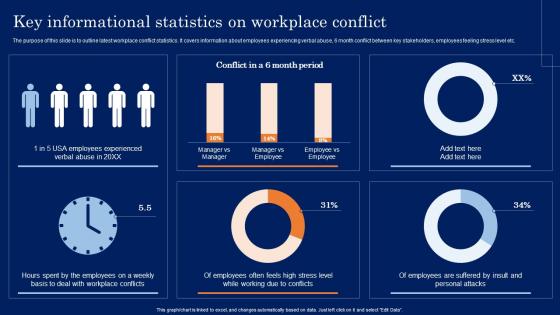
The purpose of this slide is to outline latest workplace conflict statistics. It covers information about employees experiencing verbal abuse, 6 month conflict between key stakeholders, employees feeling stress level etc.
People who downloaded this PowerPoint presentation also viewed the following :
Key Informational Statistics On Workplace Conflict Resolution In The Workplace with all 7 slides:
Use our Key Informational Statistics On Workplace Conflict Resolution In The Workplace to effectively help you save your valuable time. They are readymade to fit into any presentation structure.






FAQs for Key Informational Statistics On Workplace Conflict Resolution
Studies consistently show that 85-95% of employees report experiencing workplace conflict during their careers, with some research indicating nearly universal exposure across all organizational levels. These conflicts, ranging from interpersonal disagreements to resource allocation disputes, ultimately present opportunities for stronger communication protocols, enhanced team dynamics, and improved leadership development initiatives across industries.
Recent studies indicate that effective conflict resolution increases employee productivity by 25-40%, reduces absenteeism by up to 50%, and decreases turnover rates significantly. Organizations implementing structured conflict resolution processes experience enhanced collaboration, faster decision-making, and improved team performance, with many companies finding that strategic conflict management ultimately delivers higher engagement levels and competitive operational efficiency.
Recent workplace surveys identify poor communication, personality clashes, workload disputes, resource competition, and differing work styles as the most common conflict sources. These workplace tensions significantly impact productivity and employee satisfaction, with organizations increasingly finding that proactive conflict resolution training, clearer communication protocols, and structured mediation processes reduce workplace disputes by up to 50%, ultimately enhancing team collaboration and organizational efficiency.
Generational differences significantly impact conflict resolution approaches, with Baby Boomers preferring hierarchical, formal processes, Gen X favoring direct confrontation and structured mediation, and Millennials and Gen Z embracing collaborative dialogue and technology-enabled solutions. Organizations increasingly find that multi-generational teams benefit from flexible resolution frameworks, ultimately delivering enhanced workplace harmony and improved cross-generational understanding.
Company culture significantly influences workplace conflict frequency and severity through established communication norms, leadership accountability standards, conflict resolution processes, and employee behavioral expectations. Organizations with transparent, inclusive cultures experience fewer escalated disputes, while toxic environments amplify tensions, with many companies finding that proactive cultural investments in psychological safety and open dialogue ultimately deliver reduced turnover and enhanced productivity.
Mediation, direct communication training, early intervention protocols, collaborative problem-solving frameworks, and structured feedback systems consistently show the highest success rates in workplace dispute resolution. Organizations implementing these approaches report 70-85% resolution rates, with financial services and healthcare sectors finding that combining mediation with communication training reduces recurring conflicts by up to 60%, ultimately delivering improved productivity and employee retention.
Mediation programs significantly enhance conflict resolution outcomes by increasing resolution rates, reducing litigation costs, and improving workplace relationships through structured dialogue and neutral facilitation. Organizations with established mediation programs report 75-85% resolution success rates, faster conflict resolution timelines, and improved employee satisfaction, while companies like Google and Microsoft leverage these programs to maintain productive team dynamics and reduce turnover costs.
Unresolved workplace conflict significantly increases employee turnover rates, with studies showing organizations experiencing high conflict levels face 25-40% higher turnover than those with effective resolution processes. This correlation stems from decreased job satisfaction, reduced team cohesion, and diminished workplace morale, ultimately costing companies substantial recruitment and training expenses while weakening organizational stability.
Diversity creates more complex conflict dynamics through varying communication styles, cultural perspectives, and problem-solving approaches, while also providing richer solutions and enhanced creativity. Organizations with diverse teams find that tailored resolution strategies, inclusive mediation practices, and cultural competency training significantly improve outcomes, ultimately delivering stronger team cohesion and competitive advantage in global markets.
Unresolved workplace conflicts cost organizations through decreased productivity, increased turnover, absenteeism, and potential legal expenses, with studies showing losses ranging from thousands to millions annually depending on company size. These conflicts ultimately drain resources through extended resolution timeframes, reduced team efficiency, and compromised employee engagement, while proactive conflict management delivers significant cost savings and enhanced organizational performance.
Studies indicate that approximately 60-70% of organizations provide some form of conflict resolution training, though frequency varies significantly across industries and company sizes. While larger corporations and healthcare institutions typically offer annual or biannual programs, many smaller businesses provide training reactively, with comprehensive conflict resolution education ultimately delivering improved workplace productivity, reduced turnover costs, and enhanced team collaboration.
Approximately 65-70% of organizations utilize external mediators for workplace conflict resolution, with this percentage increasing significantly among larger enterprises and regulated industries like healthcare, financial services, and manufacturing. These external mediation services streamline resolution processes, reduce legal costs, and deliver more neutral outcomes, with many organizations finding that professional mediators ultimately enhance workplace relationships while minimizing litigation risks.
Remote work transforms workplace conflicts by shifting communication challenges online, reducing face-to-face tensions, and creating new disputes around digital boundaries and collaboration tools. Through virtual mediation platforms and structured communication protocols, organizations streamline conflict resolution processes, enable more documented discussions, and often find faster resolution times, while ultimately delivering more inclusive participation in conflict resolution across distributed teams.
Age, gender, cultural background, education level, and hierarchical position significantly influence conflict resolution outcomes, with younger employees and women often showing higher collaboration rates. Organizations find that diverse teams, while initially presenting more communication challenges, ultimately achieve more innovative solutions and sustainable agreements when proper mediation frameworks address these demographic considerations strategically.
Women typically prefer collaborative, relationship-focused approaches emphasizing communication and mutual understanding, while men often favor direct, solution-oriented methods prioritizing quick resolution. These preferences significantly impact workplace dynamics, with organizations increasingly finding that diverse resolution strategies, combining both empathetic dialogue and decisive action, ultimately deliver more effective outcomes and stronger team cohesion.
-
I downloaded some of the presentations for work. They were simple to modify and saved me a lot of time and effort.
-
Great product with highly impressive and engaging designs.