


Key issues with strategy recommendations





Try Before you Buy Download Free Sample Product
 Impress Your
 Audience
 100%
100% Editable
 Save Hours
 of Time


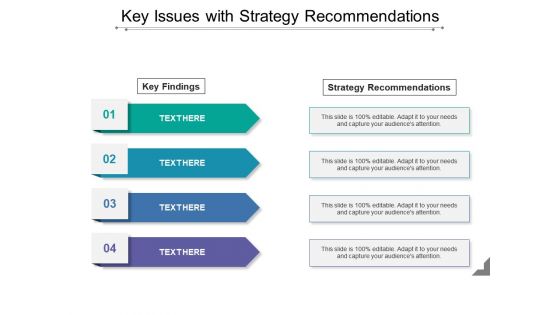
We present before you the key issues with strategy recommendations PowerPoint presentation. You can use this PPT presentation sample slide to solve your key issues with all the numerous strategies provided to you. After identifying all the key issues in your business organisation you can rely for the solutions on our key issues with strategy recommendations PPT slide. This PowerPoint template is not only for a business organisation but can also be used in any presentation, related to any topic. This PowerPoint presentation slide can be used for any four staged process. All the problems and there suitable solutions can be showcased using this business PowerPoint template. The key issues have been put into for arrows which make the presentation look attractive. This type of slideshow is also helpful for technology oriented firms. To finalise the presentation you can use various icons on each topic. The PPT has been completely designed by our top level experts. Our Key Issues With Strategy Recommendations have a classic element. They incorporate aspects of traditional wisdom.
People who downloaded this PowerPoint presentation also viewed the following :
Content of this Powerpoint Presentation
Description:
This image displays a PowerPoint slide titled "Key Issues with Strategy Recommendations," designed to concisely present major findings and their associated strategic recommendations. On the left side of the slide, there is a column labeled "Key Findings," featuring four numbered points where specific findings can be inserted (represented by "TEXT HERE"). These findings should summarize critical aspects or outcomes identified during analysis or research. On the opposite side, there is a column labeled "Strategy Recommendations," which corresponds to each of the key findings.
Use Cases:
This slide layout can be applied across various industries where strategic planning and presentation of findings are essential:
1. Consulting:
Use: Presenting research outcomes and strategic solutions to clients.
Presenter: Management consultant.
Audience: Corporate executives.
2. Healthcare:
Use: Discussing diagnosis or treatment challenges and corresponding medical protocols.
Presenter: Healthcare administrator or physician.
Audience: Medical staff or stakeholders.
3. Technology:
Use: Sharing technological assessments and proposing technological upgrades or solutions.
Presenter: IT manager or system analyst.
Audience: Technical team or decision-makers.
4. Education:
Use: Summarizing key educational challenges and outlining improvement plans.
Presenter: Educational consultant or school administrator.
Audience: School board or teaching staff.
5. Manufacturing:
Use: Reporting on production issues and suggesting process optimizations.
Presenter: Operations manager.
Audience: Production team or department heads.
6. Finance:
Use: Reviewing financial performance and recommending financial strategies.
Presenter: Financial analyst or CFO.
Audience: Investors or company board members.
7. Marketing:
Use: Describing marketing campaign results and proposing future marketing strategies.
Presenter: Marketing director.
Audience: Marketing team or business partners.
Key issues with strategy recommendations with all 5 slides:
Our Key Issues With Strategy Recommendations facilitate direct contact. You and your clients will see eye to eye.



FAQs for Key issues
Honestly, most strategic plans crash because nobody's actually in charge of making stuff happen. Teams try to juggle like 10 priorities at once - which obviously means nothing's really a priority. Communication breakdowns are huge too. Hard to execute when you're confused about what you're supposed to be doing, right? Market changes and budget issues don't help either. Here's what actually works: pick 2-3 super clear goals, put specific people on the hook for each one, and schedule regular reality checks. Because your perfect plan will definitely get punched in the gut by real life at some point.
Honestly, ditch the rigid long-term planning thing. Build in flexibility from day one - like quarterly check-ins instead of those brutal 3-year plans nobody follows anyway. Set up feedback loops so you're actually watching what customers do, not just what they say. Cross-functional teams work great for this stuff. I've watched so many companies crash because they wouldn't pivot when things obviously weren't working. Your strategy should be more like GPS that reroutes when there's traffic, you know? Start by figuring out which parts of your current plan would totally fall apart if the market shifted.
Honestly, your team is watching you when things get messy - they need to see you've got a handle on it. People panic when their leader disappears during tough calls. So stay visible, communicate like crazy, and don't drag your feet on the hard decisions. I learned this the hard way watching strategies implode because leadership went MIA. Quick thing that actually works? Set up regular check-ins when you're pivoting strategy. Sounds obvious but you'd be surprised how many small problems turn into disasters just because nobody's talking. Keep everyone on the same page, even when it feels like chaos.
Pick 3-5 metrics that actually tie to what you're trying to accomplish - revenue growth, new customers, whatever matters most. Track both the stuff that predicts success (like your sales pipeline) and the actual results. Most companies just make this up as they go, which is why they're always confused about whether things are working. Check in quarterly to see how you're doing. If the numbers suck, change course - don't just keep doing the same thing hoping it'll magically work. Oh, and don't overthink this part. Better to track a few important things well than try to measure everything poorly.
Honestly, most strategies crash because of terrible communication. Leadership gets all hyped about their vision but forgets to actually tell everyone what's happening. Then nobody knows who's supposed to do what - zero accountability. Budget issues kill things too. Teams get pumped about the plan until they realize there's no money or staff to make it work. The worst part though? Companies try tackling everything simultaneously instead of focusing. Pick maybe 2-3 things that actually matter, give each one a clear owner, then bug them about progress every week. Don't just assume it'll happen on its own.
Oh man, this is huge. What crushes companies in Tokyo might work perfectly in São Paulo - people communicate totally differently, make decisions at different speeds, respect different hierarchies. I've watched "one-size-fits-all" strategies just implode when they ignore local customs. Your Tokyo team might need way more consensus-building time while your NYC office wants quick decisions. Risk tolerance varies wildly too. Here's what actually works: get local teams involved from the start, not after you've already planned everything. Adapt your approach for each market. Cultural stuff isn't optional - it'll make or break you.
Honestly, psychological safety is everything - nobody's gonna take risks if they think they'll get roasted for failing. Maybe give people like 10% of their time just to mess around with new ideas? Cross-functional teams work surprisingly well too. I've seen magic happen when you throw together people who normally never talk. Also, celebrate the tiny wins! Sounds cheesy but it actually keeps people motivated when everything's falling apart. Your frontline folks probably have the best insights anyway - they see stuff management completely misses. Just ask your team what's one thing they'd fix tomorrow if they could.
Honestly, just automate the boring stuff first. Look at what data you're collecting by hand right now - that's where you start. Dashboards can pull competitor info and market data automatically instead of you spending weeks on it. Your team can use tools like Miro to actually see different scenarios without sitting through a million meetings (well, you'll still have some unfortunately). The real win is freeing up your headspace for the strategic thinking part. Real-time metrics and AI tools help you spot patterns way faster than manual analysis ever could.
Get stakeholders involved in actually building the strategy - people buy into stuff they help create. Talk through the "why" and connect it to what they personally care about. Too many leaders just drop these things from above and wonder why nobody cares, honestly. Have real conversations with the influential people, especially one-on-one where they'll actually open up. Address their concerns directly and actually listen to their input. Create some early wins so people can see it's working. Oh, and don't make it feel like you're dictating from your ivory tower - collaboration beats commands every time.
Honestly, don't treat risk management like some boring checkbox exercise. Figure out what could actually screw up your main goals first - market changes, ops breaking down, competitors doing something crazy. Then bake those mitigation plans right into your strategy work instead of making it separate busywork that nobody pays attention to. Give someone ownership of tracking each risk. I'd tie your risk check-ins to quarterly strategy reviews so you're always tweaking things based on real data. The whole point is making it feel like part of the actual planning, not compliance theater.
Look, if you never review your strategic plan, it just turns into expensive wall decoration. Your team starts losing faith when they realize they're following outdated stuff - and honestly, that's probably the worst part because morale tanks fast. Meanwhile your competitors are pivoting left and right while you're still chasing last year's goals. Market changes happen constantly, so you'll miss new opportunities and shifting customer demands. I'd say check in quarterly at least, maybe monthly if things are really volatile in your industry. Don't overthink it though - when the numbers say pivot, just pivot.
Honestly, data is like having superpowers for business decisions - you'll catch stuff your gut totally misses. Start with customer behavior patterns, market shifts, operational numbers. I've watched entire teams do complete 180s after finding something wild in their data. The real trick? Track things that predict problems, not just measure what already happened. Focus on your biggest "what ifs" first, then build dashboards around those specific worries. Leading indicators are everything - they give you that heads up before you're scrambling to fix things.
Okay so here's the thing - big companies are basically dinosaurs when it comes to speed. They're stuck in endless meetings while you can literally change course tomorrow if needed. Use that! Get tight with your local community and find those weird little gaps they're totally ignoring. Maybe team up with other small businesses too? Like, why compete when you could swap referrals instead. Your scrappy energy is honestly your biggest weapon here. Pick one thing you can crush them on this week - could be how fast you respond to customers or just being more flexible. That's where you win.
Look, you gotta protect your long-term stuff even when sales get sketchy. Set up separate budget buckets - one for day-to-day operations, another for strategic projects. Then stick to it! I've watched way too many companies panic and cut their future investments the second things get tight. Bad move. Make your leadership team look at both short-term AND long-term metrics every meeting, not just revenue. Treat strategic goals like they're as critical as keeping the lights on - because honestly, they kind of are. Figure out which strategic projects would seriously hurt you if paused. Those get protected no matter what.
Honestly, economic shifts can flip your whole strategy upside down crazy fast. Like when interest rates spike or recession fears hit - I've watched companies go from "let's expand everywhere!" to cutting budgets within weeks. Your customers start spending differently, supply chains get messy, and boom - that five-year plan you worked on? Needs a total redo. Inflation alone can wreck your pricing models. The trick is baking flexibility into everything from day one. That way you're adapting smoothly instead of running around like crazy when the economy decides to throw a curveball.
-
Thanks for all your great templates they have saved me lots of time and accelerate my presentations. Great product, keep them up!
-
Understandable and informative presentation.