


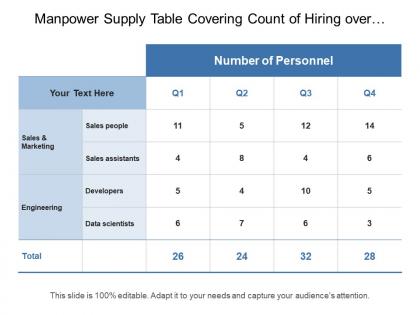
Manpower supply table covering count of hiring over different quarter of time




Try Before you Buy Download Free Sample Product
 Impress Your
 Audience
 100%
100% Editable
 Save Hours
 of Time


Our Manpower Supply Table Covering Count Of Hiring Over Different Quarter Of Time follow established etiquette. They adhere to accepted norms.
People who downloaded this PowerPoint presentation also viewed the following :
Content of this Powerpoint Presentation
Description:
The image is a PowerPoint slide titled "Manpower Supply Table Covering Count of Hiring over..." which seems to be used for human resource planning. It features a table that tracks the number of personnel hired in different roles across four quarters (Q1, Q2, Q3, Q4). The positions tracked are 'Salespeople', 'Sales Assistants', 'Developers', and 'Data Scientists', categorized under 'Sales & Marketing' and 'Engineering'. The table allows for the insertion of numerical data to display hiring trends over the year, and it also includes totals for each quarter, providing a clear overview of hiring volumes over time.
Use Cases:
This type of slide can be used across various industries for workforce planning and reporting:
1. Technology:
Use: Tracking developer and data scientist hiring trends.
Presenter: HR Director
Audience: Management Team, HR Department
2. Retail:
Use: Monitoring sales staff hiring to manage seasonal demand.
Presenter: Recruitment Manager
Audience: Store Managers, HR Team
3. Healthcare:
Use: Documenting hiring of medical professionals by quarter.
Presenter: Chief of Staff
Audience: Department Heads, Administrative Staff
4. Automotive:
Use: Analyzing engineer and support staff hiring for new projects.
Presenter: Operations Manager
Audience: Project Teams, HR Planners
5. Education:
Use: Managing the hiring of educators and support staff across semesters.
Presenter: Dean of Faculty
Audience: Academic Affairs, HR Department
6. Financial Services:
Use: Reporting on the hiring of financial analysts and support staff.
Presenter: Chief Financial Officer
Audience: Finance Department, Recruiters
7. Consulting:
Use: Planning consultant and support role hiring for project cycles.
Presenter: Talent Acquisition Lead
Audience: Practice Leaders, Resource Management Teams
Manpower supply table covering count of hiring over different quarter of time with all 5 slides:
Our Manpower Supply Table Covering Count Of Hiring Over Different Quarter Of Time absorb the best from every culture. You will gain from diversity.




FAQs for Manpower supply table covering count of hiring over different
Okay so the big things to watch are demographics and skills gaps. Baby boomers are retiring everywhere, which is shrinking the workforce. Meanwhile tech keeps evolving faster than people can learn new skills - it's honestly pretty wild how quickly things change now. Immigration policies play a huge role too, plus what colleges are actually teaching versus what companies need. Remote work threw everything for a loop geographically speaking. Oh and don't forget how many people just... stepped back from work during COVID and never came back the same way. I'd definitely look at your local trends and see what skills shortages are coming for your specific industry.
Start with employment rates, skill availability, and demographic changes in your target areas. Government labor stats and industry reports are your best bet - LinkedIn's workforce data is actually pretty solid too. Map that against your business projections and any seasonal stuff you deal with. The real magic happens when you spot gaps between available skills and what you'll need in 6-12 months. Don't just rely on spreadsheets though. Your recruiters and hiring managers have ground-level insights that data can't capture. Monthly check-ins help you pivot when things shift unexpectedly.
Dude, automation and AI are literally changing everything about hiring right now. Companies can predict skill shortages way before they happen with these new analytics tools. Some jobs are disappearing, but honestly? New ones are popping up faster than I can keep track of. Recruiting got way easier with AI platforms finding talent automatically. Plus remote work tech means you can hire from anywhere now - which is pretty cool. My advice? Start upskilling your team and build flexibility into your workforce strategy. The companies adapting quickest are winning right now.
So basically the whole workforce is aging out super fast - all those boomers retiring means tons of experience walking out the door. Birth rates are down too, so there's just fewer people coming in to replace them. It's honestly kind of a mess. Immigration helps but there's still that skills gap issue. You're gonna want to really focus on keeping the people you have and training them up. Maybe look at hiring from other cities too? Oh, and definitely start figuring out who's replacing your key people now because this isn't getting better anytime soon.
Honestly, demand forecasting is your worst enemy here. Business needs change overnight but hiring takes forever - total nightmare. Skills gaps are brutal too, can't find anyone qualified these days. High turnover doesn't help either, just when you think you've got staffing figured out, half your team bounces. Seasonal stuff and tight budgets make it even messier. Oh and cross-training is clutch - teach people multiple roles so you're not scrambling when someone leaves. Build in some buffer capacity too, trust me on that one.
Honestly, tracking your actual data beats just copying last year's hiring plan. Look at when demand spikes, how often people quit, and productivity patterns - that stuff tells you exactly when you'll need more bodies and what skills to prioritize. We did this at my last job and stopped wasting money on random temp workers. Plus you'll catch weird bottlenecks, like marketing drowning in Q4 while accounting sits around twiddling thumbs. Start simple though - just gather your current workforce data and demand cycles. Then build basic models to time your hiring better.
Look, workforce planning is seriously the backbone of figuring out your staffing situation. Map out who you have now against what's coming up - that's your starting point. You'll spot the gaps before they bite you in the ass, plus it helps forecast what talent you actually need down the road. Honestly, without this you're just winging it and hoping for the best. Nobody wants those crazy expensive last-minute hiring sprees (been there, it sucks). It aligns your hiring with where the business is headed. Short version: do this right and you won't be scrambling later when projects ramp up.
Honestly, global economics mess with your hiring pool more than people realize. When other places are booming, your best talent just leaves for better pay - happens every time. Then when there's a recession, sure you get more applicants, but they're usually not the right fit anyway (which is its own headache). Currency stuff matters too - if your local wages suddenly look weak compared to international rates, good luck competing. I'd say watch these trends early so you can tweak your timeline and pay before everyone else catches on.
Honestly, it comes down to three things: pay people well, don't make them miserable, and show them a future. Your salary has to be competitive or they'll bail - I've seen it happen too many times. But money isn't everything (shocking, I know). People stay when they feel valued. Flexible hours, actually recognizing good work, letting them have a life outside the office. Career development matters too - training, mentorship, chances to move up. I'd start by checking what your competitors offer and fix the worst gaps first.
Look, training your current people is honestly the smartest way to keep your workforce solid long-term. You're building skills internally instead of constantly scrambling to hire from outside - which btw gets ridiculously expensive. People stick around longer when they feel like you're actually investing in them. Cross-training helps too since someone can jump into different roles if needed. My advice? Figure out where your skill gaps are first, then build training around those specific areas. Way cheaper than panic-hiring later when someone quits unexpectedly.
Dude, remote work totally changed the game for finding people. You can hire from literally anywhere now instead of just your city. Need some super niche skill? There's probably someone perfect in another country. But honestly, it's kinda a double-edged sword. Everyone's competing for the same remote talent now, so salaries are getting crazy. Plus dealing with time zones is annoying - I learned that the hard way. Different laws and cultures make it tricky too. My take? Start connecting with remote communities now because local-only recruiting is pretty much dead.
Honestly? Get your agencies talking to each other first - that's like 80% of the battle right there. Set up shared data systems so everyone can see where the worker shortages actually are. Then coordinate training programs instead of having five different departments doing random stuff. Immigration policy needs to be way more flexible for sectors that are desperate for people. Oh, and definitely loop in private companies early since they know exactly what skills they're missing. I'd probably start small though - pick your worst three shortage areas and just get those agencies in one room. The bureaucracy will fight you but it works when they actually collaborate.
So there are like 4 main things you should watch. Time-to-fill is obvious - how long from job post to butt in seat. Then quality of hire, which is trickier but look at performance reviews and if people stick around 6+ months. Cost-per-hire matters too, all your recruiting spend divided by new hires. Internal mobility is probably the most underrated one - people moving up internally instead of jumping ship. Oh and definitely track offer acceptance rates. I'd honestly just pick 2-3 that match whatever's driving you crazy right now and build some basic dashboards. Don't try to track everything at once or you'll burn out.
Look, education and training are basically what make or break your talent pool. Strong schools and training programs = more skilled workers who can actually do the job. Simple as that. But honestly, so many companies just ignore this connection entirely. Areas with crappy education or no vocational programs? They're always gonna struggle finding people, especially for tech stuff. My advice - map out what educational resources are around you when you're planning workforce needs. Maybe even team up with local schools or training centers to build your own pipeline of candidates.
Honestly, treat them like partners instead of just order-takers. Be upfront about budget and timeline from day one - nobody likes getting blindsided later. I'd stick with 2-3 solid agencies rather than constantly hunting for new ones (saves so much headache). Check in regularly but don't micromanage. Give real feedback on candidates too, even if it's brutal - helps them get better at reading what you actually want. Oh, and pay your invoices fast because recruiters gossip more than high schoolers. Start by figuring out where your current process usually falls apart.
-
Great designs, Easily Editable.
-
Awesome use of colors and designs in product templates.