

Manufacturing Execution System MES Deployment Plan Powerpoint Presentation Slides





Try Before you Buy Download Free Sample Product
 Impress Your
 Audience
 100%
100% Editable
 Save Hours
 of Time


Check out our professionally designed Manufacturing Execution System MES Deployment Plan PPT. This MES PowerPoint showcases current company challenges related to the production cycle and quality control. This Manufacturing Process Automation deck also includes the need for MES implementation in the company and provides a comprehensive implementation process involving key steps. Furthermore, this MES platform presentation outlines software implementation best practices and challenges to address obstacles effectively. Lastly, this Template includes a streamlined manufacturing process, impact on production performance, and a KPI dashboard for real-time visibility and insights. Get access to this powerful Template now.
People who downloaded this PowerPoint presentation also viewed the following :
Content of this Powerpoint Presentation
Slide 1: The slide introduces Manufacturing Execution System (MES) Deployment Plan. State your Company name and begin.
Slide 2: This is our Agenda slide. State your agenda here.
Slide 3: The slide displays Table of contents for the presentation.
Slide 4: The slide continues Title of contents.
Slide 5: This slide includes matrix showcasing ineffective production output performance with KPIs such as production cycle time, machine downtime, etc.
Slide 6: This slide showcases increase in defects in production products due to lack of real time visibility in overall process including KPI.
Slide 7: This slide includes additional challenges faced by production manager responsible for overseeing manufacturing processes.
Slide 8: This slide graphically provided information about impact of ineffective manufacturing procedure on company.
Slide 9: The slide again shows Title of contents.
Slide 10: This slide showcases existing product manufacturing operations management technologies along with current process including steps.
Slide 11: This slide highlights shortfalls in current manufacturing process to improve productivity including patchwork, high operating and management costs, etc.
Slide 12: The slide displays Title of contents further.
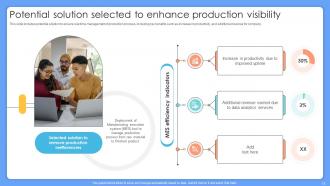
Slide 13: This slide includes potential solution to ensure real time management of production process, including key benefits.
Slide 14: This slide shows role of MES software to monitor end to end production process including production planning and scheduling, order tracking and tracing, etc.
Slide 15: This slide includes need for MES software implementation in organization including inventory management, purchase order management, and predictive maintenance management.
Slide 16: The slide represents Title of contents further.
Slide 17: This slide demonstrates steps to implement manufacturing execution system in production processes including key steps.
Slide 18: The slide again shows Title of contents.
Slide 19: This slide includes project management team structure involving internal and external team members.
Slide 20: This slide displays MES project management team role and responsibilities for effective implementation, including key users, project managers, etc.
Slide 21: The slide renders Title of contents further.
Slide 22: This slide includes types of implementation partners such as license form and specialized firms that provide tool and help in planning and implementation.
Slide 23: This slide highlight factors to consider before selecting MES software, including scalability and flexibility, user interface, etc.
Slide 24: This slide includes comparison of MES service providers to optimize production line based on certain features.
Slide 25: This slide renders evaluation of industry experience of selected vendors for final selection, including basis.
Slide 26: The slide illustrates Title of contents further.
Slide 27: This slide shows implementation plan with milestones including key steps such as implementation approach, configuration, pilot testing, etc.
Slide 28: This slide includes MES implementation categories depending on industry, budget, and resources available.
Slide 29: This slide presents MES implementation and configuration process to improve operational efficiency, including configure infrastructure, etc.
Slide 30: This slide includes MES software architecture divided into major four levels as process control system using machines and Manufacturing operations management system (MES).
Slide 31: This slide includes different ways to integrate ERP and MES software such as batch integration, real time integration, middleware integration, etc.
Slide 32: This slide includes best practices for integrating MES with other business manufacturing software's.
Slide 33: This slide includes checklist that covers different types of quality assurance testing for manufacturing execution system (MES).
Slide 34: The slide displays another Title of contents.
Slide 35: This slide includes key components of MES data management to enhance operational efficiency.
Slide 36: The slide again shows Title of contents.
Slide 37: This slide includes training plan to encourage system knowledge acceptance including key elements.
Slide 38: The slide represents Title of contents further.
Slide 39: This slide includes MES deployment timeline to optimize operation for efficiency, including steps such as analyzing business needs, build business scope, etc.
Slide 40: This slide demonstrates manufacturing process after MES implementation including basic steps and backend steps.
Slide 41: This slide highlights tips to implement MES software successfully to drive operational wins, including cross functional departments, execute data cleaning, etc.
Slide 42: This slide includes MES deployment challenges with potential solutions for smooth deployment including high deployment costs, over customization of MES systems, and knowledge transfer.
Slide 43: The slide shows another Title of contents.
Slide 44: This slide depicts improved performance of production due to software implementation, including KPI such as production cycle time, machine downtime, etc.
Slide 45: This slide highlights impact of MES software and data analytics implementation on quality control.
Slide 46: The slide again covers Title of contents.
Slide 47: This slide presents the performance of assets and production processes including key performance metrics.
Slide 48: This slide renders structured dashboard to track manufacturing effectiveness including KPI.
Slide 49: The slide again represents Title of contents.
Slide 50: This slide presents manufacturing execution system case study including key elements.
Slide 51: This slide shows all the icons included in the presentation.
Slide 52: This slide is titled as Additional Slides for moving forward.
Slide 53: This slide presents annual report on defective goods and their rate along with total production made, encompassing reasons for high defective goods.
Slide 54: This is our vision, mission and goal slide. State your firm's goal here.
Slide 55: This is Our Team slide with names and designation.
Slide 56: This is About Us slide to show company specifications etc.
Slide 57: This is an Idea Generation slide to state a new idea or highlight information, specifications etc.
Slide 58: This slide depicts Venn diagram with text boxes.
Slide 59: This slide presents Roadmap with additional textboxes.
Slide 60: This is a Financial slide. Show your finance related stuff here.
Slide 61: This is a Timeline slide. Show data related to time intervals here.
Slide 62: This slide describes Line chart with two products comparison.
Slide 63: This is a Thank You slide with address, contact numbers and email address.
Manufacturing Execution System MES Deployment Plan Powerpoint Presentation Slides with all 71 slides:
Use our Manufacturing Execution System MES Deployment Plan Powerpoint Presentation Slides to effectively help you save your valuable time. They are readymade to fit into any presentation structure.












FAQs for Manufacturing Execution System MES Deployment Plan
So you're looking at production scheduling, work order management, and quality control as your main pieces. Real-time data collection from equipment is massive too. Then there's inventory tracking, labor management, performance analytics - basically it runs your whole operation like a nervous system or whatever. Oh and genealogy/traceability is critical if you're dealing with regulations. Resource allocation and maintenance management are the other big ones. Honestly though, none of this matters if the modules don't play nice together. Integration between components can make or break these systems, so definitely test that part thoroughly before you commit.
So here's the deal - MES gives you real-time eyes on your production floor instead of waiting around for those end-of-day reports. Bottlenecks become obvious right away. You'll optimize scheduling way better and track materials without the guesswork. Costs drop because you're not wasting resources, and quality issues get caught early (which honestly saves your butt). Nobody wants to do manual data entry anyway, so that's gone too. Just make sure whatever system you pick actually plays nice with what you already have - I've seen too many companies create bigger messes trying to fix smaller ones.
Dude, real-time data is what separates a useful MES from expensive shelf decoration. You're flying blind without live feeds from your production floor - decisions get made on stale info and that's just asking for trouble. The magic happens when you spot issues as they're developing, not hours later when it's too late. Honestly, trying to manage production with yesterday's numbers sounds like my worst nightmare. My advice? Pick your most critical data points first. Get those feeds as close to real-time as you can manage, then build from there.
So you've got a few options here - APIs, middleware, or direct database connections work best. Your MES grabs production schedules from the ERP, then sends back real-time data like quality metrics and inventory updates. Honestly, most systems today integrate pretty smoothly (way better than my coffee maker situation!). The trick is getting your data fields mapped right and setting up those automated workflows. Figure out what needs real-time syncing versus batch updates first. Then just work with IT to get everything talking to each other properly.
Manufacturing companies that deal with lots of regulations really need MES systems - automotive, pharma, food production, aerospace, that kind of stuff. Basically anywhere a screwup could cost serious money or hurt someone. You'll get the most bang for your buck if you've got multiple production steps and need to track everything for audits. The electronics industry loves these systems too, honestly. If you're drowning in batch records or constantly stressing about compliance documentation, MES will be a lifesaver. Real-time visibility becomes pretty addictive once you have it.
Think of MES as constantly watching your production line for quality issues. Real-time data gets captured at every step, so problems get flagged right away instead of becoming disasters later. The compliance stuff is honestly a lifesaver - everything gets documented automatically for audits and regulatory headaches. You'll have full traceability from raw materials through finished products. Plus operators can't skip steps since it enforces your SOPs. I'd start by figuring out your worst quality pain points first, then see how MES data could give you better visibility into those specific areas.
Integration with your current systems is gonna be a nightmare - that's probably the worst part. Getting your operators on board is tough too since they're set in their ways. Data quality becomes this whole thing you didn't expect. The technical side? Usually way easier than dealing with people, honestly. Everyone needs tons of training time for new workflows. Oh, and budget like triple the time you think - once departments see what this stuff can do, they'll want everything. I'd definitely start small with one area, grab some wins, then roll it out. Trust me on that one.
Cloud MES is way faster to get running and cheaper upfront - you don't have to deal with server headaches either. But you're giving up some control over customization. On-premises lets you tweak everything exactly how you want and keeps all your data in-house. Implementation takes forever though, and your IT team will hate you. Honestly, I'd probably go cloud unless you have some really weird workflows that need heavy customization. Just figure out your security stuff first - that's usually the dealbreaker either way.
So traceability in MES lets you track every component and process step through manufacturing. Think digital breadcrumbs - you'll know exactly where parts came from, what happened to them, and when. Super helpful for recalls or when auditors show up (which always seems to happen at the worst times). Instead of shutting down your whole operation, you can pinpoint problems to specific batches or timeframes. Quality investigations become way easier too. My advice? Figure out your most critical trace points first, then build from there.
So MES gives you live data flowing between the factory floor and management - no more waiting around for shift reports or playing phone tag about issues. Your production guys can flag problems right when they happen. Management gets dashboards with real-time metrics and quality alerts. Honestly, it kills those vague "something's wrong with the equipment" conversations because everyone's looking at the same actual data. Quick decisions become way easier when managers have visibility into what's really happening. Just make sure you set up permissions so teams only see what matters to them - nobody wants data overload.
Start with OEE - it's honestly the best metric for seeing how efficient your production really is. Cycle times and throughput rates matter too, plus quality stuff like defect rates. Downtime tracking is massive, especially those random stops that mess up everything. Labor productivity and inventory accuracy can totally wreck you if they're off. Oh, and definitely watch order fulfillment and on-time delivery. Those are pretty much non-negotiable for keeping customers happy. Once you've got these basics down, you can add more specific KPIs based on whatever's actually hurting your profits most.
So MES basically shows you what's actually happening on your production floor in real-time - no more guessing games. Bottlenecks become obvious right away. You'll stop overproducing because it syncs everything with actual demand, not just forecasts. Wait times between processes? Those drop fast. Quality tracking gets way better too, which means fewer defects slipping through. It's honestly pretty wild how much clearer everything becomes - like suddenly you can see all the waste you couldn't spot before. I'd start with whatever area feels most chaotic right now. That's where you'll see the biggest impact first.
Honestly, AI and machine learning are completely changing MES right now. You're looking at predictive maintenance, real-time quality control, plus scheduling systems that actually get smarter over time. IoT sensors are pumping tons of data into everything too. Cloud computing's making it way more affordable - smaller companies can finally get in without those crazy upfront costs. Oh, and digital twins are insane now, like having a virtual copy of your whole production setup. If you're thinking upgrades, I'd definitely hit the AI analytics first. That's probably your quickest payback.
Your MES is already tracking tons of stuff - temperature, vibration, cycle times, error rates. All that data can actually predict failures before they happen. Pretty neat, right? Look for patterns in the historical data that show up weeks or months before equipment craps out. Most analytics tools can handle this kind of analysis without getting too fancy about it. Set up alerts when metrics go outside normal ranges. That way you're fixing things on your schedule instead of dealing with surprise breakdowns. Trust me, proactive beats reactive every single time.
Focus on hands-on training for the people actually using it daily - that's where your time pays off. Don't dump every feature on everyone though. Role-based makes way more sense. Honestly, the change management stuff matters as much as the tech side. Get your floor supervisors on board first because they'll sell it for you when people start complaining. And they will complain, trust me. Explain why you're doing this, not just how to click buttons. Start small with a pilot group, see what breaks, fix it. Show some quick wins early - nothing builds momentum like people seeing actual benefits instead of just promises.
-
Extremely professional slides with attractive designs. I especially appreciate how easily they can be modified and come in different colors, shapes, and sizes!
-
Innovative and creative templates with high-quality designs. Helped me with my presentation as the slides were easy to edit.